Endangered
Madagascar Jacana
Actophilornis albinucha
The Madagascar jacana (Actophilornis albinucha) is a long-toed wading bird found only on Madagascar, on lakes, marshes and pools with floating plants. The IUCN Red List rated it Endangered in 2020, with a population estimated at fewer than 1,700 birds and still falling.
How to recognise it
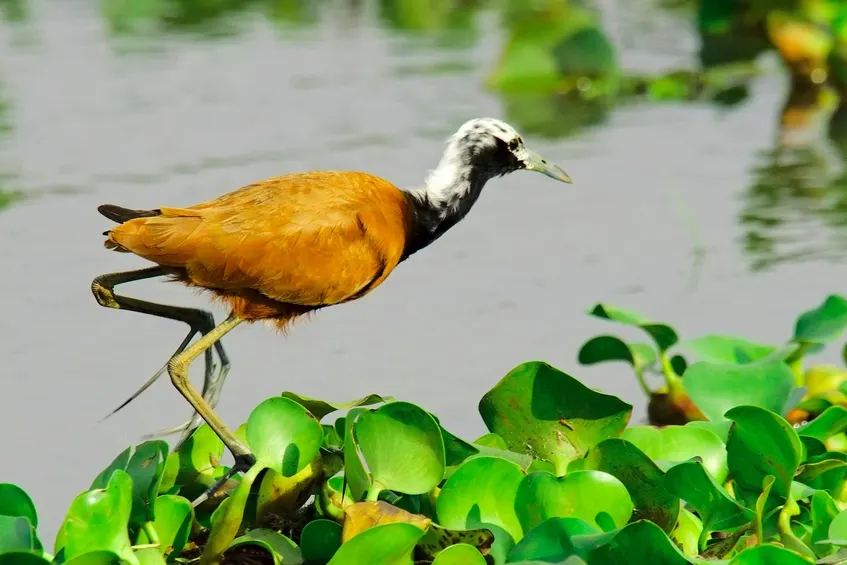
It's a small waterbird, up to about 31 cm long, with a mostly chestnut body. The back of the crown and the nape are white, while the face, throat and upper breast are black. Like other jacanas it has very long toes, which spread its weight so it can walk across floating leaves.
Females are noticeably larger than males, a pattern found across the jacana family. It is the only jacana on Madagascar. Its closest relative is the African jacana (Actophilornis africanus), a link confirmed by a 2019 DNA study in the journal Ostrich.
Where it lives
The species is endemic to Madagascar and is recorded from sea level up to about 750 m. It uses freshwater wetlands: lakes of both seasonal and permanent kinds, marshes and pools, slow rivers and streams, and small artificial ponds. Floating vegetation is a key feature of the places it chooses.
Birds are not strictly tied to one place. They reportedly use different sites in the wet and dry seasons, and the IUCN assessment treats the species as dispersive rather than migratory.
Pins are Wikidata “endemic to” fields. Orange dots, when present, are GBIF occurrence tiles — survey bias included.
How it lives
It picks aquatic insects and other small invertebrates from floating plants, and also takes seeds. It is reported to be unwary of human activity, though it is thought to avoid the common moorhen.
Breeding is poorly documented. The Madagascar jacana is presumed to be polyandrous, with females taking several mates, as some other jacanas are, but a 2019 study in Ostrich noted that little data supports this.
How many are left
The 2020 assessment gives a population of 780 to 1,643 individuals, all treated as one population, and says numbers are decreasing. That is a small figure.
A survey of 54 lakes in 2016, reported in Ostrich in 2019, found the birds at 22 of them, at an average density of about 3.5 birds per hectare of surveyed habitat. Its own estimate was 975 to 2,064 birds worldwide. The study called for further work to reassess the species' threat status and population trend.
Why it is in trouble
The Red List names several ongoing pressures: hunting aimed at the birds, accidental catches in small-scale harvesting, water being drawn off wetlands, and soil erosion that silts them up. Each is listed as affecting less than half the population, with slow but significant declines. The 2019 survey study named habitat destruction as the main threat, and wetlands are reportedly filled in for farming.
The bird is listed under criterion C2a(ii), which covers a small population in continuing decline.
What is being done
Conservation sites have been identified across its whole range, and it occurs in at least one protected area. A monitoring scheme is in place, and the assessment lists awareness work and site protection among the needed actions. There is no recovery plan, no captive population and no control of invasive species.
Sources
Written for this catalog in our own words from the sources below, checked against them on 12 November 2026. Population figures are estimates and carry the year they were made. Status and assessment year: IUCN. 2026. The IUCN Red List of Threatened Species. Version 2026-1. iucnredlist.org.




