Endangered
Milos viper
Milos viper
The Milos viper is a stout venomous snake found only on four small islands in the western Cyclades, Greece. The Red List lists it as Endangered (2024 assessment), with an estimated 3,300 to 4,000 adults and a decreasing trend. It was long treated as a subspecies of the blunt-nosed viper.
How to recognise it
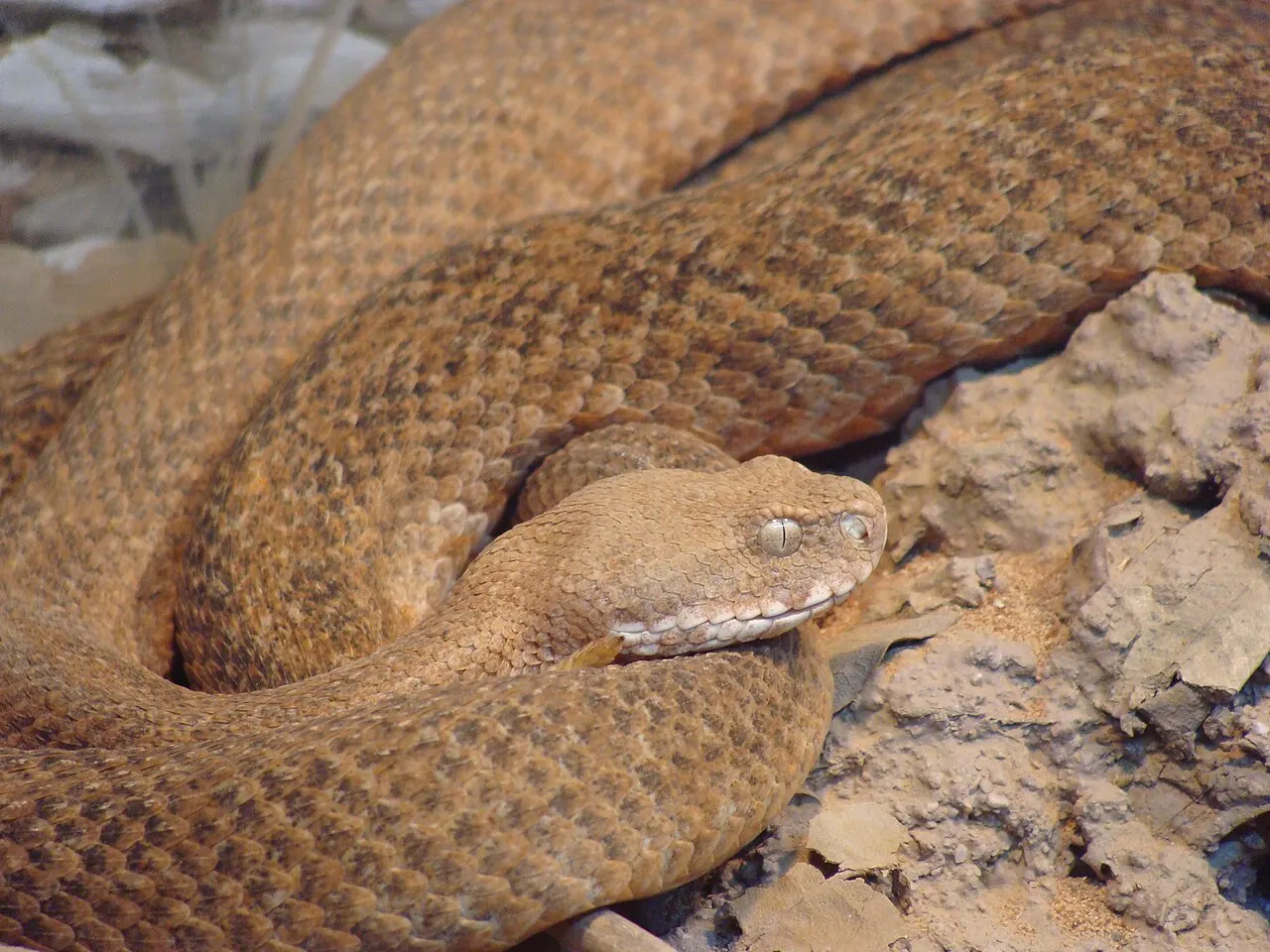
This is a heavy-bodied viper with a broad, triangular head, more pronounced in males. Most adults are up to about 90 cm long, and the tail often turns yellowish toward the tip. Two colour forms are known. The usual one is grey, while a rarer ceramic-red form is found mainly on western Milos. Males are darker than females in both.
The longest snakes on record are reported at 98.5 cm and, from Sifnos, 107 cm.
Where it lives
The species occurs on Milos, Kimolos, Polyaigos and Sifnos, and nowhere else. Milos holds the largest population, and Sifnos the smallest and most scattered. It lives from sea level up to about 500 m, mainly in Mediterranean-type scrub, and is also found in dry stream beds, sandy areas, farmland and small pools.
The Red List counts 4 to 5 locations, an extent of occurrence of about 848 square kilometres and an area of occupancy of 250 to 480 square kilometres.
Older sources call it Macrovipera lebetinus schweizeri, a subspecies of the blunt-nosed viper. The Red List and recent literature treat it as a full species. Its Red List common names are Cyclades blunt-nosed viper and Milos viper.
Pins are Wikidata “endemic to” fields. Orange dots, when present, are GBIF occurrence tiles — survey bias included.
How it lives
Adults hunt birds, especially small songbirds, using a sit-and-wait approach, and are reported foraging in trees at night in autumn. Young snakes under about 35 cm reportedly feed mainly on small lizards. Males stop feeding during the breeding season, which runs from late March to the end of May.
Activity follows the seasons. In summer the heat pushes them toward dusk and night, in autumn they become active by day again, and in winter they are mostly hidden but do not enter deep dormancy. When disturbed, a Milos viper tends to hiss, raise its head and rear body and back away rather than attack. Local medical centres are reported to record about one bite a year on Kimolos and about four on Milos, with no deaths.
Why it is in trouble
The islands are small, so the whole species sits in a few places. Vipers are killed on roads, most often males in the breeding season, and locals have long killed them on sight, though that is slowly changing. Illegal collection for the reptile trade is another pressure. A figure from 1998 reportedly put losses to collection, road traffic and persecution combined at 500 to 600 adults a year, while a recent estimate of collection alone is about 100 a year.
The Red List also names mining and quarrying and more frequent fires. Wind-farm and geothermal proposals have been raised as concerns, particularly on Polyaigos, and droughts and higher temperatures add longer-term worry. Feral cats are reported to kill some vipers as well.
What is being done
The species is strictly protected under Greek law (Presidential Decree 67 of 1981), listed in Appendix II of the Berne Convention and covered by EU Council Directive 92/43/EEC. Parts of the islands fall within Natura 2000 sites. A working group gives yearly talks on the islands, collects sightings and reports of illegal collection, and is working toward port checks to deter smuggling. The Red List lists awareness work and site management as needed actions.
Sources
Written for this catalog in our own words from the sources below, checked against them on 12 November 2026. Population figures are estimates and carry the year they were made. Status and assessment year: IUCN. 2026. The IUCN Red List of Threatened Species. Version 2026-1. iucnredlist.org.




