Endangered
Aral barbel
Luciobarbus brachycephalus
The Aral barbel (Luciobarbus brachycephalus) is a large river fish of the Aral and Caspian Sea basins that swims upstream each year to spawn. The IUCN Red List assessed it globally as Endangered in 2024. Dams, irrigation withdrawals and the shrinking Aral Sea have cut its numbers sharply.
How to recognise it
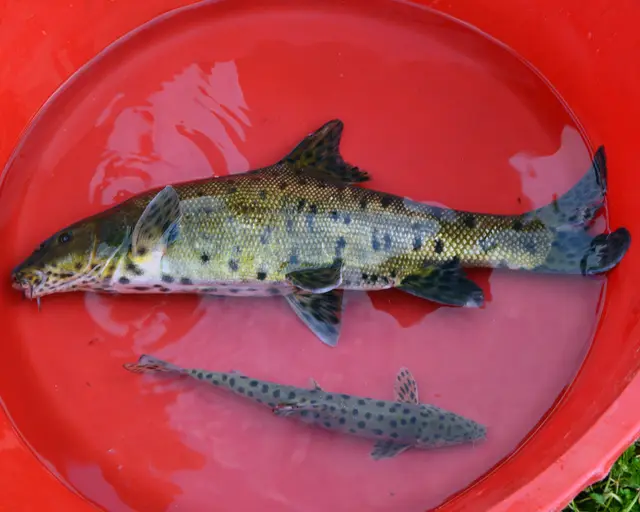
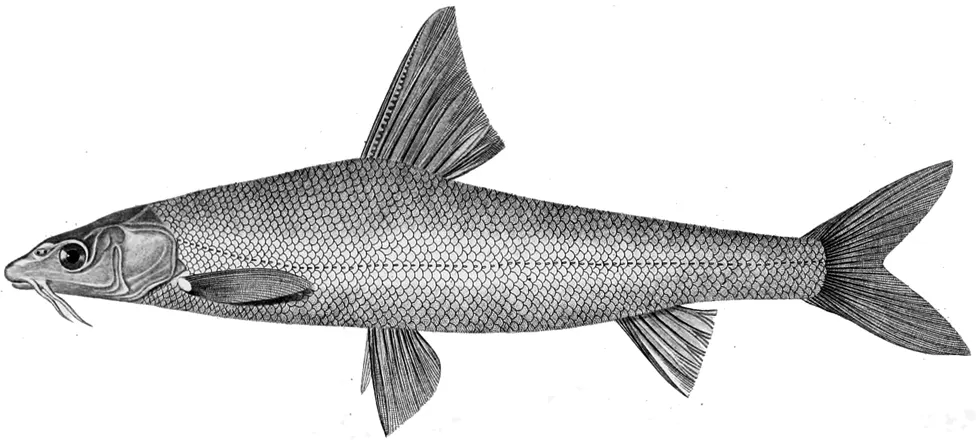
This is a big, bottom-dwelling carp relative. It can reach about 90 cm, or 105 cm in females, and up to 22 kg, though 62 to 66 cm is more typical. Fish mature at around 60 cm.
Identifying features include a thin lower lip with no middle lobe, usually 65 to 77 scales along the side, and usually seven and a half branched rays in the dorsal fin.
Where it lives
Its native range covers the Aral Sea basin, the Chu drainage, and the southern and western Caspian Sea. The IUCN lists it as present in Uzbekistan, Kazakhstan, Turkmenistan, Russia and Azerbaijan, as possibly present in Iran, and as extinct in Tajikistan. A separate 2024 IUCN assessment for Europe classes it as Regionally Extinct, because the fish is gone from European Russia, including the Volga system in the south.
It lives in rivers, reservoirs, lakes and canals, and in the freshened, brackish parts of the sea. Many fish are semi-migratory, feeding in brackish water and running up rivers to breed. In the Caspian, spawning runs go up the Terek, Samur, Kura and lower Aras. Its Aral Sea population has been lost: a 2023 review reports that by the early 1980s, rising salinity meant the fish no longer lived in the sea itself.
Pins are Wikidata “endemic to” fields. Orange dots, when present, are GBIF occurrence tiles — survey bias included.
How it lives
Spawning takes place in fast, shallow water over hard bottoms, and in the Syr Darya it begins in late April or May at 17 to 18 degrees Celsius. It happens at night and is most intense at about 20 to 23 degrees. The eggs are swept into the water column, where they are fertilised. Young fish settle in slow water, then drift to the sea, or to a reservoir if the river is dammed, after two to 12 months.
Adults feeding in brackish water eat mostly bottom-living crustaceans. They stop feeding during the upstream run and take insects and small fish once on the spawning grounds. The oldest fish recorded in Kazakhstan was 22 years old.
Why it is in trouble
Dams have blocked the route to traditional spawning grounds. On the Syr Darya, the Kazalinsk dam obstructs the migration. Water drawn off for irrigation has killed large numbers of juveniles that wash into canals and rice paddies, and the IUCN also lists drought, dams, pollution, sewage, mining and small-scale harvest for food among the threats, with the scale of each unknown.
The old fishery targeted the migration. About 90 percent of the Aral Sea catch was taken when fish gathered in river deltas. In the Aral Sea the average annual catch fell from 1,140 tonnes in the 1930s to 326 tonnes in the 1970s. A 2023 review in Biology repeats an earlier report of a 30 percent decline over 30 years, while the IUCN's 2024 assessment gives a past population reduction of 50 percent. It counts nine locations, three subpopulations and an occupied area of roughly 4,520 square kilometres, with continuing decline.
What is being done
Kazakhstan added the species to its Red Book in 2008 and prohibits fishing for it. The IUCN notes a harvest management plan and an area-based regional management plan, and that the fish occurs in at least one protected area. It records no recovery plan or monitoring scheme.
The 2023 review argues that stocking hatchery-reared juveniles is the only way to restore the Aral barbel. Its Kazakh authors describe collecting wild fish of different ages, including young fish rescued from rice paddies, and moving some to the Kamyshlybash hatchery and the Zhambyl fish farm to start replacement broodstocks.
Sources
Written for this catalog in our own words from the sources below, checked against them on 12 November 2026. Population figures are estimates and carry the year they were made. Status and assessment year: IUCN. 2026. The IUCN Red List of Threatened Species. Version 2026-1. iucnredlist.org.
- IUCN Red List assessment, Luciobarbus brachycephalus (global, 2024)
- IUCN Red List Europe regional assessment, Luciobarbus brachycephalus (2024)
- FishBase species summary, Luciobarbus brachycephalus
- Review of Aral and Bulatmai barbels in Kazakhstan, Biology 2023 (PMC full text)
- Aral barbel (encyclopedia article)