Endangered
Hawaii akepa
Loxops coccineus
The Hawaii akepa (Loxops coccineus) is a tiny, finch-like honeycreeper of the high forests on the island of Hawaiʻi. Males are bright orange. The IUCN rated it Endangered in 2023, with about 10,800 birds and a falling trend, pushed upslope by mosquito-borne disease and the loss of old trees.
How to recognise it
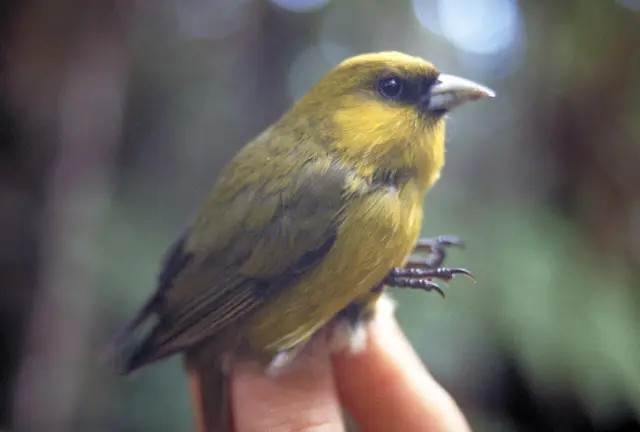
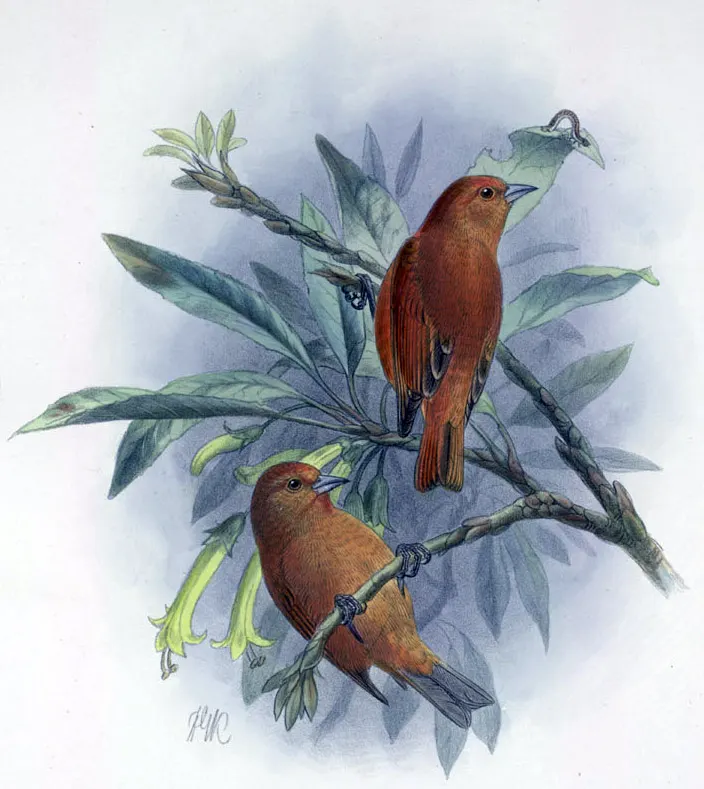
It is a small bird, about 10 cm long. Adult males are bright reddish-orange with dusky wings and tail, while females are grey-green with a yellow-orange wash on the breast. Young males start out looking like females and turn orange gradually, taking about three years to reach full adult plumage. The crossed bill tips that give the genus its name are hard to see in the field.
A female can be confused with the Hawaiʻi creeper, though that bird has a darker face and behaves very differently. Dull amakihi have a curved bill and dark lores. Listen for a slow trill that shifts in pitch and speed, and a call that has been written as 'cheedle-ee'.
Where it lives
It lives only on Hawaiʻi, the Big Island, in old-growth wet forest of ʻōhiʻa and koa, mostly above about 1,200 m. The IUCN gives its elevation as 1,100 to 2,100 m. Its range is broken into patches. The largest numbers are on the slopes of Mauna Kea and Mauna Loa, with a Hualālai population that may have disappeared. Hakalau Forest National Wildlife Refuge, on Mauna Kea, is a stronghold.
The IUCN puts the extent of occurrence at about 3,500 square kilometres and the area it actually occupies at about 740. It was once treated as one species with the ʻākepa of Maui and Oʻahu, both now regarded as extinct. The three were split in 2015.
Pins are Wikidata “endemic to” fields. Orange dots, when present, are GBIF occurrence tiles — survey bias included.
How it lives
ʻĀkepa eat spiders, caterpillars and other insects, prying open ʻōhiʻa buds to reach them, and sip nectar from ʻōhiʻa flowers. They are the only Hawaiian honeycreeper that must nest in natural tree cavities. No native Hawaiian bird makes holes big enough, so they depend on big, old ʻōhiʻa and koa. The first nest was found only in 1974.
Clutches are small, usually two eggs. The female incubates for 14 to 16 days and the chicks fledge after 16 to 20 days, with the parents feeding young birds for up to ten weeks more. Pairs form long-term bonds, yet large courtship gatherings of males have been seen high in the canopy.
Why it is in trouble
Avian malaria and avian pox, carried by the introduced southern house mosquito, are thought to have helped eliminate the lower-elevation populations. A 2005 study of forest birds in the Kona unit of Hakalau found malaria in 28 percent of sampled birds at 710 m and 13 percent at 1,830 m, so even high forest is not free of it. A warming climate could carry mosquitoes higher.
Logging, ranching and farming cleared much of the old forest, and pigs, cattle, goats and sheep still degrade what is left. Introduced rats take eggs and young, and cats and barn owls take adults. Large cavity trees are also dying faster than new ones mature. The IUCN records a population reduction of 25 to 35 percent.
What is being done
Hakalau was set aside for native forest birds, and fencing and the removal of feral hoofed animals there have helped the forest recover. A recovery plan is in place and the species occurs in at least one protected area. The Birds, Not Mosquitoes partnership releases lab-reared male mosquitoes that carry a bacterium which makes wild females' eggs infertile, and drones are being used to deliver mosquito control. Artificial nest boxes were occasionally used in a 1987 study, with high nesting success, but no ongoing nest box use was reported as of 2010.
Sources
Written for this catalog in our own words from the sources below, checked against them on 12 November 2026. Population figures are estimates and carry the year they were made. Status and assessment year: IUCN. 2026. The IUCN Red List of Threatened Species. Version 2026-1. iucnredlist.org.