Endangered
Louisiana pinesnake
Pituophis ruthveni
The Louisiana pinesnake (Pituophis ruthveni) is a large, non-venomous constrictor of west-central Louisiana and east Texas, where it survives in only a few small, isolated populations. The IUCN Red List assessed it as Endangered in 2007, and that is still its latest global assessment. It spends much of its life underground in pocket gopher burrows.
How to recognise it
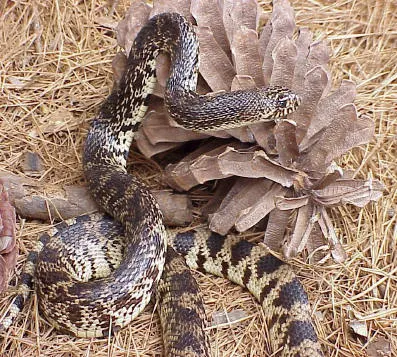
Adults usually measure 4 to 5 feet (1.2 to 1.5 m), and the largest on record was 5.8 feet (1.7 m). The body is buff to yellowish with dark brown blotches, and the snout is pointed, which helps it enter pocket gopher tunnels.
Its eggs and hatchlings are among the largest of any North American snake, with hatchlings reaching up to about 22 inches (56 cm). Clutches are tiny, usually three to five eggs, the smallest of any North American colubrid.
Where it lives
It was once found across western Louisiana and east Texas and now survives in scattered pockets. The US Fish and Wildlife Service's 2025 recovery plan counts six remaining natural populations plus one founded from captive-bred snakes. By the agency's 2023 five-year review, three of the six natural populations were possibly extirpated.
Critical habitat proposed in 2022 covers 209,520 acres in six units in Bienville, Grant, Rapides and Vernon parishes in Louisiana and Angelina, Jasper and Newton counties in Texas. Five of the six units are currently occupied.
Pins are Wikidata “endemic to” fields. Orange dots, when present, are GBIF occurrence tiles — survey bias included.
How it lives
It needs sandy, well-drained soil in open pine forest with little midstory and a diverse layer of grasses and wildflowers. That ground cover feeds Baird's pocket gopher, the snake's primary prey and the source of its main shelter, because the snake uses the gopher's burrows.
It spends more than half of its life underground, according to the National Wildlife Federation, and studies in Texas and Louisiana put it at 60% or more. When disturbed above ground it may hiss loudly, spread its head and vibrate its tail. It kills gophers by pinning them against a tunnel wall rather than wrapping them in coils.
Why it is in trouble
The main problem is loss, degradation and fragmentation of habitat. Almost all the virgin timber in the region was cut between 1870 and 1920, and by 1935 only about 3% of the longleaf pine forest in southwest Louisiana and southeast Texas was uncut old growth, according to the IUCN's summary of earlier surveys. Without regular fire, the open forest and its ground cover decline, and so may the gophers. Clear-cutting and dense loblolly pine plantations shade the ground, and roads kill snakes on the move.
The small clutches mean populations rebuild slowly. The recovery plan stresses that the remaining groups are isolated and small, and so exposed to chance events and to a loss of genetic variety.
What is being done
The US Fish and Wildlife Service listed the snake as threatened under the Endangered Species Act, effective 7 May 2018, and issued a species-specific rule in 2020. Captive breeding supports releases at the Catahoula District of Kisatchie National Forest. The recovery plan says captive-bred snakes released into an unoccupied area there can survive at least nine years and produce young, though the population was considered stable at the 2023 review possibly only because it was being topped up with captive-bred snakes. The plan gives an estimated recovery date of 2075.
Habitat work centres on prescribed burning, thinning woody growth and replanting native pine forest, through voluntary agreements with landowners. The IUCN Endangered label dates from 2007 and rests on an occupied area under 500 square kilometres, continuing decline and severe fragmentation, which fits the federal findings.
Sources
Written for this catalog in our own words from the sources below, checked against them on 12 November 2026. Population figures are estimates and carry the year they were made. Status and assessment year: IUCN. 2026. The IUCN Red List of Threatened Species. Version 2026-1. iucnredlist.org.
- IUCN Red List assessment, Pituophis ruthveni (2007)
- US Fish and Wildlife Service, Recovery Plan for the Louisiana Pinesnake (2025)
- US Fish and Wildlife Service, Federal Register 27 Feb 2020 (4(d) rule)
- US Fish and Wildlife Service, proposed critical habitat FAQ (2022)
- National Wildlife Federation, Louisiana pine snake
- Louisiana pine snake, encyclopedia entry




