Critically Endangered
Spicicalyx myola
Litoria myola
The Kuranda tree frog (Litoria myola, also placed in the genus Spicicalyx) lives along a handful of rainforest streams around Kuranda in Far North Queensland, Australia, and nowhere else. The IUCN Red List rated it Critically Endangered in 2023, estimating only 700 to 1,000 mature individuals in one location.
How to recognise it
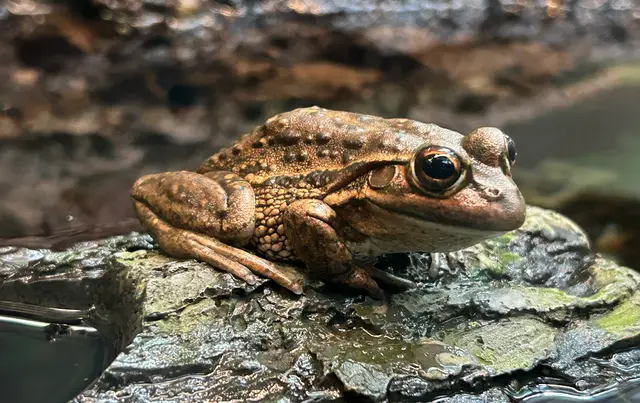
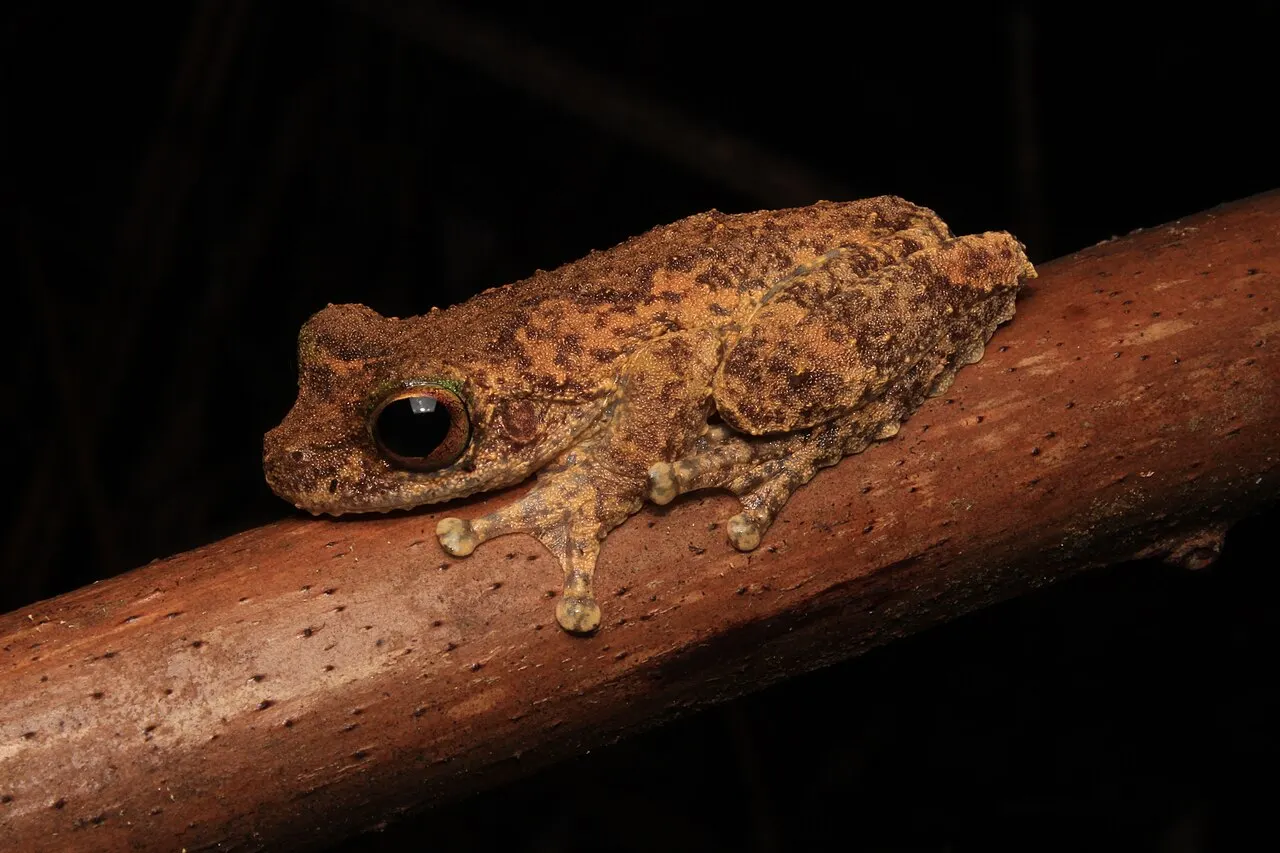
It's a medium-sized stream and rainforest frog, with males smaller than females. The body is mottled tan and brown above and whitish cream below. A green crescent marks the area above the eye, and the backs of the forearms and legs have a fringed edge.
It looks similar to the green-eyed tree frog (Litoria serrata), which lives alongside it. Conrad Hoskin formally described the Kuranda tree frog as a species in 2007.
Where it lives
The frog is endemic to Australia, restricted to Far North Queensland around Kuranda, Myola, Kowrowa and Oak Forest, in tributaries and creeks that feed the Barron River. The IUCN counts one location, at about 300 to 400 m elevation, with an extent of occurrence of 13.5 to 20 square km. Its habitat entries are permanent and seasonal streams and moist lowland tropical forest.
Most of its forested range was cleared at some point and has since regrown.
Pins are Wikidata “endemic to” fields. Orange dots, when present, are GBIF occurrence tiles — survey bias included.
Why it is in trouble
A 2023 genetic study in Conservation Genetics by Bertola and colleagues compared frogs sampled in 2001 to 2004 with those from 2007 to 2009, either side of a population decline. It estimated that the effective population (the number of animals breeding in a genetic sense) fell from about 1,720 to about 818. That is roughly 800 adults, split about evenly between Jumrum Creek and all other sites combined. The study found the genetic decline was steeper than the decline seen in field counts.
Breeding sites are mostly well connected, but the Jumrum Creek population at the eastern end of the range is genetically distinct from the rest. The study found no measurable loss of genetic diversity between the two periods.
The IUCN assessment, based on 2021 information and published in 2023, lists the amphibian chytrid fungus, housing, roads, dams, soil erosion and sediment, storms and flooding, yellow crazy ants, feral pigs and competition or hybridisation with the green-eyed tree frog as ongoing threats. Storms and flooding are scored medium impact, and most of the others low impact. Ants and pigs have unknown impact. The population is recorded as decreasing and severely fragmented.
What is being done
The IUCN records that the frog occurs in a protected area and that invasive species control is in place, and lists site protection, habitat restoration, policy and training among its conservation actions.
Bertola and colleagues, from James Cook University, recommend formal legal protection for the Jumrum Creek habitat, replanting rainforest to keep other sites connected, and careful management of stream flow and water quality.
Sources
Written for this catalog in our own words from the sources below, checked against them on 12 November 2026. Population figures are estimates and carry the year they were made. Status and assessment year: IUCN. 2026. The IUCN Red List of Threatened Species. Version 2026-1. iucnredlist.org.