Endangered
Booroolong frog
Litoria booroolongensis
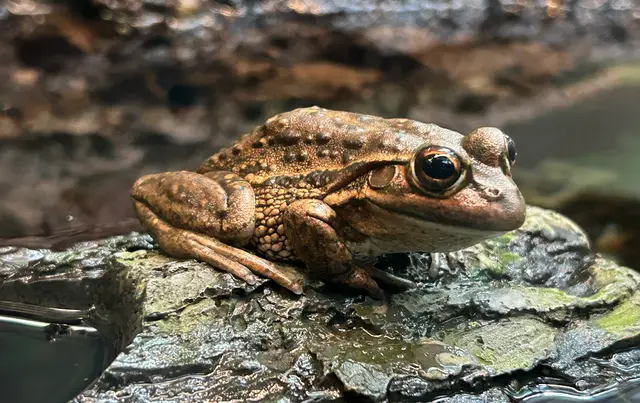
The Booroolong frog (Litoria booroolongensis) is a stream frog of the tablelands and slopes of south-eastern Australia, living in permanent, rocky, flowing water. The IUCN Red List assessed it as Endangered in 2023, with chytrid fungus, drought and changes to its streams all driving numbers down.
How to recognise it
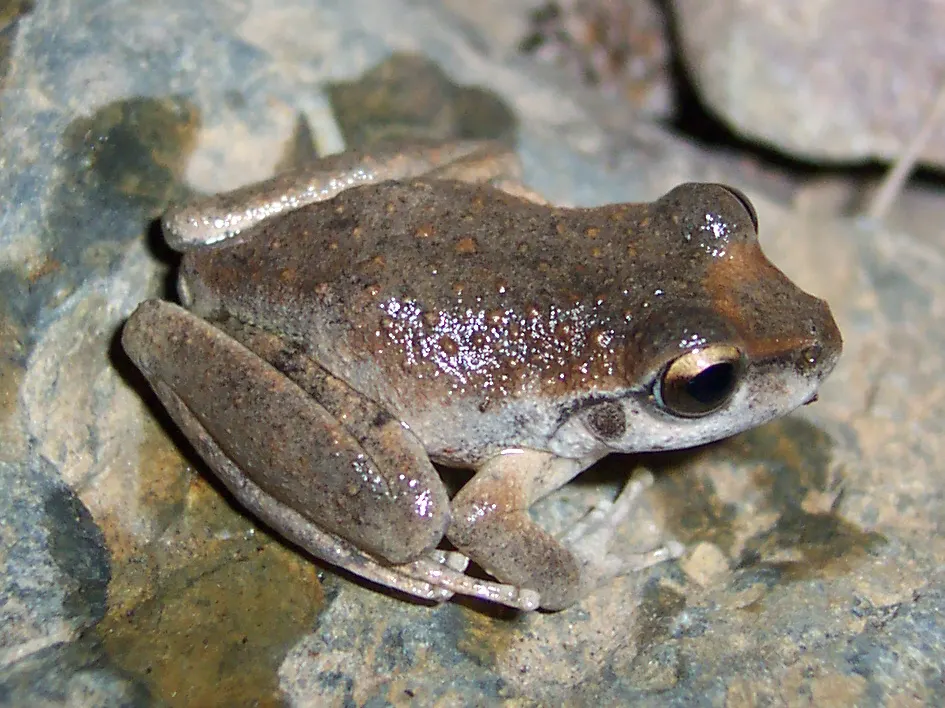
It's a medium-sized frog. Females grow to about 55 mm from snout to vent and males to about 40 mm. The back is grey, olive or reddish-brown with a darker net-like pattern, and the belly is pale or cream. A thin pale stripe runs from the nostril through the eye and around the eardrum, which reportedly helps separate it from the stony creek frog and Lesueur's frog.
The toes are almost fully webbed, the fingers are not, and the eyes are golden. Males have dark specks on the throat and give a quiet, purring call lasting 2 to 3 seconds, from late winter through summer.
Where it lives
The Booroolong frog is found only in Australia, in New South Wales and Victoria. It was once abundant in streams above about 200 m along the tablelands and slopes of the Great Dividing Range, but today it is patchy. By 2021 the northern population, around Tamworth and Glen Innes, was down to a few sites covering about 10 square kilometres. The central and southern tablelands (including the Abercrombie, Turon, Tumut and upper Murray catchments) held more, and one Victorian stream still had frogs. One account of the 2021 situation counted 28 isolated subpopulations.
The IUCN gives an elevation range of 200 to 1,300 m and lists permanent rocky streams and creeks, temperate forest and open pastureland as habitat. Its extent of occurrence is roughly 51,000 to 180,000 square kilometres, but the area the frog actually occupies is only about 370 to 710 square kilometres.
Pins are Wikidata “endemic to” fields. Orange dots, when present, are GBIF occurrence tiles — survey bias included.
How it lives
Adults are mostly nocturnal and stay in or beside streams, usually moving less than 50 m in a breeding season. They sometimes bask on rocks in summer and shelter in crevices, grass and logs. Females lay about 1,300 eggs on average in a single sticky clump attached to rocks or in still pools, and the eggs hatch in 4 to 7 days.
The tadpoles cope with fast flow and feed mostly on organic detritus such as algae. In summer they take about 75 days to turn into frogs. Annual adult mortality is reportedly above 90 percent and a generation lasts about 3 years (IUCN), so a couple of bad seasons can hit a stream population hard.
Why it is in trouble
Chytridiomycosis, caused by the fungus Batrachochytrium dendrobatidis, is described as the most widespread cause of loss. The NSW government says disease has removed the frog from more than half of its former range. A 2013 PLOS ONE experiment on captive-bred Booroolong frogs found that prior infection did not improve survival when frogs were exposed again, so frogs don't appear to build protective immunity.
Habitat and weather add to the damage. The IUCN lists plantations, grazing and farming, dams, water extraction, roads, soil erosion and sediment, drought, more frequent fires and temperature extremes among the threats, and records a continuing decline with severely fragmented populations. Introduced trout reportedly prey on tadpoles. The northern population was almost entirely lost at the height of the 2019 drought. Floods in 2022 reportedly boosted numbers in places.
What is being done
A national recovery plan, written by the NSW government in 2012, ran until 2022. In 2019 the Saving our Species program, the Australian Museum and Taronga Zoo set up an insurance colony of captive frogs, now about 110 animals. Almost 1,300 Taronga-bred frogs have been released into streams in northern New South Wales, and NSW officials say they appear to be doing very well.
Earlier results were mixed. In a release trial reported in 2010, 610 captive-bred frogs aged 2 to 4 months were put into a creek. Over two years only 105 were recaptured and 29 survived to breed. In the New England Tablelands, a researcher from the Australian Museum found the frog again after more than 40 years without records there, and is studying whether northern and southern populations might be separate species. The IUCN notes the frog occurs in at least one protected area, with invasive species control and monitoring in place.
Sources
Written for this catalog in our own words from the sources below, checked against them on 12 November 2026. Population figures are estimates and carry the year they were made. Status and assessment year: IUCN. 2026. The IUCN Red List of Threatened Species. Version 2026-1. iucnredlist.org.