Endangered
Eastern mourning skink
Lissolepis coventryi
The eastern mourning skink, also called the swamp skink, is a medium-sized lizard of freshwater and saltwater wetlands in south-eastern Australia. It is listed as Endangered on the IUCN Red List (assessed 2018) because its wetlands have been drained and cleared, leaving small, isolated colonies, mostly in Victoria.
How to recognise it
It's a smooth, medium-sized skink, roughly 10 cm from snout to vent, with a tail about one and a half times the length of the body. Adults weigh up to around 35 g. Males have longer, broader heads than females.
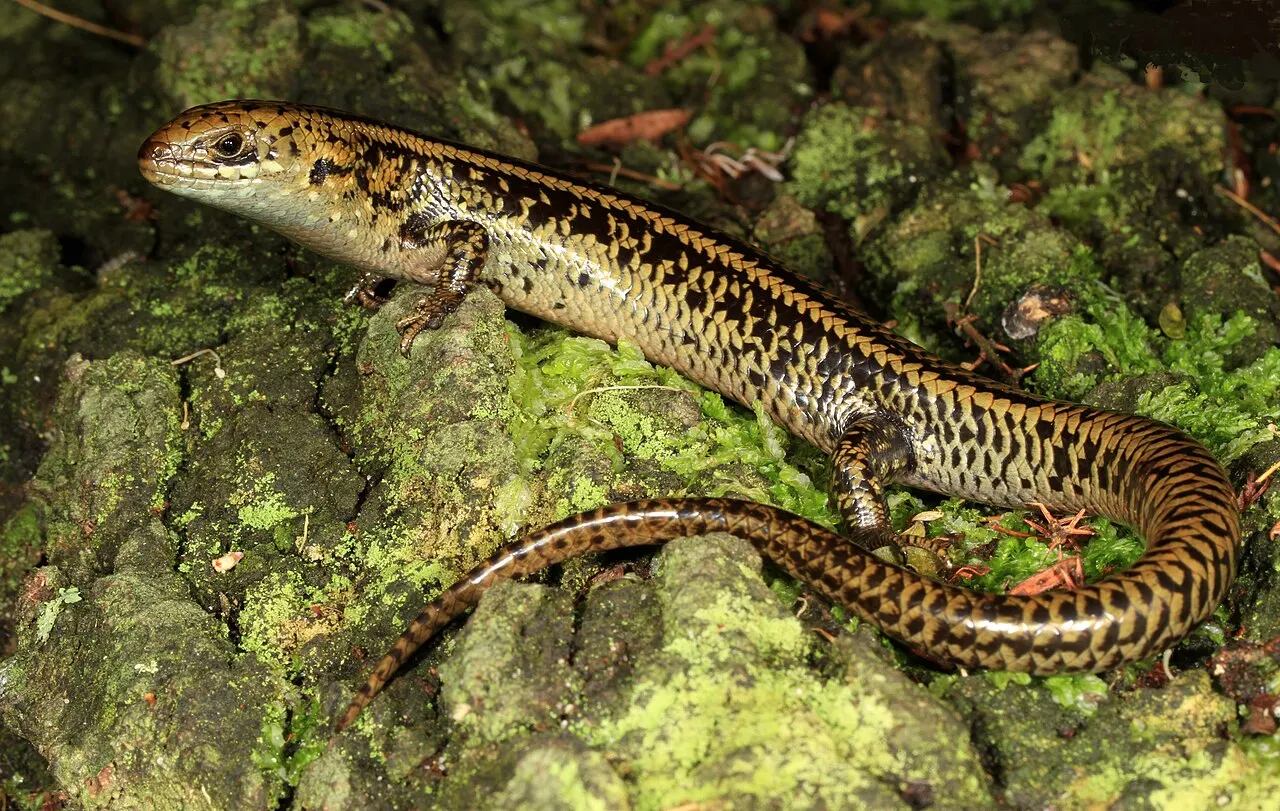
The back ranges from pale greenish-brown to olive or yellow-brown. Dark edges on many back scales form a black stripe down each side, and a second black stripe runs from above the ear to the base of the tail. The head and legs are flecked with black, the limbs often carry pale spots, and the belly is whitish.
Where it lives
The species is found in south-eastern Australia. Most records are from Victoria, with some in south-eastern South Australia. The IUCN assessment also lists New South Wales, but there is just one historical record there, from the Nadgee area, and its current status in that state is unknown.
Within Victoria it occurs in places such as the Otways, Discovery Bay, Gippsland, the Mornington Peninsula and the Grampians, where the northernmost known population lives. It needs freshwater or saltwater wetlands with dense, low vegetation and little or no tree canopy, often on poorly drained peaty soils or coastal saltmarsh.
Pins are Wikidata “endemic to” fields. Orange dots, when present, are GBIF occurrence tiles — survey bias included.
How it lives
This is a secretive, sun-loving skink that basks on fallen timber, driftwood, sedges and tussocks and rarely strays far from cover. When disturbed it dives into dense plants or a burrow, and it digs its own burrows but also uses those of freshwater crayfish. It's active from about September to May and shelters in burrows through the colder months. An account from the SWIFFT conservation partnership gives adults a home range of only about 10 m from the burrow.
It eats invertebrates, aquatic amphipods and some plant material. Mating happens in spring, and females give birth to live young in summer, typically one to four according to one profile and up to six according to another, with three being most usual. The IUCN assessment gives a generation length of about 7 years.
Why it is in trouble
Wetland loss is the core problem. The IUCN lists housing and urban development and the taking of surface water for domestic and farm use among the pressures, and records that the population is severely fragmented and its habitat area still shrinking.
An older Victorian assessment counted 72 known sites. Of these, 5 or 6 were presumed extinct, 38 had too little habitat left to hold a viable population, 22 were uncertain and just 12 were judged secure. Clearing, road and drain building, heavy grazing, weeds, and predation by foxes and feral cats add to the pressure. The IUCN puts its area of occupancy at about 499 square kilometres.
What is being done
The skink is listed as Endangered under Australian national law, and New South Wales gazetted it as Endangered on 5 April 2024. The IUCN records that it occurs in at least one protected area. Recommended work includes protecting known colonies, restoring wetlands and woolly tea-tree stands, fencing out stock, controlling foxes and cats, and surveying for new populations. A New South Wales conservation project is still in development.
Sources
Written for this catalog in our own words from the sources below, checked against them on 12 November 2026. Population figures are estimates and carry the year they were made. Status and assessment year: IUCN. 2026. The IUCN Red List of Threatened Species. Version 2026-1. iucnredlist.org.




