Endangered
Lila Downs' Friar Grasshopper
Liladownsia fraile
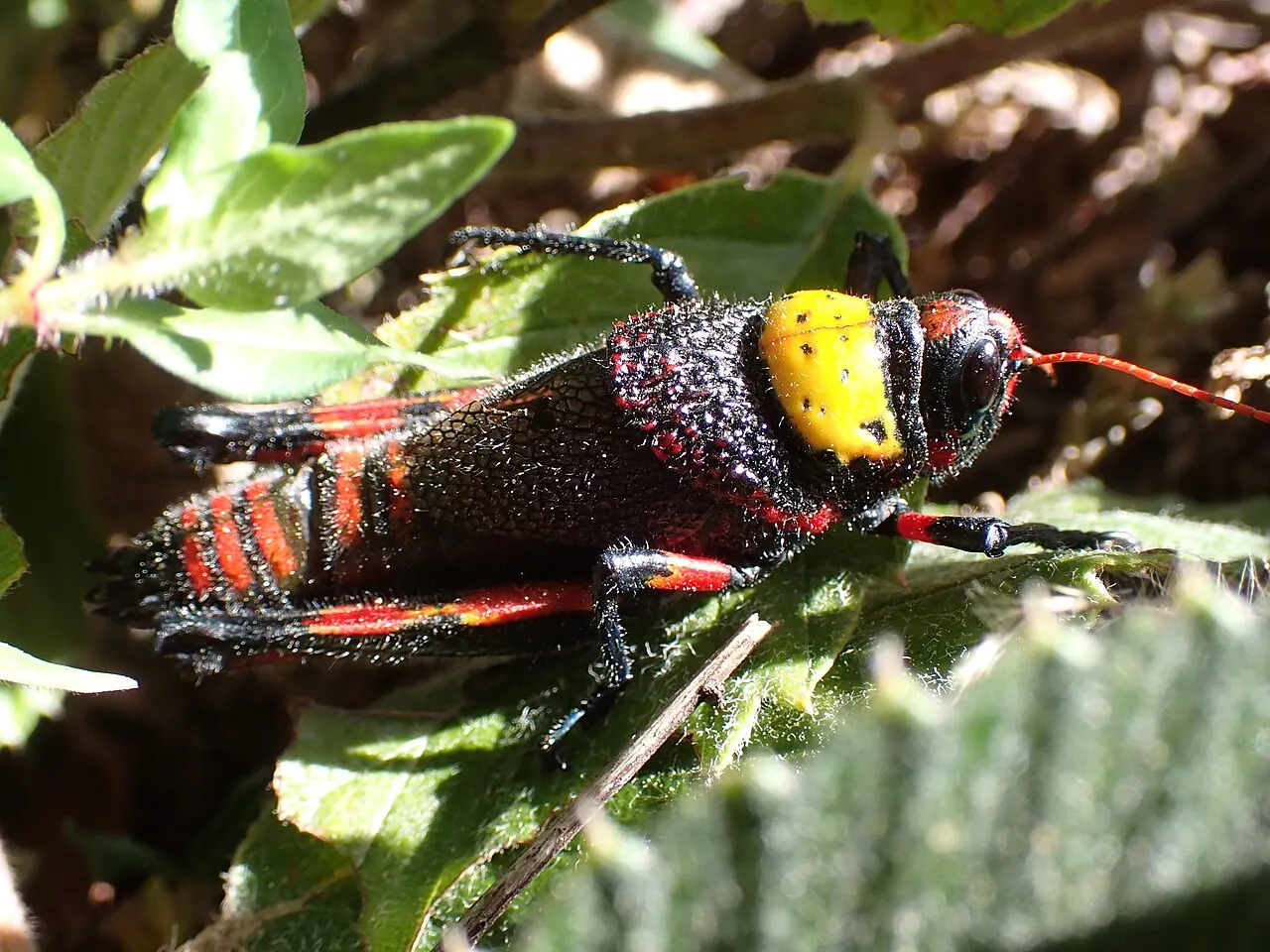
Lila Downs' friar grasshopper (Liladownsia fraile) is a brightly colored, short-winged grasshopper known only from pine and oak forest in the Sierra Madre del Sur of Oaxaca, Mexico. Described in 2014, it was rated Endangered by the IUCN the same year, with a tiny known range.
How to recognise it
This is a big grasshopper by the standards of its group. Males measure about 24 to 29 mm in body length and females 33 to 41 mm. The body is blackish steel-blue with patches of yellow and red, and sometimes orange. There are two color forms: a lighter one with more blue and yellow, and a darker one with more red and orange.
The pronotum, the plate behind the head, is swollen and smooth at the front and wrinkled behind, so it looks like a monk's hood. That shape gave the species its Spanish epithet fraile, meaning friar. A man in Oaxaca told the discoverers that locals call it exactly that. The wings are short, the hind wings are vestigial, and fine hairs give the body a silky look.
Where it lives
All records come from southern Oaxaca. The type locality lies near Suchixtepec, on the edge of a pine forest at about 2,321 m, along the road beyond San José del Pacífico. The grasshopper has been found between roughly 1,900 and 3,000 m, along the edges of oak, pine-oak and pine woods.
The IUCN counts four locations. Its estimated extent of occurrence is only 50 sq km and its area of occupancy 16 sq km. Two specimens collected in May 1962 at Río Molino, northeast of Suchixtepec, turned up decades later in a Paris museum, which shows the insect was in the area long before it was named.
Pins are Wikidata “endemic to” fields. Orange dots, when present, are GBIF occurrence tiles — survey bias included.
How it lives
Very little has been recorded. In 2011 the discoverers found it on pineapple sage (Salvia elegans), a possible host plant, and in 2013 on a wider set of mostly mint-family plants. A mating pair was seen on a shrub about two meters off the ground. Its diet, life cycle and seasonal timing are still unstudied, and the describers asked for more field data.
Why it is in trouble
The IUCN rates it Endangered under criteria B1ab(iii)+2ab(iii), which are based on a small range and ongoing habitat decline. Its population trend is listed as unknown. The threats named are small-holder plantations and small-scale grazing and farming, which convert and degrade the forest where it lives. The assessment recorded none of the population inside a protected area.
What is being done
At the 2014 assessment no recovery plan, monitoring scheme or captive population existed. The Red List entry calls for habitat protection and restoration. The species was suggested for assessment by Paolo Fontana, one of its describers, who put it forward to the IUCN grasshopper specialists because of its small range and apparently small populations. The describers say further surveys are needed to clarify its status.
Sources
Written for this catalog in our own words from the sources below, checked against them on 12 November 2026. Population figures are estimates and carry the year they were made. Status and assessment year: IUCN. 2026. The IUCN Red List of Threatened Species. Version 2026-1. iucnredlist.org.




