Endangered
Tenasserim spadefoot toad
Leptobrachium tenasserimense
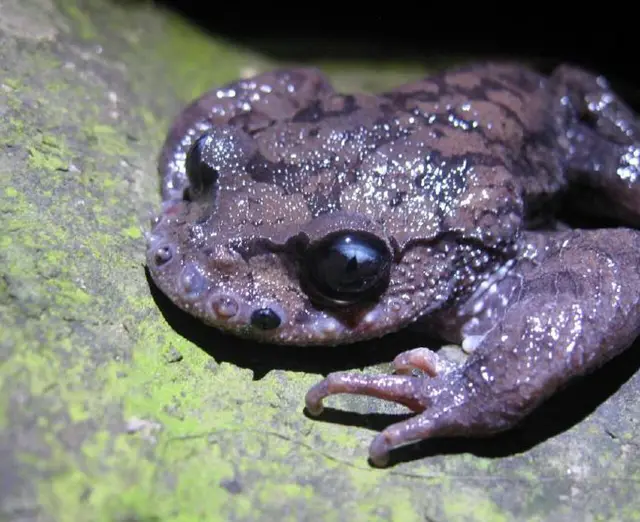
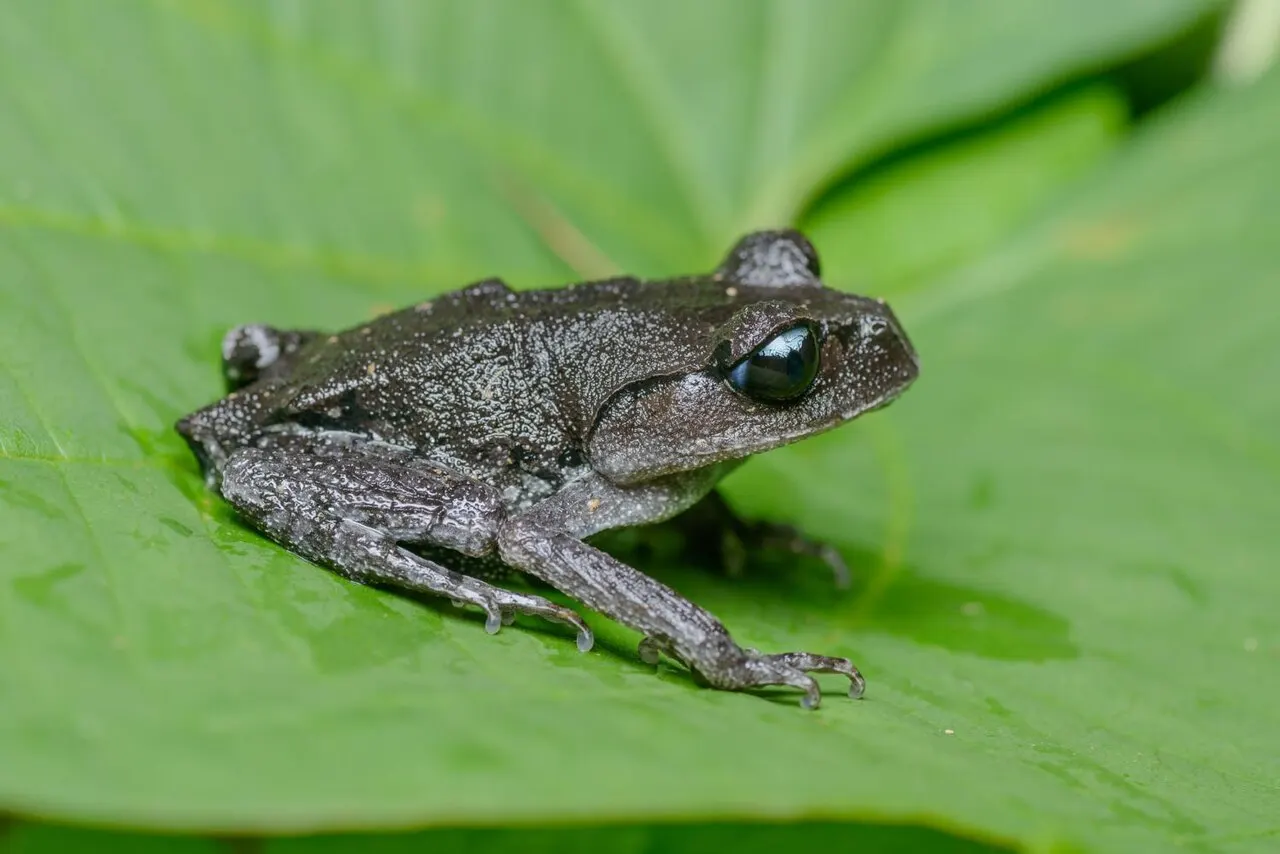
The Tenasserim spadefoot toad (Leptobrachium tenasserimense) is a medium-sized, brown and grey frog with black and turquoise eyes. It lives in hill forest streams of the Tenasserim range in western Thailand and is listed as Endangered (2021 assessment). It was described to science only in 2018.
How to recognise it
This is a stocky forest frog. Adult males measure 41.4 to 58.8 mm from snout to vent (six measured in the type series), and the two females measured were 54.7 and 58.6 mm. The back is grey-brown to grey with dark brown blotches edged in darker brown, three of them forming an inverted V between the eyes, and the legs carry distinct black bars. The belly is white to bluish-white with dense black blotches that thicken towards the groin, and the groin itself is heavily marked.
The eyes give it away. The lower two thirds of the iris is black and the upper third whitish-turquoise, with a bright light blue ring around it. Smith's spadefoot toad (Leptobrachium smithi), which shares its streams, has black and red or black and yellow eyes, and a broad dark stripe from eye to nostril. In this species that stripe is fine and narrow.
Where it lives
The 2018 description named Khao Laem mountain, in Suan Phung District, Ratchaburi Province, as the type locality, with the holotype collected at 715 m. The other known site is Pilok District in Kanchanaburi Province, where the same lineage had earlier been sequenced from tadpoles. The describers thought it strongly likely to occur in Tanintharyi Division, Myanmar, but had no record there. The Red List lists Thailand and Myanmar, two locations, an elevation range of 700 to 1,000 m and an extent of occurrence of about 3,636 square km.
At Khao Laem it was found in montane tropical forest beside slow-flowing streams. The describers noted it had never been recorded below 700 m.
Pins are Wikidata “endemic to” fields. Orange dots, when present, are GBIF occurrence tiles — survey bias included.
How it lives
Frogs at the type locality were found in leaf litter or under tree roots, in dense vegetation that included giant bamboo. Males were heard calling in August, September and November 2017, and a pair in amplexus (the mating clasp) was seen in November 2017.
The Tenasserim spadefoot toad and Smith's spadefoot toad use the same streams at Khao Laem, and their breeding seasons appear to overlap. Tadpoles of this species have not been described.
Why it is in trouble
The Red List classes it as Endangered (criterion B1ab(iii)) because its known range is small and its habitat is shrinking. The threats listed are small-scale farming and shifting agriculture. The population trend is unknown, and there is no population estimate.
Part of the problem is how little is known. When it was named, the describers said further field surveys were needed to work out its distribution.
What is being done
The Red List lists no specific conservation actions for the species, and it is unknown whether it occurs in a protected area. Surveys in Thailand and Myanmar would show whether it lives anywhere beyond the known sites.
Sources
Written for this catalog in our own words from the sources below, checked against them on 12 November 2026. Population figures are estimates and carry the year they were made. Status and assessment year: IUCN. 2026. The IUCN Red List of Threatened Species. Version 2026-1. iucnredlist.org.