Endangered
Peters' Butterfly Lizard
Leiolepis guentherpetersi
Peters' butterfly lizard, Leiolepis guentherpetersi, lives on coastal sand dunes in central Vietnam. It is Endangered on the IUCN Red List (2018). The species is unusual for another reason: every member is female, and they reproduce without mating.
How to recognise it
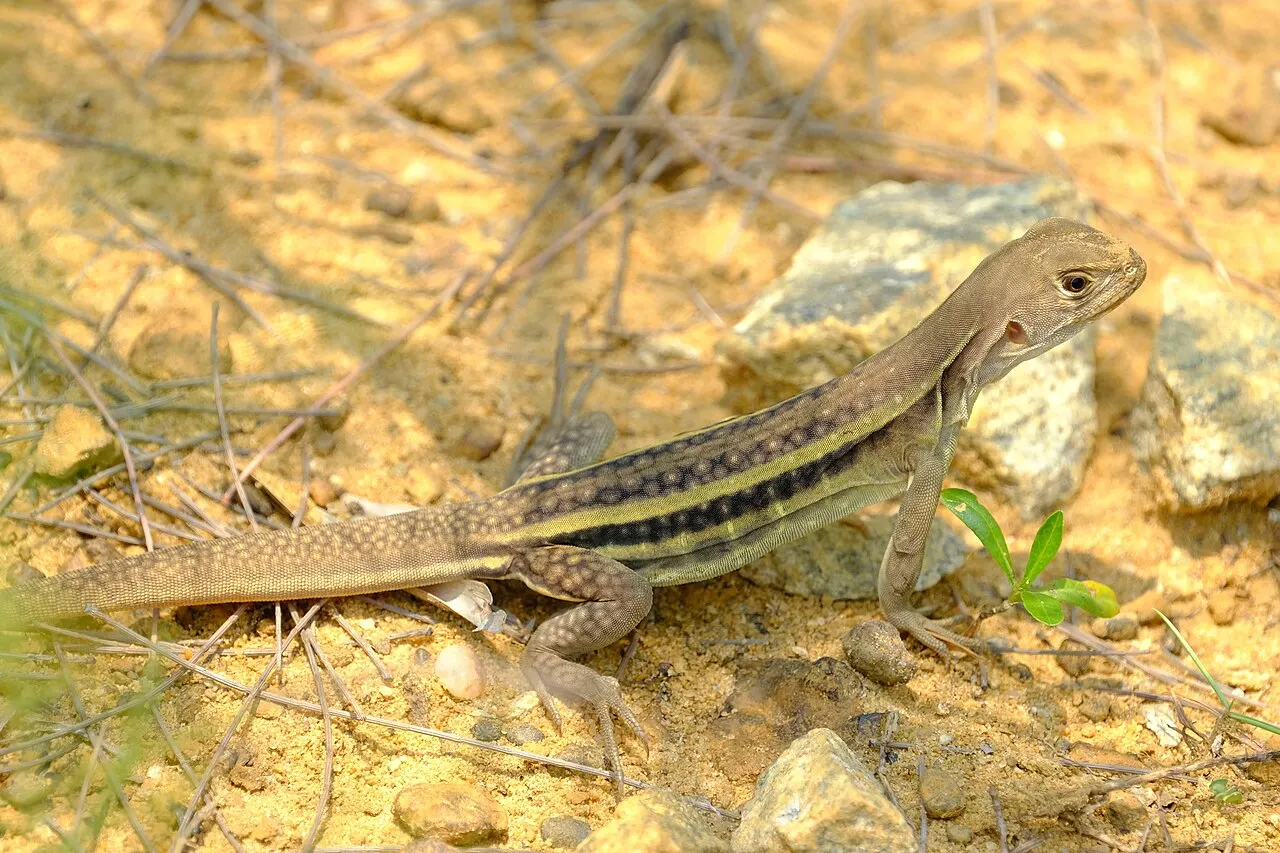
This is a large butterfly lizard for its genus, with a body length from snout to vent of up to about 15.6 cm. It has two pale stripes along its back and, between them, rows of four or five light oval spots that form a net-like pattern. Unlike some relatives, it has no stripe down the middle of the back.
It was described in 1993 by Ilya Darevsky and Lyudmila Kupriyanova. The name honours the German herpetologist Günther Peters (1932 to 2023).
Where it lives
The species is known from central Vietnam, in the old Binh Tri Thien and Quang Nam-Da Nang provinces. The type locality is Thuy Phu, about 17 km south-east of Hue.
It prefers sparsely vegetated coastal dunes from sea level to about 45 m. The IUCN counts four locations, with an extent of occurrence of about 3,943 square kilometres, and records it in at least one protected area.
Pins are Wikidata “endemic to” fields. Orange dots, when present, are GBIF occurrence tiles — survey bias included.
How it lives
All individuals are female. The species reproduces by parthenogenesis, meaning eggs develop without fertilisation, and the eggs develop inside the mother, which gives birth to live young. A litter holds one to three young.
It is also triploid, with three sets of chromosomes. A 2014 study by Grismer and colleagues proposed that its ancestors were Leiolepis guttata and L. reevesii. A 2025 Scientific Reports paper by Galoyan and colleagues suggested instead that a backcross with a male L. guttata raised its ploidy from two sets to three. The same team found a tetraploid male within its range, likely sterile, that carried three L. guttata genomes and one from L. reevesii.
Why it is in trouble
The IUCN trend is decreasing, with continuing decline in habitat. Two causes are listed: tourism and recreation development, which converts coastal dunes, and deliberate collection of the lizard itself. The assessment does not say what the collected animals are used for.
The 2018 assessment lists no conservation actions beyond the species occurring in at least one protected area.
Sources
Written for this catalog in our own words from the sources below, checked against them on 12 November 2026. Population figures are estimates and carry the year they were made. Status and assessment year: IUCN. 2026. The IUCN Red List of Threatened Species. Version 2026-1. iucnredlist.org.




