Critically Endangered
Lantzia
Lantzia carinata
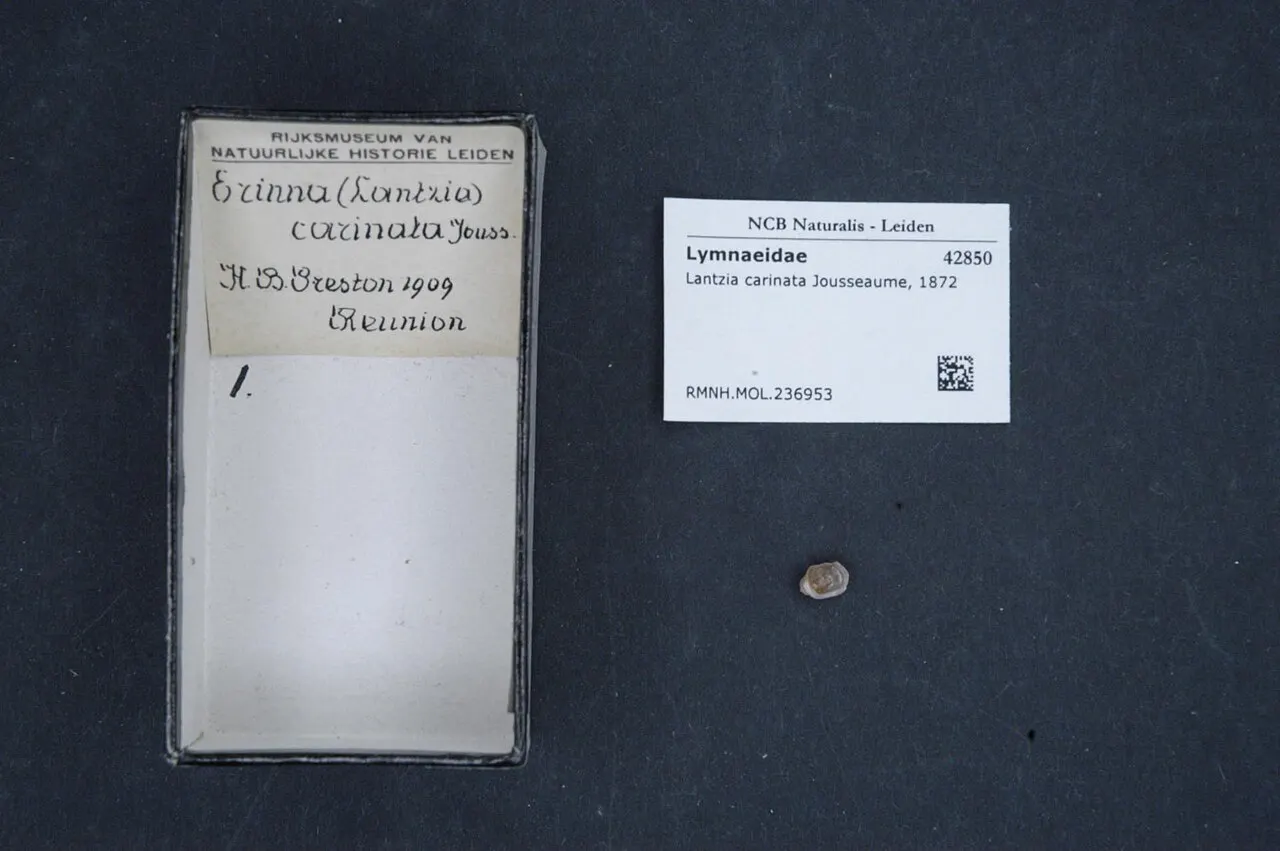
Lantzia carinata is a small, limpet-shaped freshwater snail found only in the mountain streams of Réunion, in the Indian Ocean, and it's the sole member of its genus. The IUCN Red List assessed it as Critically Endangered in 2016 and flags it as possibly extinct, because modern surveys have not recorded it.
How to recognise it
Lantzia is a small, limpet-like member of the pond snail family (Lymnaeidae), an amphibious pulmonate snail. Published descriptions give few details of its size.
Its shape and its habit of clinging to mosses and stones in running water resemble the Hawaiian snail genus Erinna. That resemblance is assumed to be convergent evolution, two unrelated groups reaching a similar body plan for a similar way of life. Lantzia has occasionally been treated as part of Erinna, though it is normally kept separate.
Where it lives
It's endemic to Réunion, a volcanic island east of Madagascar. The snail lives in mountain streams and waterfalls at around 1,200 to 1,300 m, on mosses and stones. The IUCN assessment counts it as occurring at a single location, with an area of occupancy of about 4 square kilometres.
Félix Pierre Jousseaume described the species in 1872. It was rediscovered in 1992, living in native mosses in a very limited area.
Pins are Wikidata “endemic to” fields. Orange dots, when present, are GBIF occurrence tiles — survey bias included.
Why it is in trouble
The Critically Endangered listing rests on criterion B2ab(iii), which applies to species with a tiny area of occupancy, a single location and declining habitat quality. Invasive species that degrade its moss habitat are reported as a threat. The Red List gives no population size, and its population trend is unknown.
The possibly extinct flag exists because the snail hasn't turned up in modern surveys of the island's endemic freshwater snails. A database of recently extinct species gives the last record as 1992 or later. Until someone searches its streams again, nobody can say whether it survives.
What is being done
The Red List lists resource and habitat protection, site protection and species recovery as the conservation actions needed. No specific protection or recovery work for this snail has been reported. Finding out whether any survive, and where, is the first job.
Sources
Written for this catalog in our own words from the sources below, checked against them on 12 November 2026. Population figures are estimates and carry the year they were made. Status and assessment year: IUCN. 2026. The IUCN Red List of Threatened Species. Version 2026-1. iucnredlist.org.




