Endangered
Lamprologus tumbanus
Lamprologus tumbanus
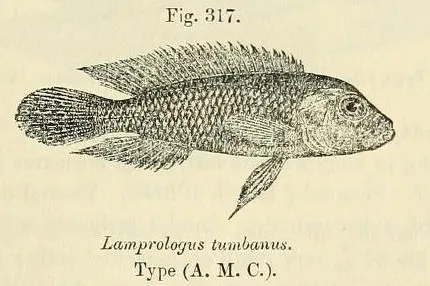
Lamprologus tumbanus is a cichlid fish from the central Congo basin, described from Lake Tumba in the Democratic Republic of the Congo. It has no widely used common name. The IUCN Red List rated it Endangered in 2010, with an unknown population trend, on the basis of a restricted range.
What it is
Lamprologus tumbanus is a cichlid. George Albert Boulenger described it in 1899 in the Annales du Musée du Congo, from specimens collected at Bikoro on Lake Tumba. Schelly and Stiassny fixed a lectotype, the specimen that serves as the name-bearer, in a 2004 revision of the Congo River Lamprologus, and the name is treated as valid.
Where it lives
The type locality is Bikoro on Lake Tumba, in Équateur Province of northwestern DR Congo. The IUCN assessment lists only the Democratic Republic of the Congo and one habitat, permanent freshwater lakes. Specimen records at the Global Biodiversity Information Facility (19 in 2026) cluster at Bikoro and Lake Tumba, with a few from elsewhere in the country, so the exact limits of its range are unclear.
Lake Tumba is a shallow lake joined to the Congo River by the Irebu channel. It covers roughly 500 to 765 square kilometres depending on the source and the season, with a maximum depth of about 6 m. It reportedly holds 114 fish species and supports important fisheries. The wider Ntomba-Ngiri-Maindombe area around it became a Ramsar wetland of international importance in 2008.
Pins are Wikidata “endemic to” fields. Orange dots, when present, are GBIF occurrence tiles — survey bias included.
Why it is in trouble
The 2010 assessment placed the fish in the Endangered category under criterion B1ab(v), which covers a small range together with a continuing decline in numbers of mature fish. The one threat listed is unintentional harm from subsistence and small-scale fishing, the kind of catch that takes non-target species. The population trend is recorded as unknown, and no population estimate is given.
What is being done
The IUCN assessment lists no conservation actions for this species. The lake lies inside a Ramsar site, but no source links that designation to measures for this cichlid.
Sources
Written for this catalog in our own words from the sources below, checked against them on 12 November 2026. Population figures are estimates and carry the year they were made. Status and assessment year: IUCN. 2026. The IUCN Red List of Threatened Species. Version 2026-1. iucnredlist.org.




