Endangered
Parma Royleova
Labeobarbus roylii
Labeobarbus roylii is a freshwater barb of the coastal rivers of Lower Guinea, known from the Chiloango and Kouilou basins in Angola and the two Congos. The IUCN Red List rated it Endangered in 2010, citing a small area of occupancy and habitat pressure from mining, siltation and dams.
What it is
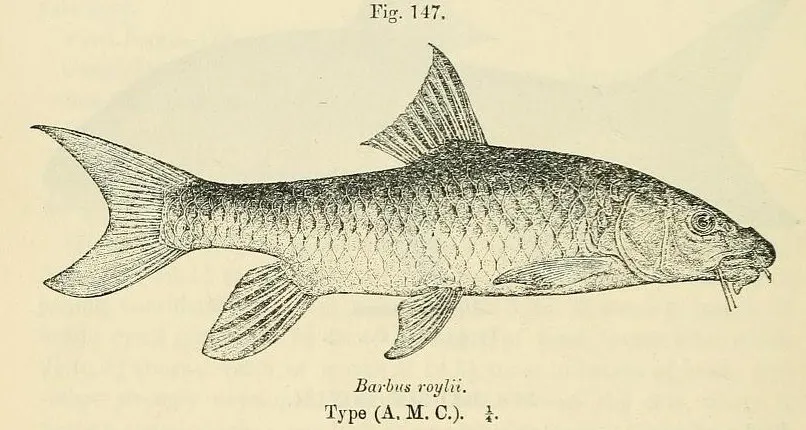
This is a cyprinid, a barb in the subfamily Torinae. William John Ansorge collected the type specimen, and Boulenger described it in 1912 as Barbus roylii. The name honours Harry Royle, an agent for a Liverpool trading firm who helped Ansorge.
It has an elongated body, a mouth set low on the head with well-developed lips, and two pairs of barbels. FishBase gives a maximum length of 55 cm and describes it as living between the middle and bottom of the water column. It lists the fish as of no interest to fisheries.
Where it lives
It is endemic to Lower Guinea and known from the Chiloango and Kouilou river basins. Museum records show where specimens have come from. They include N'Kutu in Angola, the Lubuzi and Bavu rivers around Tshela and Mayumbe in the Democratic Republic of the Congo, and the Niari (Kouilou) at Pont Niari in the Republic of the Congo.
The IUCN assessment lists only Angola as a range country, so the museum records and the assessment do not fully agree. It estimates the area occupied at under 500 square kilometres and lists inland waters as the habitat. FishBase classes the fish as a freshwater species.
Pins are Wikidata “endemic to” fields. Orange dots, when present, are GBIF occurrence tiles — survey bias included.
Why it is in trouble
The IUCN lists soil erosion and sedimentation as an ongoing threat, along with a further ongoing pressure that is not specified. Mining and quarrying and dams of unknown size are listed as future threats. Together they point to degraded or lost river habitat within an already small range.
The Endangered rating rests on criterion B2ab(iii), a small area of occupancy with continuing decline in habitat quality. The population trend is recorded as unknown, and no population count exists.
What is being done
The assessment records no conservation measures in place and lists no research needs. FishBase shows the fish as not evaluated under CITES or the Convention on Migratory Species.
Sources
Written for this catalog in our own words from the sources below, checked against them on 12 November 2026. Population figures are estimates and carry the year they were made. Status and assessment year: IUCN. 2026. The IUCN Red List of Threatened Species. Version 2026-1. iucnredlist.org.




