Endangered
La Plata skate
Atlantoraja platana
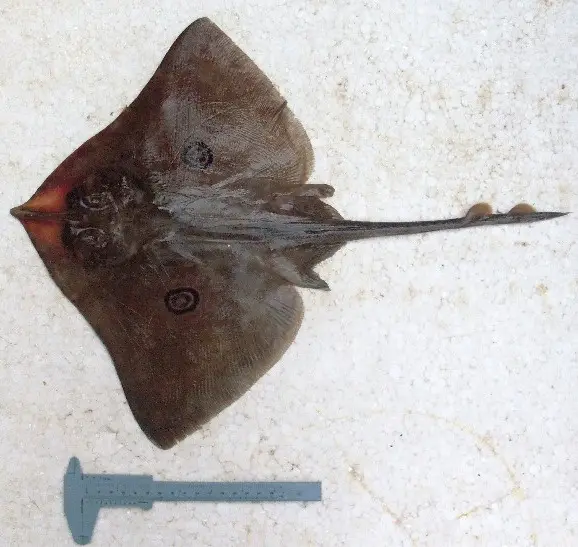
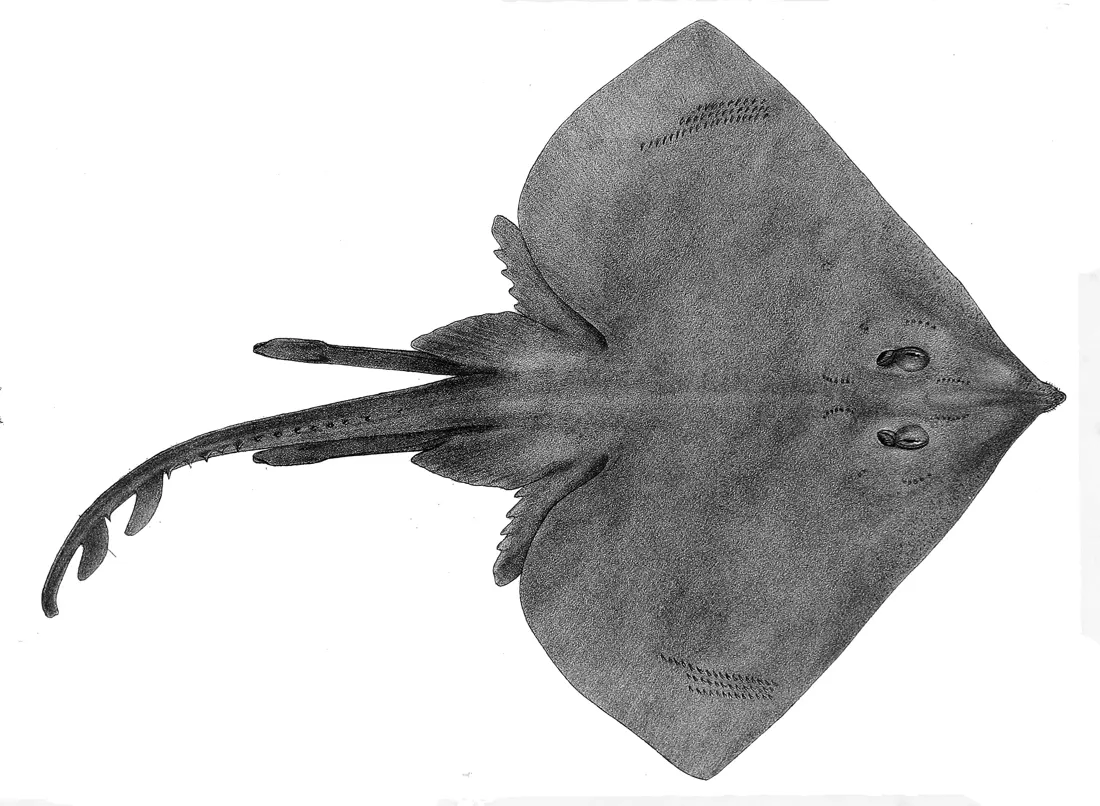
The La Plata skate (Atlantoraja platana) is a flat, bottom-living egg-laying skate of the southwestern Atlantic, found off Brazil, Uruguay and Argentina. The IUCN Red List assessed it as Endangered in 2020, after suspected declines of 50 to 79 percent, driven by trawl and other fishing that catches it by accident.
How to recognise it
It belongs to the softnose skates (family Arhynchobatidae), a group of flattened, bottom-dwelling rays. Günther described the species in 1880. The largest recorded length is 81.6 cm, and a 2008 study of fish from the southwest Atlantic found that males mature at about 620 mm and females at about 715 mm.
Like other skates, it lays eggs in tough capsules rather than giving birth to live young, and the capsules have horns at the corners. A 2004 Zootaxa description of skate egg cases reported that those of the La Plata skate average about 69 mm long and 45 mm wide, with longer horns than those of the related Atlantoraja cyclophora.
Where it lives
The species is recorded from Brazil, Uruguay and Argentina, and the IUCN gives its range as Espírito Santo in Brazil south to Chubut in Argentina. It lives on the seabed over sand, sandy mud and mud, from the shallows down to about 320 m. FishBase gives a depth range of 19 to 181 m, and the type specimen was taken at around 24 m.
Pins are Wikidata “endemic to” fields. Orange dots, when present, are GBIF occurrence tiles — survey bias included.
How it lives
It feeds on fish, crustaceans and cephalopods (squid and relatives). Embryos inside the egg capsules live on yolk alone. FishBase rates its resilience as low, estimating that a population needs between 4.5 and 14 years to double. The IUCN gives its generation length as 13.5 years.
Why it is in trouble
Hardly anyone fishes for it on purpose. The problem is the nets. The IUCN lists unintentional capture in both large-scale and small-scale fisheries as the threat, and the assessment suspects that numbers fell by 50 to 79 percent over three generations (about 40 years). That estimate rests on an index of abundance and on levels of exploitation, so it is an inference rather than a headcount. The causes have not stopped.
With a low resilience rating and a population doubling time that may be more than a decade, the species cannot absorb that kind of loss quickly.
What is being done
As of the 2020 assessment, the IUCN recorded no recovery plan, no monitoring scheme, no harvest management plan and no international trade controls for the species. It recommends species recovery, harvest management, trade management and protected areas, with action at national level. Whether the species occurs in any protected area was listed as unknown.
Sources
Written for this catalog in our own words from the sources below, checked against them on 12 November 2026. Population figures are estimates and carry the year they were made. Status and assessment year: IUCN. 2026. The IUCN Red List of Threatened Species. Version 2026-1. iucnredlist.org.