Endangered
Eyespot skate
Atlantoraja cyclophora
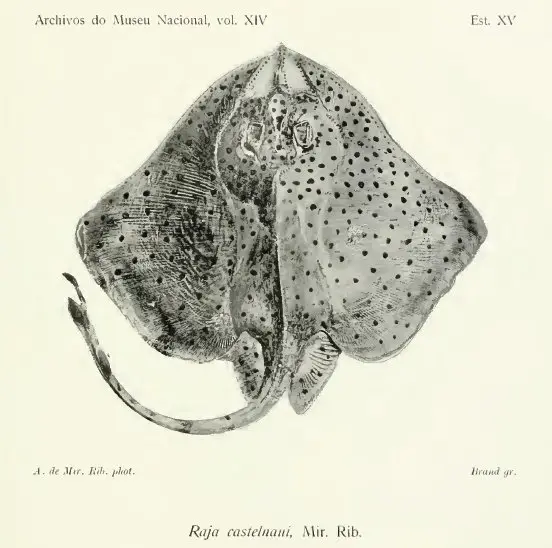
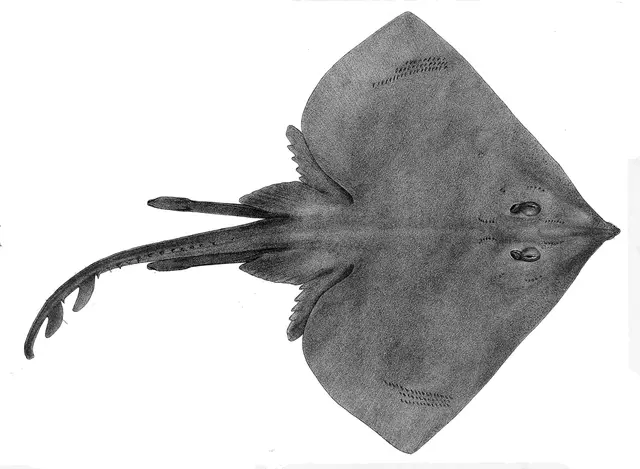
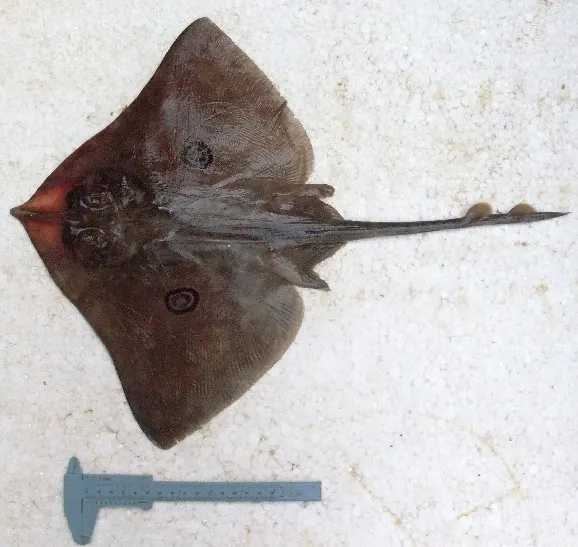
The eyespot skate (Atlantoraja cyclophora) is a flat-bodied, egg-laying skate of the southwestern Atlantic, found on the sea floor off Brazil, Uruguay and Argentina. The IUCN Red List rated it Endangered in 2020 and records a falling population, with fishing as the cause.
How to recognise it
It's a skate in the softnose family Arhynchobatidae, a group of flattened, wing-shaped bottom fish related to rays and sharks.
It's not a small animal. FishBase gives a maximum length of 78.9 cm for males or unsexed fish and about 54 cm as the length at which it first matures. In a 2016 study off Uruguay and northern Argentina, the fish examined measured from 210 to 686 mm in total length.
Where it lives
The species is native to the continental shelf of the southwest Atlantic, off Brazil, Uruguay and Argentina. FishBase places it from Cabo Frio in Brazil southward into Argentine waters. The IUCN assessment lists depths from the surface down to 320 m, and gives its habitat as sandy, sandy-mud, muddy and gravelly sea floor in shallow coastal seas.
The genus Atlantoraja has three living species, and all of them are considered threatened.
Pins are Wikidata “endemic to” fields. Orange dots, when present, are GBIF occurrence tiles — survey bias included.
How it lives
Eyespot skates lay eggs in pairs, in cases with horn-like projections, and the embryos feed only on yolk. They hunt close to the bottom. A study of 442 skates sampled between 2005 and 2007 found that decapod crustaceans (shrimps and crabs) made up most of the diet, with bony fish second. Smaller skates ate more shrimp, larger ones more fish, and mature skates ate more crabs than young ones.
FishBase rates its resilience to fishing as very low, with a population doubling time of more than 14 years. The IUCN assessment puts one generation at about 13.5 years. Slow-growing animals like this recover slowly once numbers drop.
Why it is in trouble
The IUCN lists fishing as the threat, both large-scale and small-scale, with skates caught unintentionally and killed. They are also used as human food, and FishBase says commercial fisheries take the species. Skates in the 2016 study came partly from commercial landings at the port of Mar del Plata, Argentina.
The 2020 assessment records a decreasing population, with a past reduction of 50 to 79 percent estimated from an abundance index and from levels of exploitation. It rates the species Endangered under criterion A2bd, which covers population decline.
What is being done
Measures are limited. The assessment records a harvest management plan as in place, but no species recovery plan, no systematic monitoring scheme and no identified conservation sites.
Sources
Written for this catalog in our own words from the sources below, checked against them on 12 November 2026. Population figures are estimates and carry the year they were made. Status and assessment year: IUCN. 2026. The IUCN Red List of Threatened Species. Version 2026-1. iucnredlist.org.