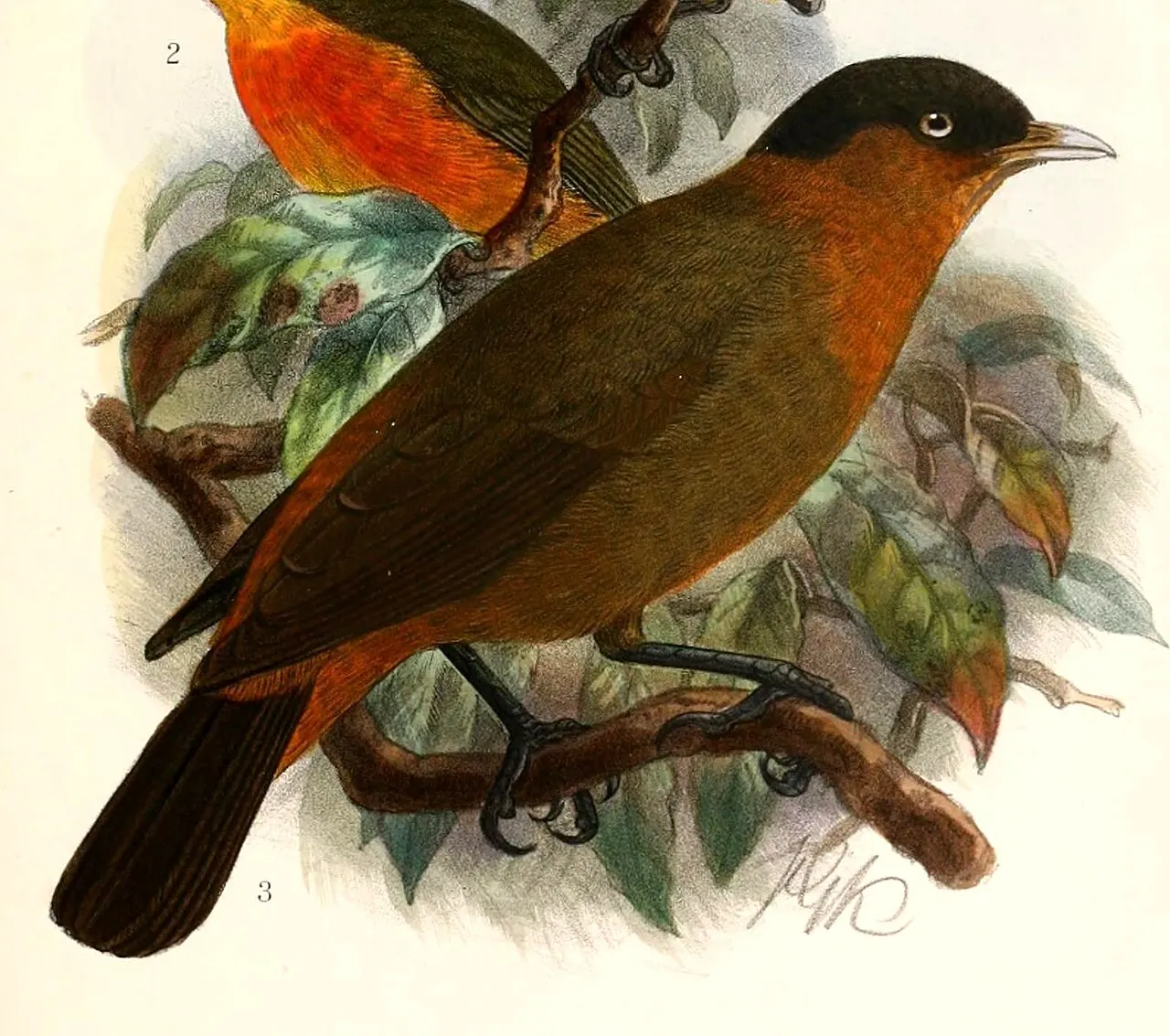
Endangered
Red-collared babbler
Kupeornis rufocinctus
The red-collared mountain-babbler (Kupeornis rufocinctus) is a songbird of high-altitude forest in the Albertine Rift of central Africa. It lives in the Democratic Republic of the Congo, Rwanda, Burundi and Uganda. The IUCN Red List moved it to Endangered in 2021, mainly because of projected habitat decline.
What it is
It belongs to the Leiothrichidae, the family of babblers and laughingthrushes, and was described by Walter Rothschild in 1908. The name has a split history. The IUCN and GBIF use the genus Kupeornis, but after a 2018 molecular study some checklists place it in Turdoides, as the red-collared babbler. The IUCN also lists the French name Timalie a collier roux.
Where it lives
The bird is tied to the Albertine Rift montane forests, a belt of mountain forest of about 103,900 square kilometres along the western edge of East Africa. The IUCN records it in four countries (Burundi, the Democratic Republic of the Congo, Rwanda and Uganda), at elevations between about 1,500 and 3,200 m, in moist montane forest. It does not migrate, and the IUCN does not consider its population severely fragmented.
Most of the records in the Global Biodiversity Information Facility come from Rwanda, followed by the Democratic Republic of the Congo and a very few from Burundi. Those counts reflect where observers go as much as where the birds are.
Pins are Wikidata “endemic to” fields. Orange dots, when present, are GBIF occurrence tiles — survey bias included.
Why it is in trouble
The Red List judges the species Endangered under criterion A3c+4c, which rests on a projected future decline in habitat and numbers. The two threats it records are shifting agriculture and habitat shifting and alteration. The population is decreasing, and the total size is unknown. Generation length is estimated at 3.5 years.
The species was rated Near Threatened (or the older Lower Risk, near threatened) in every assessment from 1988 to 2016, so this is a recent change in assessment rather than a sudden crash. Across the wider ecoregion, forest clearance for farming and logging is a major ongoing problem, particularly in densely populated Rwanda and Burundi, and regional conflict has damaged protected areas such as Kahuzi-Biega.
What is being done
The only conservation action the IUCN recommends is protecting suitable habitat. It records conservation sites identified across the whole range, and the bird is present in at least one protected area. The ecoregion includes national parks such as Nyungwe in Rwanda and Bwindi in Uganda, and roughly 12 per cent of the ecoregion is protected. The IUCN records no recovery plan and no systematic monitoring scheme for this species.
Sources
Written for this catalog in our own words from the sources below, checked against them on 12 November 2026. Population figures are estimates and carry the year they were made. Status and assessment year: IUCN. 2026. The IUCN Red List of Threatened Species. Version 2026-1. iucnredlist.org.




