Endangered
Australian Alpine Grasshopper
Kosciuscola tristis
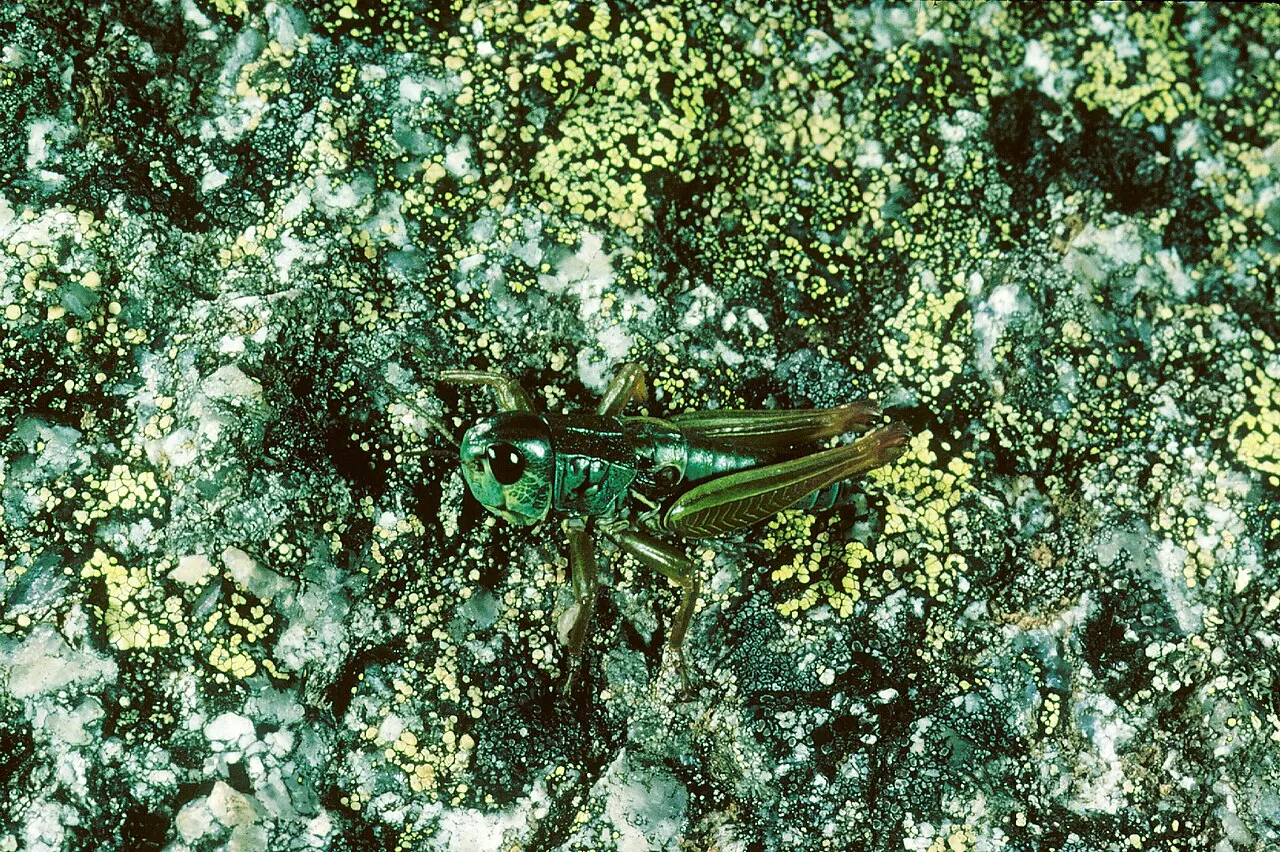
The chameleon grasshopper (Kosciuscola tristis) lives in the high country of the Australian Alps, where males turn from black to bright turquoise as the day warms. The IUCN Red List rated it Endangered in 2022. It occupies a small area above 1,500 m, and snow, fire and drought all bear on its future.
How to recognise it
This is a short-horned grasshopper with a trick. Males are nearly black on cold mornings, with the darkest tone below about 10 degrees Celsius. As the air warms they shift through blue to a vivid turquoise, brightest at around 25 degrees. Females do not show the colour.
A 2011 study by Umbers in the Journal of Insect Physiology found that temperature is the main trigger, and that the change to turquoise can happen up to 10 times faster than the change back to black. The insect's body temperature follows the air within about 10 minutes, but the colour change lags behind it, so colour is not a close readout of body heat.
Where it lives
It is found only in Australia's alpine country. The IUCN counts 1 to 5 locations, with an extent of occurrence of about 914 square kilometres, at elevations from 1,500 to 2,228 m. It lives in temperate grassland, shrubland and forest, and some of its range lies inside a protected area.
Where it occurs it can be extremely abundant in summer. Walkers on the southern Kosciuszko tracks near the ski fields, at about 1,600 to 1,900 m, are most likely to meet it in late summer and early autumn.
Pins are Wikidata “endemic to” fields. Orange dots, when present, are GBIF occurrence tiles — survey bias included.
How it lives
The colour change comes from tiny granules in the cuticle. Pale granules form a reflective layer when it is warm, and larger dark ones beneath sharpen the turquoise. Pieces of isolated cuticle still change colour, and the change carries on after death, so temperature acts on the skin directly rather than through hormones.
What the colour is for is still unsettled. After about a decade of study, no evidence has turned up that it helps the insect regulate its temperature, though that idea has not been ruled out. Females do not seem to care about male colour. Males do fight each other, wrestling and using their jaws, mostly over females that are laying eggs.
Why it is in trouble
The IUCN judges the population to be declining. Ongoing threats it lists are habitat shifting and alteration, temperature extremes, and feral horses, pigs and red foxes. It also lists drought, more frequent and intense fire, large dams and further problem species as future threats.
Snow cover matters too. A 2022 genetic study of the whole skyhopper group, published in Pacific Conservation Biology, cites predictions that the Alps will have little snow by 2070. It warns that eggs of these flightless grasshoppers risk freezing in low-snow years. The same work finds that K. tristis as currently defined splits into four separate clades, which may be distinct species, so each could be rarer than the name suggests.
What is being done
The IUCN assessment lists site management, control of invasive species and restoration of habitat as the actions needed. Researchers are also working on its genetics, taxonomy and distribution, areas where little was known, so that conservation can be aimed at the right populations.
Sources
Written for this catalog in our own words from the sources below, checked against them on 12 November 2026. Population figures are estimates and carry the year they were made. Status and assessment year: IUCN. 2026. The IUCN Red List of Threatened Species. Version 2026-1. iucnredlist.org.




