Endangered
Key's matchstick grasshopper
Key's matchstick grasshopper
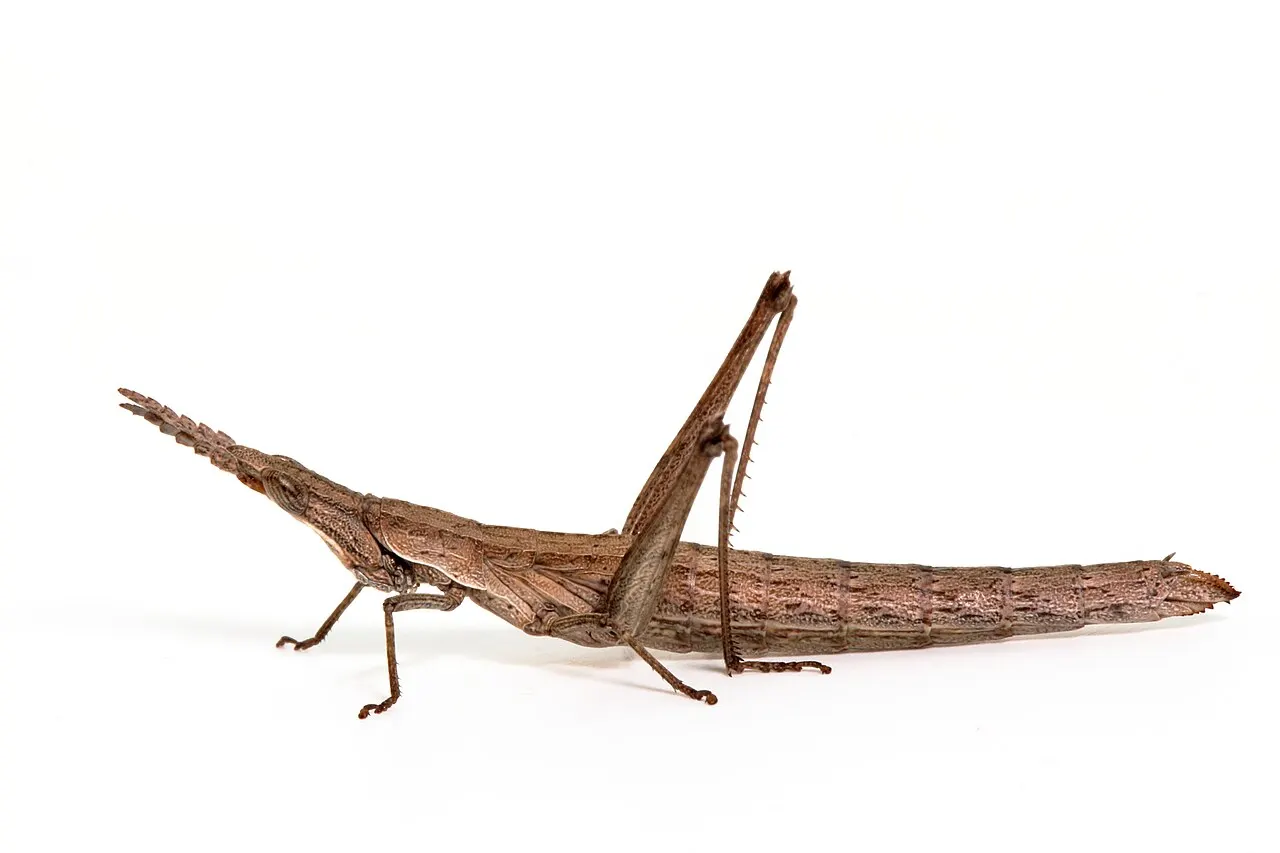
Key's matchstick grasshopper (Key's matchstick grasshopper) is a small, wingless, stick-shaped grasshopper of the grasslands and grassy woodlands of south-eastern Australia. The IUCN Red List rated it Endangered in 2021. Its habitat is cut into small, scattered fragments, and the flightless insects rarely move more than 10 m.
How to recognise it
It's a slender, wingless grasshopper with a slanted face, splayed hind legs and sword-shaped antennae. Females reach about 25 mm and males are smaller, at about 15 to 18 mm depending on the source. Brown is the commonest colour, though green and red forms occur.
The nymphs of the giant green slantface look similar in the same grass, but they develop wing buds and this grasshopper never does. It belongs to the morabine grasshoppers, a group of flightless species found only in Australia.
Where it lives
The species was once recorded from Victoria north to Orange in New South Wales, across the old wheat and sheep country, and the Red List lists it only for Australia. Records include reserves in the Australian Capital Territory, Murrumbateman, Bathurst (the northernmost recent ones) and other sites in the NSW highlands, plus the Omeo district in Victoria. Its true abundance and distribution are poorly understood because the species is hard to identify.
It prefers native grassland and open woodland with a grassy understorey, often with kangaroo grass and daisy-family food plants. Disturbance seems to matter, since it is absent from sites disturbed at the wrong time or grazed erratically. It can't fly and disperses under 10 m.
Pins are Wikidata “endemic to” fields. Orange dots, when present, are GBIF occurrence tiles — survey bias included.
How it lives
It has one generation a year. Eggs hatch between January and March, most males are adult by May, and females pass the winter as nymphs and mature in spring. Mating has been seen from September to late December. Egg output is low: the most recorded from one captive pair was 21 eggs, laid in soil pods.
It eats a wide mix of plants, and native daisies such as common everlasting and the burr Acaena ovina are favourites.
Why it is in trouble
Habitat loss and degradation from urban and farm development, together with fragmentation and the small size of remnants, are the main concerns. The Red List records an estimated area of occupancy of 124 square kilometres and an extent of occurrence of 32,809 square kilometres, with the population severely fragmented and still declining. Listed threats include urban and farm development, grazing and ranching, more frequent fire and temperature extremes.
Locally, ploughing, fertiliser, heavy grazing, invasive pasture grasses, St John's wort, tree and shrub invasion and slashing that strips protective cover all count against it.
What is being done
The species is listed as Endangered in New South Wales (gazetted 17 July 2020) and under Commonwealth law, and the Red List notes it occurs in at least one protected area. Recommended actions include searching for it before any development or land management change, keeping grassland remnants, avoiding ploughing and prolonged heavy grazing, controlling weeds and linking remnants. The Red List also records reintroduction as an action, and a New South Wales recovery project was being developed as of the 2024 profile.
Sources
Written for this catalog in our own words from the sources below, checked against them on 12 November 2026. Population figures are estimates and carry the year they were made. Status and assessment year: IUCN. 2026. The IUCN Red List of Threatened Species. Version 2026-1. iucnredlist.org.




