Critically Endangered
Kenya jewel
Platycypha amboniensis
The Kenya jewel (Platycypha amboniensis) is a small damselfly that lives only along forest streams in the highlands of central Kenya. The IUCN Red List rated it Critically Endangered in 2018. Males defend stream territories and flash bright orange and white legs to rivals and mates.
How to recognise it
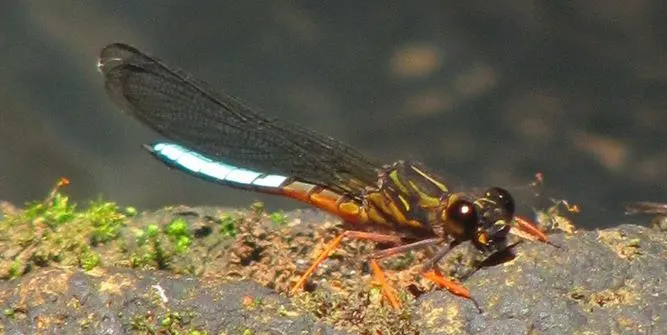
Kenya jewels are small. Males measure about 33 to 34.5 mm from head to tail, females about 29.5 to 30.5 mm. The male's abdomen is flattened from side to side and reddish, with a sky-blue patch on the upper surface of segments 5 to 10 and a rufous (rusty) zone on segments 2 to 4.
The legs give males away. The thighs are black, while the shins are bright orange, white on the front edge, and slightly flattened. Females lack the widened shins and the white. Their abdomen is rounded, striped and netted with black and dull yellow-brown or greenish yellow.
Where it lives
The species belongs to the jewel family (Chlorocyphidae) and is found nowhere outside Kenya. The type specimen and every record known until recently came from Mount Kenya and the Aberdare Range, along forested montane streams at roughly 1,600 to 2,000 m above sea level.
In March 2024 a single male turned up at Brackenhurst Botanical Garden and Forest, about 25 km north of Nairobi. It was the southernmost record and the first from a restored forest in upland Kenya. Follow-up surveys found a breeding population there, including larvae. The forest is surrounded by tea plantations, and researchers had assumed that populations outside forested areas had been wiped out by farming and deforestation.
Pins are Wikidata “endemic to” fields. Orange dots, when present, are GBIF occurrence tiles — survey bias included.
How it lives
Jewels need clean, well-oxygenated running water, because the larvae develop in flowing streams.
A 2025 paper by Anthony Karani and Laban Njoroge described the adults' routine at Brackenhurst. Males perch on stones, dead wood or tree roots in sunlit stretches of stream and chase off intruders in circling flights without touching them. Rivals sometimes hover head to head and raise their abdomens to flash the orange and white shins. A brief courtship display of the same kind comes before mating. Pairs fly in tandem, and the female lays eggs in dead plant material near the water while the male guards his territory.
Why it is in trouble
The IUCN lists farming and plantations, both large and small-scale, as the ongoing threats, and rates the species Critically Endangered because of its tiny range. Its area of occupancy is only about 4 square km, spread over 3 locations. The Brackenhurst surveys counted an average of 23 damselflies per visit along their transects, and a model based on those counts predicted that only about 17 percent of survey sites were occupied.
The 2025 paper also names water pollution, abstraction from streams and fragmentation of habitat as direct threats to breeding success. The IUCN lists the population trend as unknown.
What is being done
Part of the range lies inside protected areas, but the Brackenhurst population sits on private land with no formal protection. Karani and Njoroge call for urgent action: protecting highland ecosystems, restoring streams for clean and steady flow, genetic studies, community monitoring of streams and regular monitoring along key rivers. They also argue the species' conservation status should be revisited in light of the new record.
Sources
Written for this catalog in our own words from the sources below, checked against them on 12 November 2026. Population figures are estimates and carry the year they were made. Status and assessment year: IUCN. 2026. The IUCN Red List of Threatened Species. Version 2026-1. iucnredlist.org.




