Critically Endangered
Jullien's Golden Carp
Probarbus jullieni
Jullien's golden carp (Probarbus jullieni) is a very large river fish of the Mekong basin and a few Malaysian rivers, reaching well over a metre. It migrates upstream to spawn. The IUCN Red List rated it Critically Endangered in 2019, and international trade is restricted under CITES Appendix I.
How to recognise it
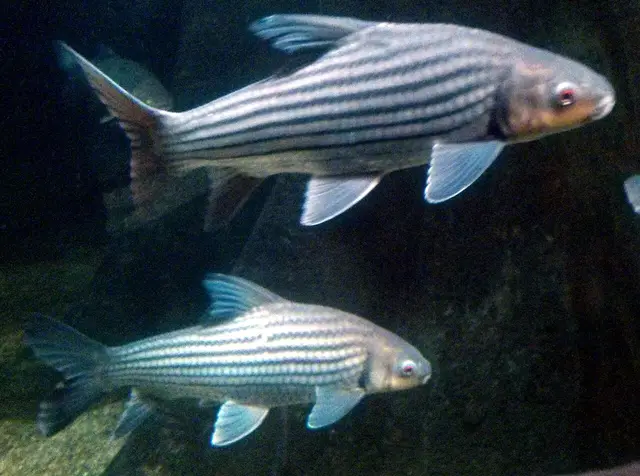
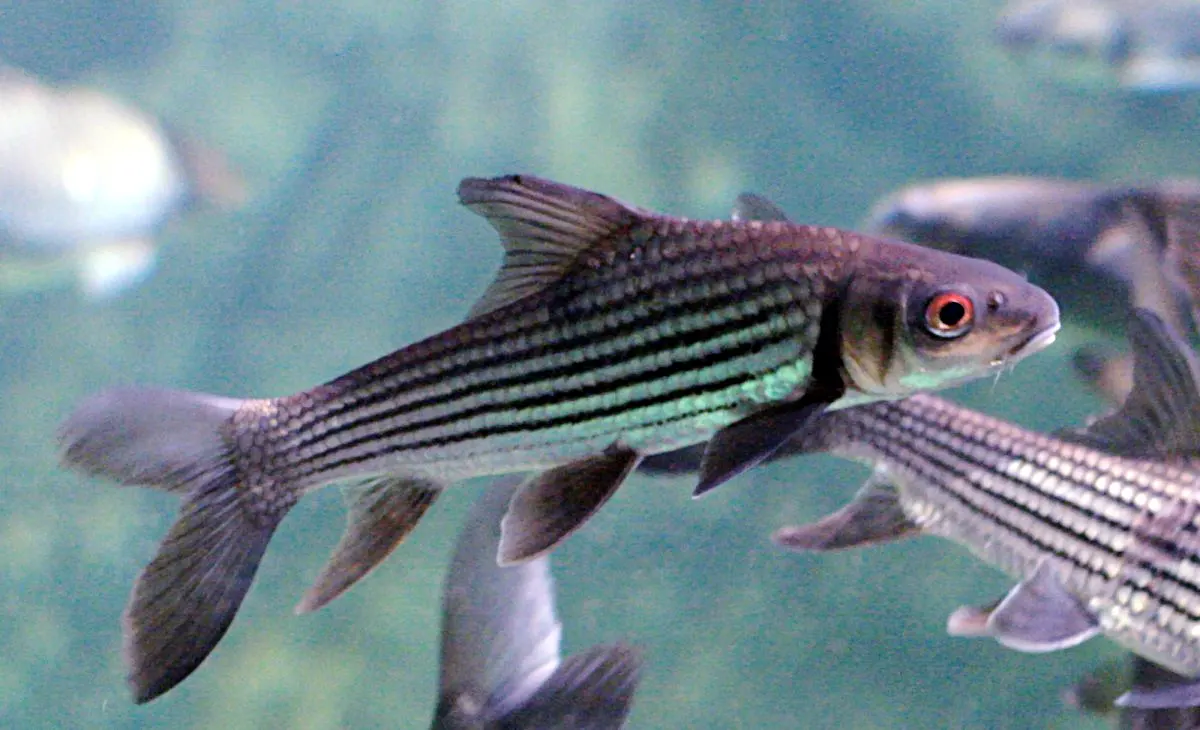
It's a heavy-bodied member of the carp family with barbels at the mouth and five stripes between the lateral line and the dorsal fin, one fewer than its relative Probarbus labeamajor. Adults and larger juveniles show more red, sometimes yellow, on the head, body and fins than the related species.
Size figures differ by source. Maximum length is given as about 150 cm in one database and 165 cm in another, with weights up to 70 kg. Fish sold in markets today are mostly 5 to 20 kg.
Where it lives
Historically it ranged through the Mekong, Chao Phraya, Meklong, Pahang and Perak basins, and it has reportedly also been recorded in the Irrawaddy. The IUCN lists Cambodia, Laos, Thailand, Viet Nam and Malaysia. Today it survives mainly in the Mekong, with small populations reported in the Pahang and Perak rivers.
It stays mostly in the main channels of big rivers and in deep, slow reaches over sand or gravel, and it also uses large permanent lakes.
Pins are Wikidata “endemic to” fields. Orange dots, when present, are GBIF occurrence tiles — survey bias included.
How it lives
It feeds on shelled molluscs, aquatic plants and insects. The IUCN classes it as a full migrant. In the Mekong, adults run upstream from October to February and spawn between late December and early February over sand and gravel. The buoyant yellow eggs, about 2 mm across, hatch in roughly 32 hours at 23 degrees C. Young fish move into tributaries and floodplains and return to the main river as adults.
It may live very long. One account gives up to 50 years, though that figure rests on a single source.
Why it is in trouble
Fishing is the main pressure. The IUCN lists both intentional and accidental harvest, at large and small scale, and gillnetting at spawning sites has been reported to take breeding fish. Fish biologists rate its fishing vulnerability as very high and its resilience as very low, with a minimum population doubling time of more than 14 years.
The IUCN also lists dams, and a 2023 IUCN account adds habitat loss and large-scale agriculture. It records a continuing decline in the population and in its area, and an estimated past reduction of about 80 percent attributed to exploitation.
Big fish fetch a high price, and the eggs are especially valued. Catch, trade and transport are forbidden in Laos.
What is being done
A project announced in June 2023 in northeast Thailand, led by the community network ComNetMekong with IUCN and CEPF support, surveyed three villages (Tad Serm, Nam Pri and Pak Som) and worked with three communities and a local temple to set up fish conservation zones that the communities manage. Thailand's Mekong fisheries plan for 2023 to 2027 includes restoring the species.
The IUCN lists captive breeding, reintroduction and a genome resource bank among the actions needed. It records conservation sites identified over the whole range and at least one protected area where the fish occurs.
Sources
Written for this catalog in our own words from the sources below, checked against them on 12 November 2026. Population figures are estimates and carry the year they were made. Status and assessment year: IUCN. 2026. The IUCN Red List of Threatened Species. Version 2026-1. iucnredlist.org.