Endangered
Johora punicea
Johora punicea
Johora punicea is a small purple freshwater crab found only on Pulau Tioman, an island off the east coast of Peninsular Malaysia. Unlike most river crabs it lives mostly on damp ground beside streams. The IUCN Red List assessed it as Endangered in 2008, mainly because its range is tiny.
How to recognise it
Large adults are deep purple, a purplish-red colour that sets them apart from every other potamid (river crab) on Tioman. Juveniles run from pink to light purple. The carapace is smooth, almost hairless and swollen, and the legs are relatively long. It stays small: the biggest recorded animals are about 25 mm across the shell, while the island's larger Johora tiomanensis reaches 35 to 50 mm.
Males carry a long, slender, sickle-shaped first gonopod, the mating limb that specialists use to tell Johora species apart.
Where it lives
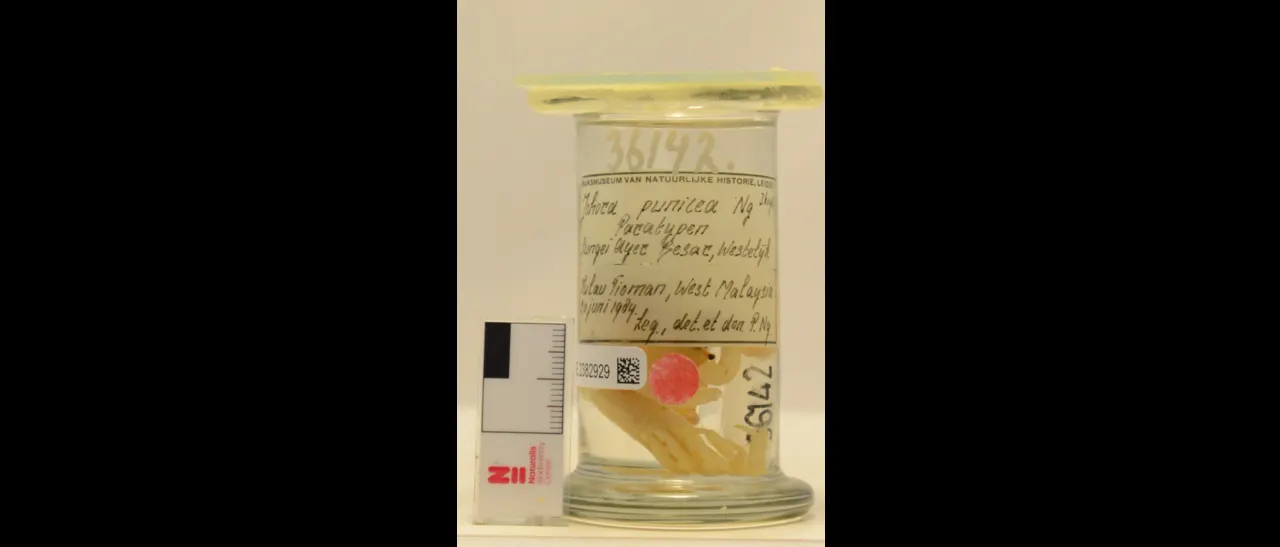
The crab is known only from Tioman. Peter Ng described it in 1985 from the holotype he collected in June 1984 under rocks on a slope beside Sungai Besar, on the island's west side, at about 300 m above sea level. A 1999 survey of Tioman's freshwater and terrestrial decapods in the Raffles Bulletin of Zoology later found it along other streams, including Sungai Salang in the northwest and the Sungai Baharu, Sungai Keliling and Sungai Paya areas. The IUCN gives its upper elevation limit as 300 m and counts five locations.
Tioman is a rugged island of about 136 km2. Its streams are generally small and, according to the 1999 survey, stay permanent only below roughly 600 m.
Pins are Wikidata “endemic to” fields. Orange dots, when present, are GBIF occurrence tiles — survey bias included.
How it lives
It's a semi-terrestrial crab. Ng's original description says it is almost always found under rocks on moist ground beside a stream and hardly ever in fast-flowing water itself, and one specimen turned up more than a hundred metres from the water. The 1999 survey suggests the long legs and swollen shell are adaptations to that lifestyle.
That habit lets it share streams with its close relative, a Johora that lives only in the flowing water, usually under rocks. Both sexes of the purple crab mature at a much smaller size than that relative.
Why it is in trouble
The 2008 Endangered listing rests on criteria B1ab(iii,v) and 2ab(iii,v), the codes for a small range at a limited number of locations where habitat quality and numbers are declining or projected to. No population size was recorded and the trend is listed as unknown. The assessment did not treat the population as severely fragmented.
The threats named are tourism and recreation areas, small-holder farming, recreational activities and taking water from streams for domestic use. Tioman is a resort and diving destination, and in 1984 a large part of its wildlife reserve was released for agriculture and tourism development.
What is being done
The assessment records that the crab occurs in at least one protected area. Tioman's inland rainforest was made a wildlife reserve in 1972, though it shrank to about 8,300 ha after the 1984 change. No species-specific recovery plan appears in the sources.
Sources
Written for this catalog in our own words from the sources below, checked against them on 12 November 2026. Population figures are estimates and carry the year they were made. Status and assessment year: IUCN. 2026. The IUCN Red List of Threatened Species. Version 2026-1. iucnredlist.org.
- IUCN Red List assessment, Johora punicea (2008)
- Ng 1985, Zoologische Mededelingen 59 (14), original description of Stoliczia (Johora) punicea
- Yeo, Cai and Ng 1999, freshwater and terrestrial decapod Crustacea of Pulau Tioman, Raffles Bulletin of Zoology Supplement 6
- Yeo 2001, Johora gua, Proceedings of the Biological Society of Washington 114(3)
- Wikipedia, Tioman Island