Critically Endangered
Jerdon's Courser
Rhinoptilus bitorquatus
Jerdon's courser is a secretive, night-active bird of dry scrub in the Eastern Ghats of India, found nowhere else. The IUCN Red List, in its 2025 assessment, lists it as Critically Endangered with an estimated 1 to 50 mature birds. Feared extinct for decades, it was found again in 1986.
How to recognise it
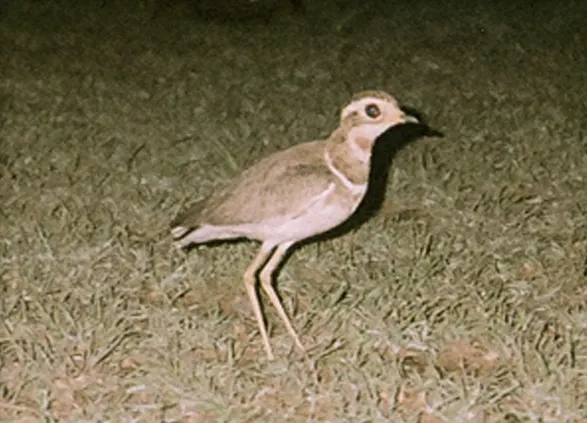
It's a compact bird about 27 cm long. Two brown bands cross the breast, the crown is mostly blackish, and a broad buff stripe runs over the eye. The throat patch is orange-chestnut, and the shortish yellow bill has a black tip.
In flight it shows a mostly black tail and a white patch near the tips of the dark flight feathers. If it's flushed, it reportedly takes off almost straight up, like a helicopter. It calls in short staccato series at dawn and dusk, and nearby birds may answer.
Where it lives
The courser lives in sparse, dry scrub forest with patches of bare ground, in southern Andhra Pradesh. The IUCN puts its extent of occurrence at about 19,300 square kilometres. Surveys have tied it to scrub with fairly tall bushes, and the two sites where it is best known are Sri Lankamalleswara and Sri Penusila Narasimha wildlife sanctuaries.
It was once recorded elsewhere, but a 2008 search of former habitat near Sironcha found no birds.
Pins are Wikidata “endemic to” fields. Orange dots, when present, are GBIF occurrence tiles — survey bias included.
A bird lost and found
Thomas Jerdon collected the first specimens, and Edward Blyth described the species in 1848. It then went unseen for more than 80 years, and it was widely assumed to be extinct.
In 1986 local trappers caught one, and Bharat Bhushan of the Bombay Natural History Society confirmed the rediscovery. India issued a stamp for the event in 1988. The only known egg, collected in 1917, is held at the University of Aberdeen's zoology museum, and DNA comparison confirmed it belongs to this species.
Its diet is presumed to be insects, though that hasn't been confirmed.
Why it is in trouble
Open scrub is not a glamorous habitat, and it keeps getting cleared. A study by Senapathi and colleagues found that 11 to 15 percent of open scrub forest was cleared between 1991 and 2000. Eucalyptus plantations, irrigated fields and orchards now occupy former scrub. The IUCN lists small-holder farming and grazing, quarrying and accidental or small-scale harvest, and snaring is a reported hazard.
In 2005 the Telugu Ganga canal threatened the only known site. After legal action the canal was diverted.
What is being done
Both best-known sites are protected areas, though many remaining scrub patches lie partly or wholly outside them. The IUCN records that a recovery plan exists, with no systematic monitoring scheme and no captive breeding.
A project led by Panchapakesan Jeganathan at the Nature Conservation Foundation, funded by a 2022 grant, surveyed vegetation in 474 plots in late 2023. Large bush cover had declined since earlier surveys, while small bush cover had increased. Camera traps ran for 7,992 nights between August 2024 and February 2025 and recorded no courser. The team built a habitat model to guide future searches and plans acoustic monitoring at new sites. In August 2025 a group of birders recorded what they reported as its call in the Lankamalla hills.
Sources
Written for this catalog in our own words from the sources below, checked against them on 12 November 2026. Population figures are estimates and carry the year they were made. Status and assessment year: IUCN. 2026. The IUCN Red List of Threatened Species. Version 2026-1. iucnredlist.org.




