Endangered
Itasenpara Bitterling
Acheilognathus longipinnis
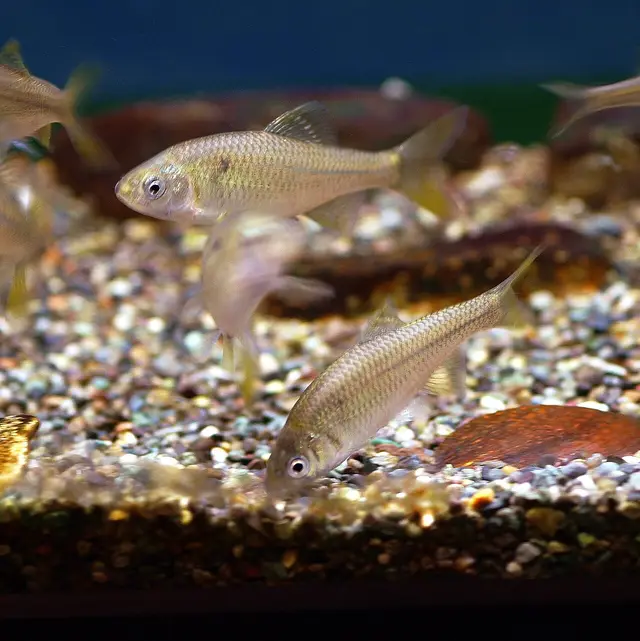
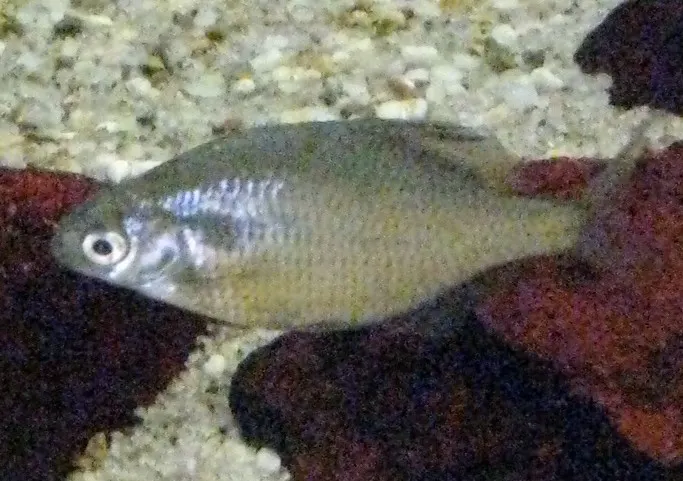
The Itasenpara bitterling (Acheilognathus longipinnis), also called the deepbody bitterling, is a deep-bodied freshwater fish found only in Japan, in a few areas of Honshu. The IUCN's 2019 assessment rates it Endangered. It lays its eggs inside living freshwater mussels, which ties its survival to theirs.
How to recognise it
It's a small, deep, flattened fish, usually 7 to 8 cm long, though some grow past 12 cm. Its dorsal and anal fins have more rays than those of any other Japanese bitterling and reach almost to the tail. In autumn males turn purplish-pink on the head, back and upper flanks, with black-edged fins. Females show no bright colour and grow a short, thick egg-laying tube. Charles Tate Regan described the species in 1905.
Where it lives
It survives in three separate regions of Honshu: the Yodo River system around Osaka, the Toyama Plain and the Nobi Plain. The IUCN counts three locations, an extent of occurrence of about 9,060 square kilometres and an area of occupancy of only about 36 square kilometres.
It favours still or slow, shallow, reedy water with connected channels and freshwater mussels, not fast main channels. It once lived in the inner lakes of Lake Biwa and in a Kyoto pond, but those populations were lost before the Second World War.
Pins are Wikidata “endemic to” fields. Orange dots, when present, are GBIF occurrence tiles — survey bias included.
How it lives
Spawning runs from about September to November, peaking in mid to late October. Males defend a mussel, and the female lays her eggs inside it. The young overwinter in the mussel and emerge in the following spring. Juveniles eat zooplankton, and adults feed largely on algae. Most live only one to two years.
Why it is in trouble
The IUCN lists a long set of pressures: river engineering and dams, nutrient, sewage and farm run-off, harvesting, and invasive fish. It scores the impact of the named invasive species as high. Japanese sources name largemouth bass, bluegill and Chinese bitterling, and describe riverbank works and farmland consolidation in the 1950s and 1960s, mussel decline, and illegal collection by aquarists. On the Yodo, a barrage finished in 1983 raised water levels and shrank the shallow spawning areas.
A 2022 study by Nagayama and colleagues on the Kiso River floodplain found juveniles in 9 of 17 waterbodies connected to the river, but in only 2 of 39 isolated ones.
What is being done
Japan declared it a Natural Monument in 1974 and a national endangered species in 1995. Himi City in Toyama began breeding it in 2003, and captive stocks are kept at places such as the Osaka Aquatic Center and the Lake Biwa Museum. The IUCN records captive breeding, reintroduction and invasive species control among the actions in place or needed.
Reintroduction hasn't been simple. In 2009, 500 captive-bred adults were released into the Yodo River. About 133 young appeared in 2010, but none were found in 2011, and the project team rated it a failure, citing floods, mussel decline, invasive fish and poaching. A 2019 survey in one Yodo area reportedly counted more than 11,000 juveniles.
Sources
Written for this catalog in our own words from the sources below, checked against them on 12 November 2026. Population figures are estimates and carry the year they were made. Status and assessment year: IUCN. 2026. The IUCN Red List of Threatened Species. Version 2026-1. iucnredlist.org.
- IUCN Red List assessment, Acheilognathus longipinnis (2019)
- Japanese Wikipedia entry, Itasenpara
- Re-introduction of the Itasenpara bitterling to the Yodo River (IUCN Conservation Translocation Specialist Group)
- Japan for Sustainability, Himi City breeding report (2004)
- Nagayama et al. 2022, Knowledge and Management of Aquatic Ecosystems (abstract as returned by search; full page blocked)