Endangered
Lakeweed Chub
Ischikauia steenackeri
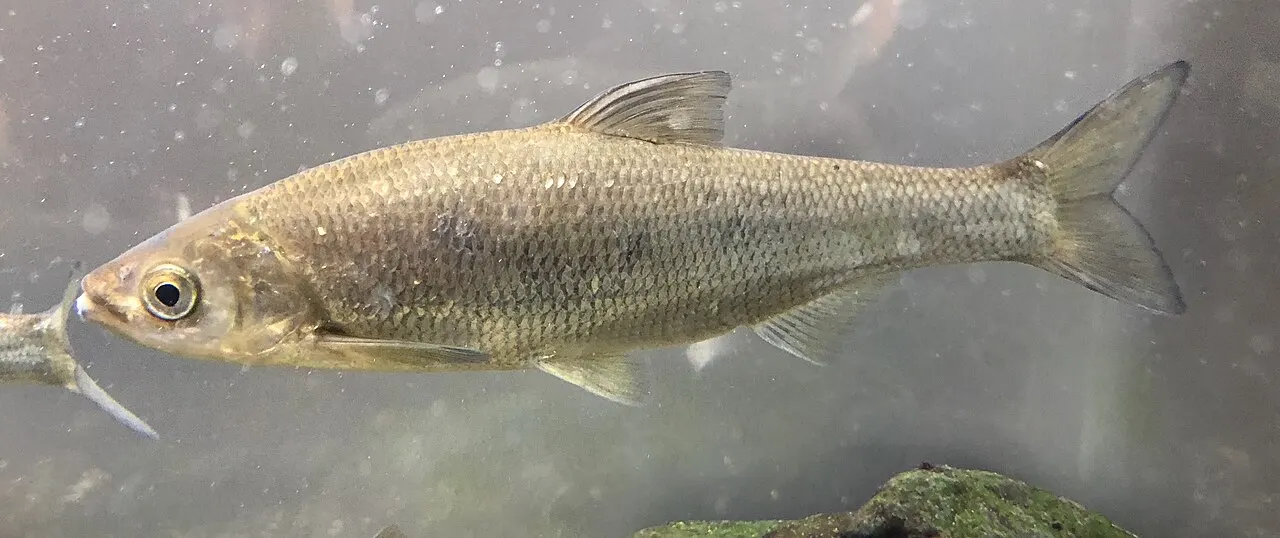
The wataka or lakeweed chub (Ischikauia steenackeri) is a Japanese freshwater fish native to the Lake Biwa and Yodo River system on Honshu. The IUCN Red List rates it Endangered (assessed 2019, population decreasing). Adults feed heavily on water plants, and the fish has become scarce in its home waters.
How to recognise it
The wataka reaches about 30 centimetres in length. The body is pale blue with a grayish blue-green back and a white belly, and the mouth points obliquely upward. Males carry star-shaped spots on the head, back and pectoral fins. It is the only member of its genus, in the carp relatives of the family Xenocyprididae, and was first described as Opsariichthys steenackeri by Sauvage in 1883.
Where it lives
The natural range is the Lake Biwa and Yodo River system in Japan. The IUCN counts only two locations and an extent of occurrence of about 1,826 square kilometres, with the population still declining. It lives in lakes, ponds, reedy marshes and the slow lower reaches of rivers.
A 2025 paper in Ichthy describes the fish as once widespread around the lakeshore and in the lagoons beside the lake, most numerous in the warm, weedy shallows of the south and east. Fossil throat teeth found mostly in western Japan suggest it may be a relict rather than a true Lake Biwa endemic.
Outside its native waters it has spread, accidentally, among young ayu fish from Lake Biwa that were released for fishing. Populations now exist in the Kanto and Hokuriku districts and in several western prefectures. Japan's invasive species database lists its impact there as unknown.
Pins are Wikidata “endemic to” fields. Orange dots, when present, are GBIF occurrence tiles — survey bias included.
How it lives
Young fish eat a mix of foods, but adults turn mainly to water plants and green algae, and wataka sometimes damage young rice shoots in paddies. They also take shrimps and aquatic insects. Spawning runs from June to July, reportedly in the evening or at night after rain, on plants near the surface such as reeds.
In July 2024, researchers found wataka eggs, about 1.5 millimetres across, stuck to floating pieces of the water plant Myriophyllum in a small channel that drains into the south basin of Lake Biwa. Mabuchi and colleagues called it the first recent record of the species using a natural spawning surface in the lake system.
Why it is in trouble
The IUCN lists dams, roads and railways, and two introduced predators, bluegill and largemouth bass, as ongoing threats. Japanese researchers also point to the loss of the reed beds along the lakeshore where the fish breeds. The Mabuchi paper places the main drop in numbers in the 1980s and early 1990s. Japan's Ministry of the Environment now lists the species as Critically Endangered, a higher category than the IUCN's.
What is being done
The IUCN records invasive species control as in place, and lists habitat restoration, site management and habitat protection as needed. Shiga Prefecture has been removing alien fish and building reed beds, but the 2025 paper reports no clear recovery in numbers.
Since 2002, hatchery-reared wataka have been released in Lake Biwa, partly to graze excess water weeds. Marking surveys have mostly caught released fish, which suggests the lake is not yet producing enough young of its own.
Sources
Written for this catalog in our own words from the sources below, checked against them on 12 November 2026. Population figures are estimates and carry the year they were made. Status and assessment year: IUCN. 2026. The IUCN Red List of Threatened Species. Version 2026-1. iucnredlist.org.




