Endangered
Iomon nan
Iomon nan
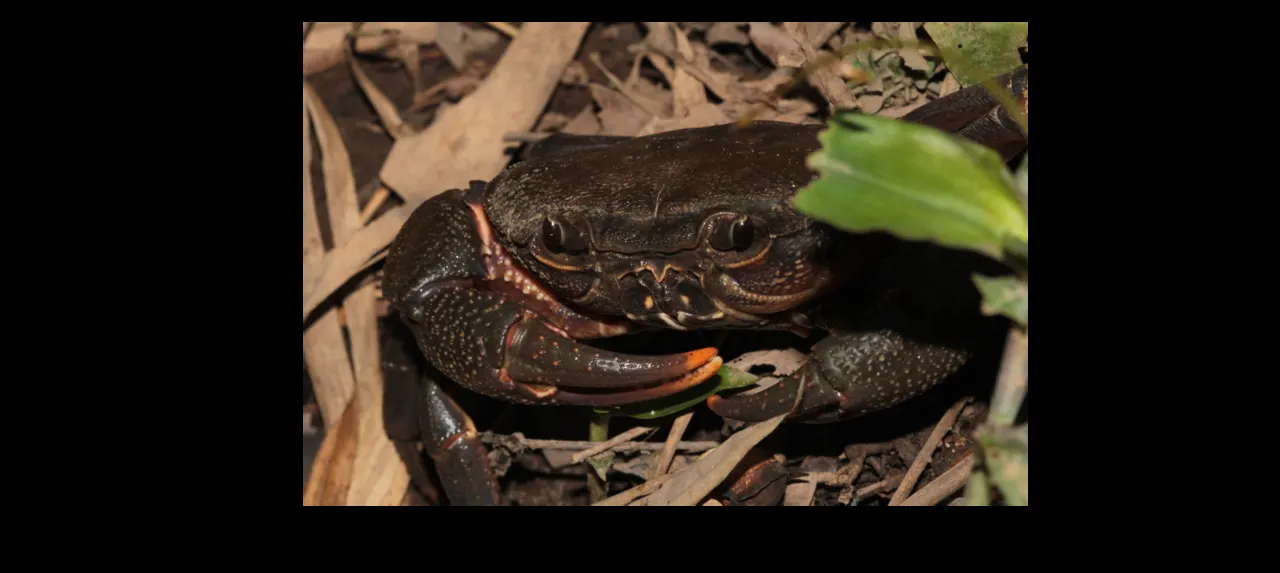
Iomon nan is a freshwater crab known only from Thailand, where it lives in hill streams in the north and northeast. The IUCN Red List lists it as Endangered (assessed 2008) because it occupies roughly 65 square kilometres across three locations. Adults are dark olive-brown above, white below, with orange-tipped claws.
How to recognise it
In a 2020 study by Suthamrit and Thaewnon-ngiw, live crabs from a 2019 survey had a dark brown-olive shell with a creased, grooved surface and a white underside. The tips of the claws and walking legs were orange, and most animals had a larger right claw than left. The original type specimen, a male, measures 35.6 by 27.2 mm.
Telling this crab from its relatives is hard. Identification rests on the shape of the male's first gonopod, whose terminal joint is bent with a hooked tip. Older literature mixed it up with another Iomon species, Iomon luangprabangense. The 2020 study also found that these crabs keep much the same body shape as they grow, which makes the job harder still.
Where it lives
The species is endemic to Thailand. Ng and Naiyanetr described it in 1993, under the name Potamon nan, from a crab collected on 24 April 1983 at Huai Sa Khorn, Sa District, in Nan Province. Later it was moved to the genus Iomon.
A trapping survey of mountain streams in the Phetchabun Mountains between May and September 2019 caught 138 crabs of four species at 15 sites, at elevations of 310 to 845 metres. Ten were Iomon nan, all from one site at 795 metres in Na Haeo District, Loei Province. The Red List assessment counts three locations in all and lists permanent rivers and streams as its habitat.
Pins are Wikidata “endemic to” fields. Orange dots, when present, are GBIF occurrence tiles — survey bias included.
How it lives
Almost nothing has been written about its breeding, diet or numbers, and the Red List rates its population trend as unknown. Its family, the Potamidae, are crabs of fast streams and waterfalls in hill country, and the 2020 study describes them as indicators of unpolluted water. Local villagers rely on mountain crabs for food and income.
Why it is in trouble
The Endangered listing comes from a very small occupied area, put at about 65 square kilometres, split between a few places. The assessment lists several ongoing pressures: roads, tourism and recreation areas, recreational activities, small-holder farming, and unintentional harvest by small-scale collectors. The effects it names are habitat conversion and degradation, and disturbance of the animals themselves.
Wider trends add to this. The 2020 study cites a fall in Thailand's forest cover from 43 percent in 1973 to 31 percent in 2019, and notes that mountain crabs are not covered by Thailand's wildlife protection law.
What is being done
The assessment records that the crab occurs in at least one protected area. No species-specific recovery programme has been reported. The 2020 study suggested that crab species facing extinction be selectively bred, with commercial rearing in mind, but that is a suggestion, not an active project.
Sources
Written for this catalog in our own words from the sources below, checked against them on 12 November 2026. Population figures are estimates and carry the year they were made. Status and assessment year: IUCN. 2026. The IUCN Red List of Threatened Species. Version 2026-1. iucnredlist.org.




