Endangered
Indian eyed turtle
Morenia petersi
The Indian eyed turtle (Morenia petersi) is a small, mostly plant-eating freshwater turtle of the Ganges and Brahmaputra lowlands in India, Bangladesh and Nepal. It is marked with yellow-ringed eyespots on its shell, and the IUCN Red List classed it as Endangered in 2021 after earlier rating it Vulnerable.
How to recognise it
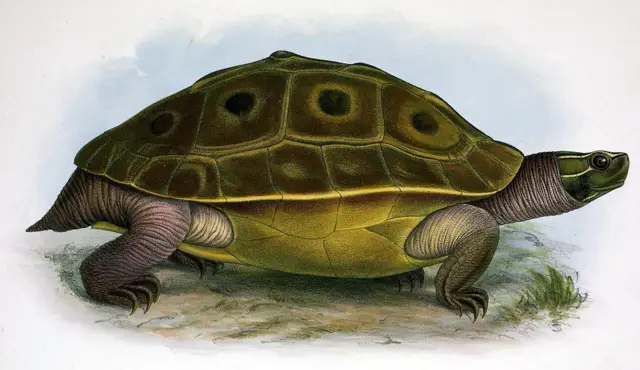
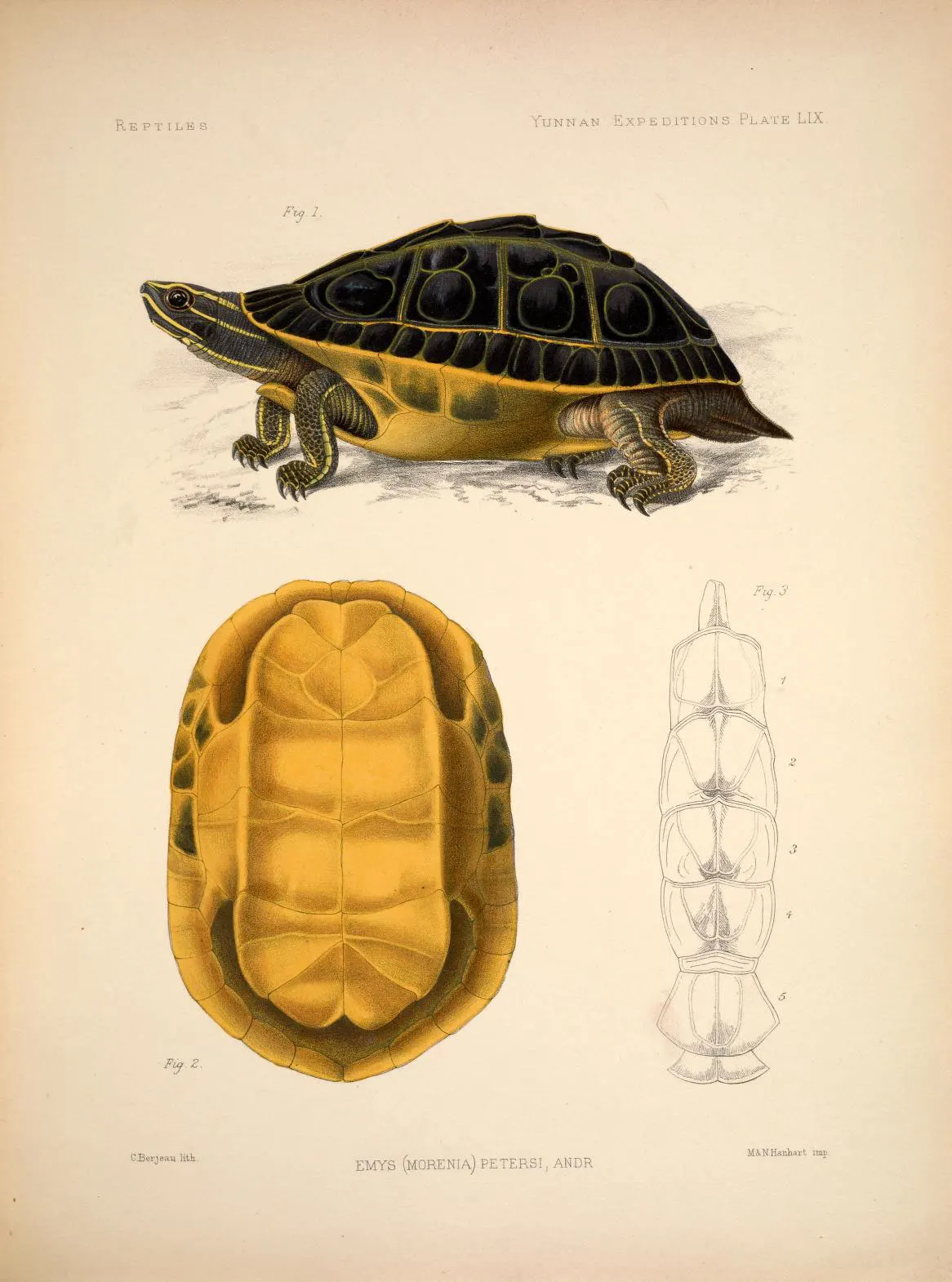
This is a modest turtle, with a slightly domed olive to grey-black shell. Pale, looping lines on the costal scutes can form eyespots, though they are often incomplete. The belly shell is yellow or orange, usually with black blotches, and the olive head has three yellow stripes on each side and a strikingly pointed snout. The feet are webbed.
Females are bigger. In Bangladesh, large males averaged about 179 mm in shell length and large females about 196 mm, with the biggest female reaching 222 mm and 1,150 g. Males have longer tails.
Where it lives
It is restricted to the Ganges and western Brahmaputra drainages, from Haridwar in Uttarakhand through Uttar Pradesh, Bihar, West Bengal, Assam and Manipur, and across Bangladesh. The single Nepal record is from Rupandehi District. The Red List gives an elevation range of 10 to 100 m.
It uses slow rivers, oxbow lakes, ponds, canals, weedy backwaters and flooded fields. Turtles bask on sandbars or floating objects and dive at the slightest disturbance.
Pins are Wikidata “endemic to” fields. Orange dots, when present, are GBIF occurrence tiles — survey bias included.
How it lives
Wild turtles examined in Bangladesh in the 1990s had eaten only plants, including water hyacinth and Hydrilla, and their jaws are shaped for chewing leaves. Captive turtles have preferred fish and prawn, and the Turtles of the World online database calls the species omnivorous.
In Bangladesh nesting was reported in winter, with 6 to 10 elongate white eggs per clutch. A single captive female from Bangladesh laid two eggs in April or May, so timing may vary.
Why it is in trouble
The 2021 assessment (criteria A2cd+4cd) records a decreasing population. Listed threats are dams, herbicides and pesticides, nutrient runoff, sewage and harvest for food. In Bangladesh the catch for food was considerable in the 1990s, mostly taken with spears or nets, and the species has turned up in food markets in southern China. One 1997 report still called it abundant in parts of Bangladesh where larger turtles had become rare.
The species was added to CITES Appendix II in 2013, which requires permits for international trade.
What is being done
The Red List records that the turtle occurs in at least one protected area, and lists harvest management, trade management and captive breeding among its conservation actions. Reported sites include Dudhwa National Park, Kaziranga National Park and Deepor Beel. A 2010 review said the species' distribution and numbers still needed investigating in each range country.
Captive care is hard: the thin shell scutes erode and become infected, and the turtle has never been widely kept.
Sources
Written for this catalog in our own words from the sources below, checked against them on 12 November 2026. Population figures are estimates and carry the year they were made. Status and assessment year: IUCN. 2026. The IUCN Red List of Threatened Species. Version 2026-1. iucnredlist.org.