Endangered
Iberolacerta martinezricai
Iberolacerta martinezricai
The Peña de Francia rock lizard (Iberolacerta martinezricai), also called Martínez-Rica's rock lizard or the Batuecan lizard, lives only on a few rocky mountain slopes in the Sierra de Francia, Salamanca province, Spain. The IUCN Red List rated it Endangered in 2024. It is the most range-restricted reptile on mainland Europe.
How to recognise it
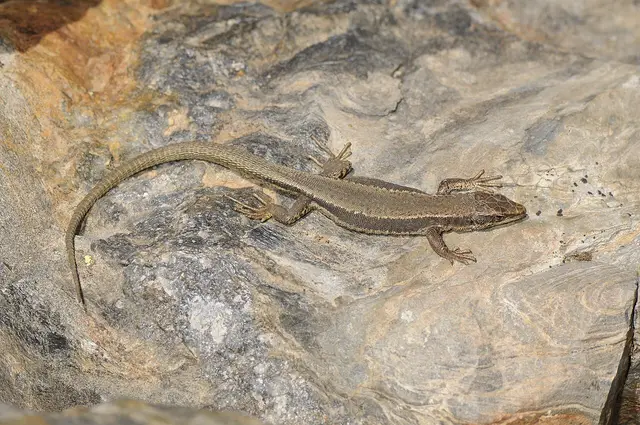
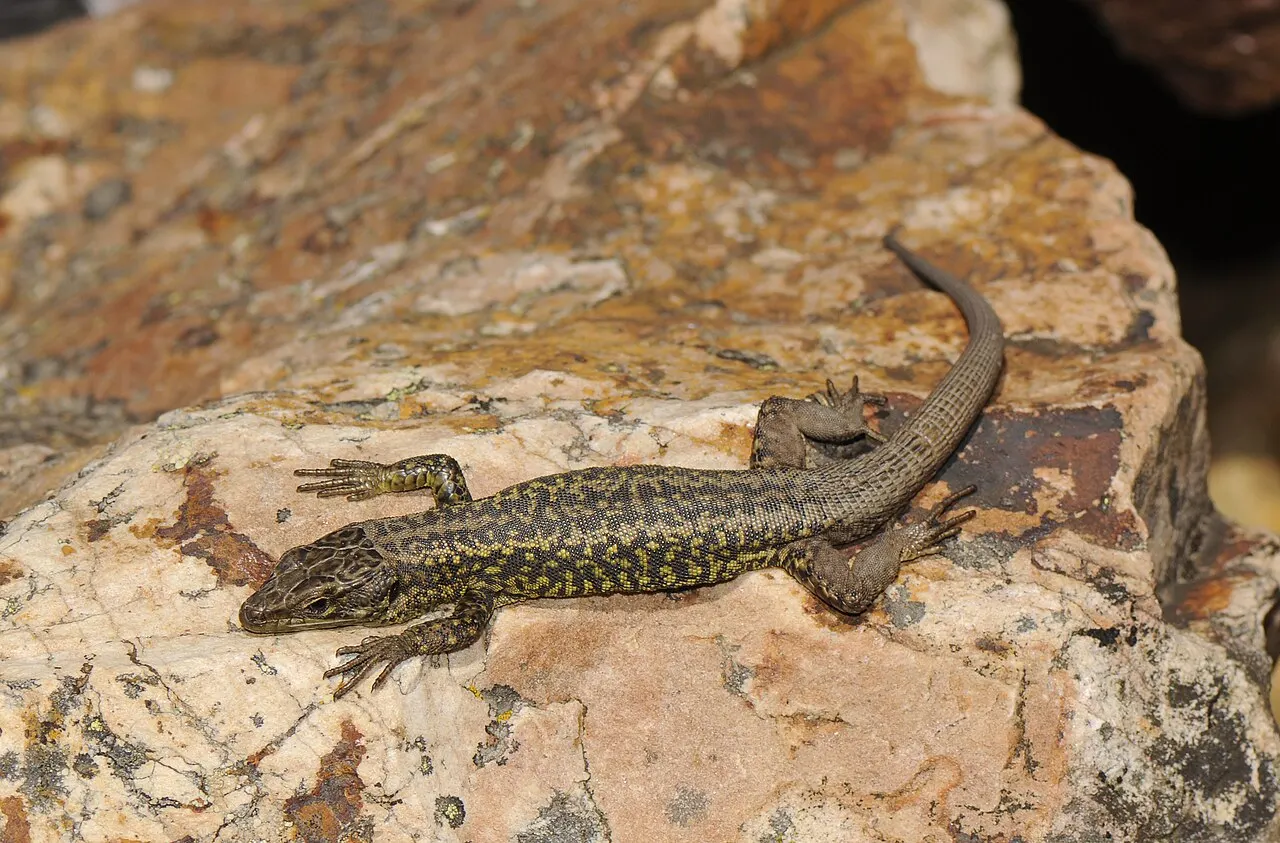
It is a medium-sized lizard with a dark, quite variable pattern. Older males can be green, grey or bluish, with netted sides, while females are usually duller, brown or grey with a row of small black dots. Most animals carry one to three bright blue spots (ocelli) at the shoulder, up to eight in adult males. Hatchlings are heavily netted, with a blue tail.
Females and young animals show tail bands that alternate between broad and narrow. It looks very like two other Iberian rock lizards, Iberolacerta monticola and I. galani, so location is the easiest way to tell them apart.
Where it lives
The lizard is endemic to the Sierra de Francia, inside the Las Batuecas-Sierra de Francia Natural Park. For years it was thought to live only on the summit of the Peña de Francia, between about 1,600 and 1,723 m. Later surveys found it on lower slopes too, down to at least 840 m, and the IUCN gives an elevation range of 800 to 1,723 m.
The IUCN lists four locations, an extent of occurrence of 248 square kilometres and an area of occupancy of 16 to 26 square kilometres. Earlier estimates of its range were smaller, 12 to 15 square kilometres in 2004 and about 20 in 2016. Its habitat is scree, slopes of loose boulders among oak woodland, grass and broom. A 2025 study in the Russian Journal of Herpetology found the lizards on larger, damper screes with bigger stones, lichens and mosses, mostly above 1,300 m. Other lizards share the slopes, including the Guadarrama wall lizard (Podarcis guadarramae) and the ocellated lizard (Timon lepidus).
Pins are Wikidata “endemic to” fields. Orange dots, when present, are GBIF occurrence tiles — survey bias included.
How it lives
It is secretive. Cold, cloudy weather keeps it in its hideouts, and on sunny days it can get too warm, so the active window is narrow. It reportedly lays eggs. Diet has not been well documented.
Because it hides so well, numbers are hard to pin down. The 2024 IUCN assessment gives a population of 1,200 to 1,500. The describer, Óscar Arribas, wrote in 1996 that he had seen fewer than a dozen animals and thought there were no more than about 50. The 2025 study surveyed 67 sites in 2018, found lizards at 30 of them, and calculated a mean density of about 41 per hectare. It extrapolated that to roughly 4,100 animals, a figure it calls almost certainly an overestimate.
Why it is in trouble
Climate is the biggest worry. The IUCN assessment treats habitat shifting and temperature extremes as affecting the whole range, and lists competitors and predators whose spread is helped by climate change.
Tourism, recreation, litter and roads affect smaller parts of its range. The population trend is listed as unknown, and the area it occupies is judged to be shrinking.
What is being done
The lizard occurs inside at least one protected area, though that does not shield it from warming or from visitor pressure. The assessment lists site management, habitat restoration, species recovery and captive breeding among relevant conservation actions.
Sources
Written for this catalog in our own words from the sources below, checked against them on 12 November 2026. Population figures are estimates and carry the year they were made. Status and assessment year: IUCN. 2026. The IUCN Red List of Threatened Species. Version 2026-1. iucnredlist.org.