Endangered
Boana ericae
Hypsiboas ericae
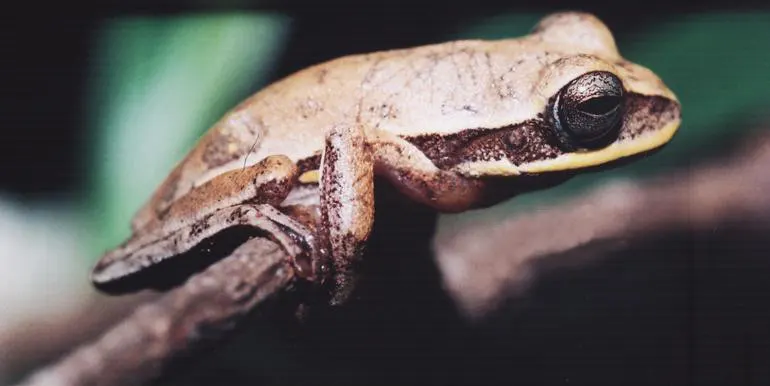
Boana ericae, also filed as Hypsiboas ericae, is a treefrog from the Chapada dos Veadeiros highlands of Goiás, central Brazil. It lives along forested streams at around 1,000 to 1,400 m. The IUCN Red List rated it Endangered in 2023, up from Data Deficient in 2004, and its habitat is shrinking.
Names and discovery
Ulisses Caramaschi and Carlos Alberto Gonçalves da Cruz described the frog in 2000 as Hyla ericae. Later reviews moved it to Hypsiboas and then to Boana, so older books and field lists may use either name. The species is named for Erica Maria Pellegrini Caramaschi, a Brazilian ichthyologist.
Where it lives
It was first found in Chapada dos Veadeiros National Park, in Goiás state, and is endemic to Brazil. The 2023 assessment gives an extent of occurrence of roughly 3,200 to 13,600 square kilometres and counts 3 to 5 locations.
It lives in gallery forest along streams, at about 1,200 m according to one account, and the Red List gives a band of 1,000 to 1,400 m. Habitats listed include permanent streams, dry savanna and dry subtropical shrubland. It breeds in the same stream habitat and is not a migrant.
Pins are Wikidata “endemic to” fields. Orange dots, when present, are GBIF occurrence tiles — survey bias included.
How it lives
Much of its biology is unrecorded, but its voice has been studied. A 2022 study of 10 frogs in Studies on Neotropical Fauna and Environment described three new note types (D, E and F) on top of three call types already known. Type A is linked to attracting mates and type C to territorial behaviour.
Air temperature and a frog's body condition both shifted the properties of advertisement and aggressive calls. Some advertisement call features varied more between frogs than within one, which could help tell individuals apart.
Why it is in trouble
The 2023 assessment records a decreasing population and a still-shrinking area of habitat. The threats it lists are mining and quarrying, more frequent or intense fires, and farming and grazing by both small holders and large agricultural operations. These bring habitat conversion and degradation, and some direct mortality.
What is being done
Protection is the main safeguard. The assessment reports that 91 to 100 percent of the population lies inside protected areas, and the type locality is within a national park. The only conservation action listed is site and area management. The Red List also calls for further work on its life history, population size and trends.
Sources
Written for this catalog in our own words from the sources below, checked against them on 12 November 2026. Population figures are estimates and carry the year they were made. Status and assessment year: IUCN. 2026. The IUCN Red List of Threatened Species. Version 2026-1. iucnredlist.org.




