Endangered
Boana buriti
Hypsiboas buriti
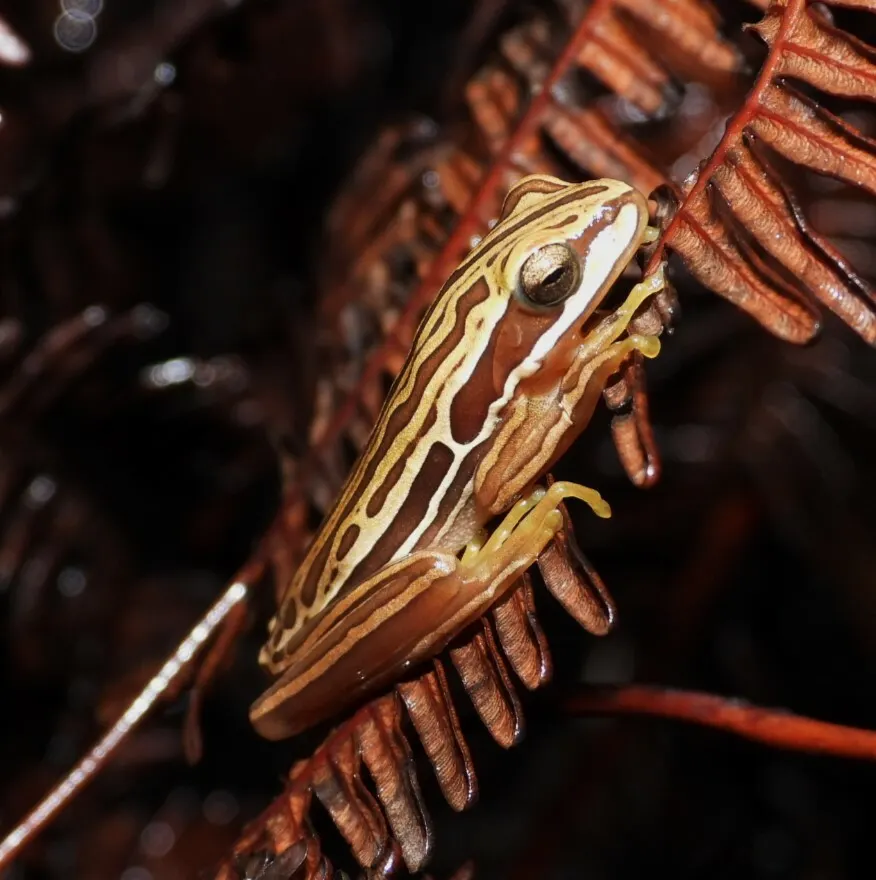
Boana buriti (formerly Hypsiboas buriti) is a small striped tree frog of the high Cerrado plateaus of central Brazil. It is known from only a handful of ponds in Minas Gerais, the Distrito Federal and Goiás. The IUCN Red List rated it Endangered in 2023 because its range is tiny and its habitat keeps shrinking.
How to recognise it
This is a slender frog with a cream back crossed lengthwise by sharply edged brown stripes. Its close relatives in the Boana polytaenia group share the pattern, and Brazilians call them pererecas-de-pijama, or pajama tree frogs. In a 2025 University of Brasília dissertation by Murielly Coimbra, frogs averaged about 28 mm from snout to vent in Brasília and about 25 mm at Cristalina, Goiás.
It is easy to mistake for Boana stenocephala, a closely related striped frog that is rated Least Concern. The two look alike, so researchers rely on their calls, which differ mainly in call rate and call duration.
Where it lives
The species was described in 1999 as Hyla buriti. Its type locality is a small reservoir in the vereda (a wetland type of the Cerrado) of the Bebedouro stream, in northwest Minas Gerais, at 940 m. The spot was long credited to the municipality of Buritis, but it lies in neighbouring Unaí.
Only a few other sites are known: a small permanent pond near Paracatu, Minas Gerais (930 m, frogs recorded from October to December 2001), the University of Brasília's Fazenda Água Limpa in the Distrito Federal, and a rocky upland near Cristalina, which was the first record for Goiás. The Coimbra team did not detect the frog at the Unaí and Paracatu sites during fieldwork in 2022 to 2024. GBIF holds just 37 records in all, 21 of them from the Distrito Federal.
The IUCN counts 1 to 3 locations, calls the population severely fragmented and gives an extent of occurrence of about 4,576 square km. Coimbra's 2025 recalculation put the extent at 12,160 square km but the area of actual occupancy at only 20 square km. The IUCN lists an elevation range of 500 to 900 m, while the dissertation describes the known areas as lying above 900 m.
Pins are Wikidata “endemic to” fields. Orange dots, when present, are GBIF occurrence tiles — survey bias included.
How it lives
It breeds in still water, either permanent or seasonal and fairly deep, in open Cerrado grassland, shrubby grassland and veredas. At the type locality, males were heard calling from grasses and herbs on the edge of a small reservoir. The Água Limpa pond is a dammed stream of about 15 square m, no more than 2 m deep, fringed with bracken and other weedy plants.
Males have a broad vocal repertoire: a three-note advertisement call, a five-note short aggressive call, a long aggressive call of 7 to 21 notes, and a trilled call of 12 to 13 notes. Fieldwork for the dissertation ran through the rainy seasons, from October to April.
Why it is in trouble
The high plateaus where it lives have been turned into farmland quickly, leaving the remaining habitat in fragments. The IUCN lists small-holder and industrial farming and grazing, herbicides and pesticides, and drought as ongoing threats, and records a continuing decline in habitat area and a decreasing population.
At the type locality, the small reservoirs on the Bebedouro vereda have been turned into large irrigation reservoirs that flooded the frog's habitat. The Paracatu pond has silted up and holds farm waste. Around Cristalina, Coimbra saw mining, cattle pasture and plans for solar power plants. Brazil's national list now rates the frog Vulnerable, up from Least Concern before the 2022 update.
What is being done
The frog occurs in at least one protected area, and the IUCN calls for site protection and management. Fazenda Água Limpa, a university research farm inside the Gama and Cabeça-de-Veado Environmental Protection Area, sets aside about 2,500 hectares for Cerrado conservation. Its pond is the best preserved of the known sites.
Coimbra's recalculated range figures would fit Vulnerable under one IUCN criterion and Endangered under another. The dissertation calls for new expeditions in Minas Gerais to learn whether the frogs persist there.
Sources
Written for this catalog in our own words from the sources below, checked against them on 12 November 2026. Population figures are estimates and carry the year they were made. Status and assessment year: IUCN. 2026. The IUCN Red List of Threatened Species. Version 2026-1. iucnredlist.org.
- IUCN Red List assessment, Boana buriti (2023)
- Coimbra, University of Brasília master's dissertation on the calls and distribution of Boana buriti (2025)
- Endemic amphibians of the Cerrado and Caatinga, Herpetological Journal 34 (2024)
- Boana buriti, encyclopedia entry
- GBIF occurrence records for Boana buriti
- GBIF species match, Boana buriti
- IUCN Red List API, Boana stenocephala (2023)




