Endangered
Veracruz White Hamlet
Hypoplectrus castroaguirrei
The Veracruz white hamlet (Hypoplectrus castroaguirrei) is a small, pale yellow reef fish known only from the Veracruz Reef System in the southwestern Gulf of Mexico. It was described in 2012 and rated Endangered in 2015 because it occupies about 22 km2 of reef close to a busy coast.
How to recognise it
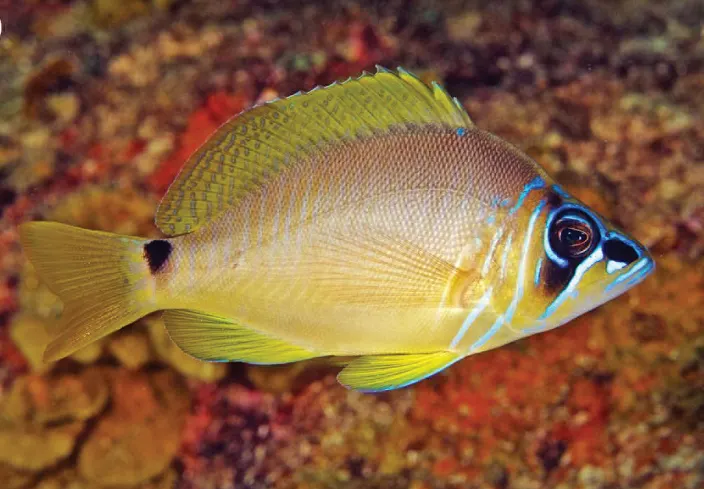
Hamlets are small sea basses, and in this group colour pattern is how species are told apart. This one has a pale yellow body with very faint brown bars, and a black vertical band that starts above the eye, passes through it like a tear and ends at the lower edge of the gill cover. A black triangular spot sits in front of the eye and a black patch crosses the base of the tail.
Iridescent blue lines mark the head around the eye. The anal, tail and pelvic fins are bright yellow, and the dorsal fin is pale yellow with slanting blue bands.
The original description gives a size of 9 to 12 cm. The two type specimens measured about 7.9 and 9.3 cm standard length, and FishBase lists 9.3 cm as the maximum.
Where it lives
It is known only from the Veracruz Reef System, a protected area off the Mexican coast in the Gulf of Campeche. The original paper found it on reefs in both the northern and southern groups, including Galleguilla, Pajaros, Verde, Chopas, Blanca and Cabezo, from 2 to 12 m deep on both windward and leeward slopes. The type specimens came from Isla Verde reef, at 3 m. FishBase gives a shallower range of 0 to 3 m.
The assessment estimates an extent of occurrence of 1,117 km2 and an area of occupancy of 22 km2, and counts a single location. Earlier diver reports of an unidentified 'Veracruz white' hamlet may refer to this fish.
Pins are Wikidata “endemic to” fields. Orange dots, when present, are GBIF occurrence tiles — survey bias included.
How it lives
Little has been published. The Red List describes it as a small predator that probably eats shrimps and fish, and says it is relatively common on the reef within its tiny range. Breeding has not been described, and the population trend is unknown.
A species described from two specimens
Divers filmed and photographed the fish on reefs between 2006 and 2011 before anyone collected one. Because the reefs are protected, only two specimens were taken, on Isla Verde reef with a single-point spear. The species is named for the Mexican ichthyologist Jose Luis Castro-Aguirre (1943 to 2011).
Hamlet species are defined mainly by colour, and they are known to interbreed freely with little genetic difference between them, so whether they are true biological species is debated.
Why it is in trouble
Everything depends on one small reef system beside a heavily used coast. The assessment records continuing decline in its area, and lists oil spills, nutrient pollution, sediment, pesticides, sewage, run-off and shipping lanes as ongoing threats, though their scale is unknown. It notes that coral cover off Veracruz fell by 17 percent between 1965 and 1999, and that the invasive lionfish may prey on the species. FishBase also names climate-related change and reef degradation.
The reef system has been a national park since 1992 and a UNESCO Biosphere Reserve since 2006, but the assessment says no effective management plan is in place, and that the Mexican government has sought to shrink the protected area to expand the port of Veracruz onto the reef.
Sources
Written for this catalog in our own words from the sources below, checked against them on 12 November 2026. Population figures are estimates and carry the year they were made. Status and assessment year: IUCN. 2026. The IUCN Red List of Threatened Species. Version 2026-1. iucnredlist.org.




