Endangered
Hosmer's frog
Cophixalus hosmeri
Hosmer's frog, also called the pipping nursery frog, is a tiny rainforest frog found only on the Carbine Tableland in the Wet Tropics of north Queensland, Australia. The IUCN Red List assessed it as Endangered in 2022. Its tapping call and its range of under 300 square kilometres make it distinctive.
How to recognise it
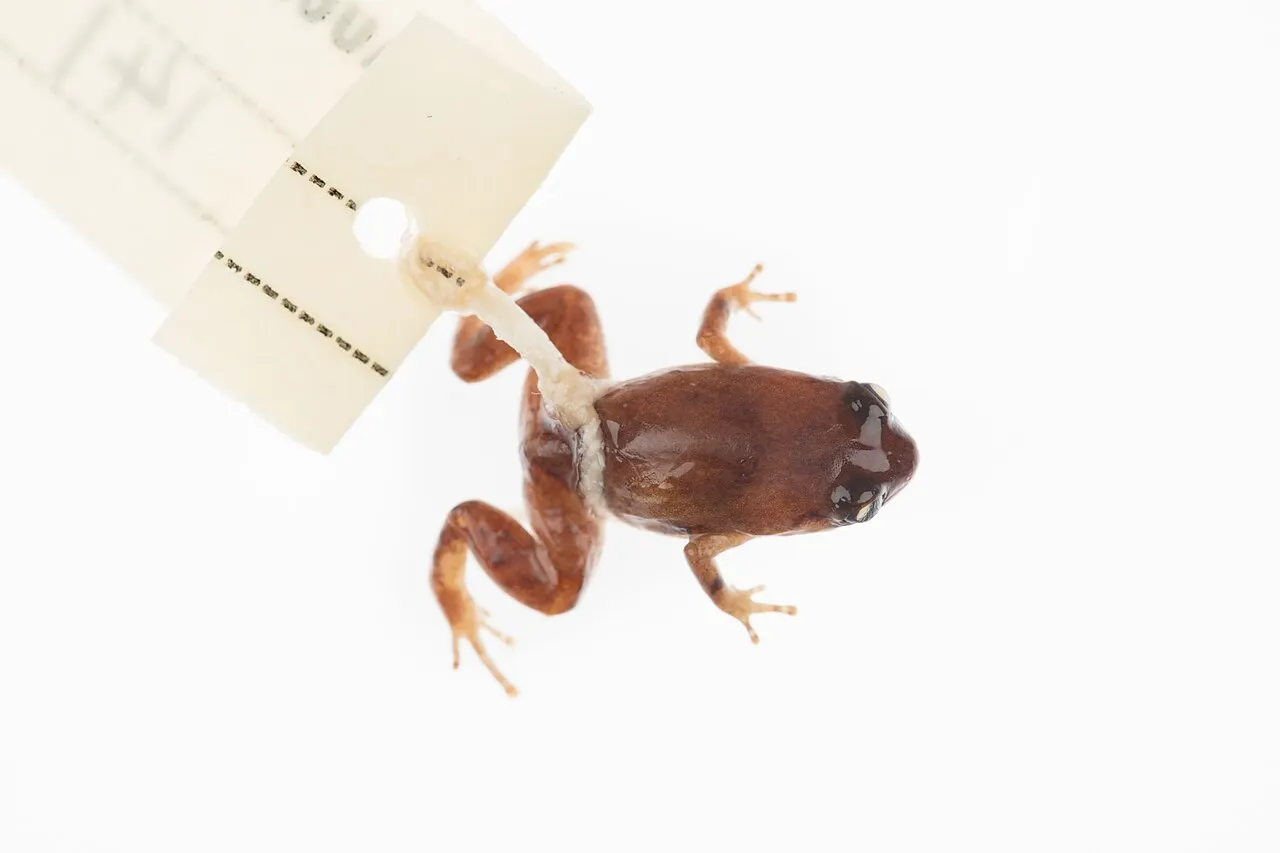
It's tiny. Males reach about 14 mm and females about 17 mm from snout to vent, and an adult averages roughly a quarter of a gram, making it the lightest Australian Cophixalus frog. The back is pale or dark brown, sometimes mottled, often with a V or W shaped dark mark, and the belly is yellow or grey-brown. The pupil is horizontal with a red ring around it.
Males call with a rapid, pulsed tap. The notes are much higher in pitch than the calls of other Australian Cophixalus frogs.
Where it lives
It occurs only in tropical rainforest on the Carbine Tableland, at about 800 to 1,318 m. The IUCN counts a single location, with an extent of occurrence of roughly 166 to 262 square kilometres and an area of occupancy of about 72 square kilometres.
Pins are Wikidata “endemic to” fields. Orange dots, when present, are GBIF occurrence tiles — survey bias included.
How it lives
Breeding runs from spring into summer after rain. The eggs are laid in a small cluster joined by a thin string of jelly, on the ground under leaf litter or in very moist soil, and more recent finds include the leaf axils of palms. The male guards them. There are no free-swimming tadpoles: the young develop inside the egg and hatch as tiny frogs. Calling peaks in October and November, and none is recorded from April to September.
Why it is in trouble
Its small, high-altitude range makes it vulnerable to warming. A 2006 study by Williams and Hilbert ranked it second among the 20 vertebrates of the Wet Tropics most at risk from climate change, and modelling projected that a rise of 1 degree Celsius could cut the core habitat of species in its genus, this one included, by more than half.
The IUCN assessment lists shifting habitat, temperature extremes and droughts as the main threats, and also names invasive species. Feral pigs, which trample rainforest ground, and yellow crazy ants are mentioned as possible risks. Its area of occupancy and extent of occurrence are both recorded as declining, though the overall population trend is stable.
What is being done
It occurs in at least one protected area and has been the subject of awareness programmes. The assessment lists site management, invasive species control, captive breeding and reintroduction among the actions, as recommended rather than already in place. Under Australia's Environment Protection and Biodiversity Conservation Act it is listed as Critically Endangered.
Sources
Written for this catalog in our own words from the sources below, checked against them on 12 November 2026. Population figures are estimates and carry the year they were made. Status and assessment year: IUCN. 2026. The IUCN Red List of Threatened Species. Version 2026-1. iucnredlist.org.




