Critically Endangered
Horned marsupial frog
Gastrotheca cornuta
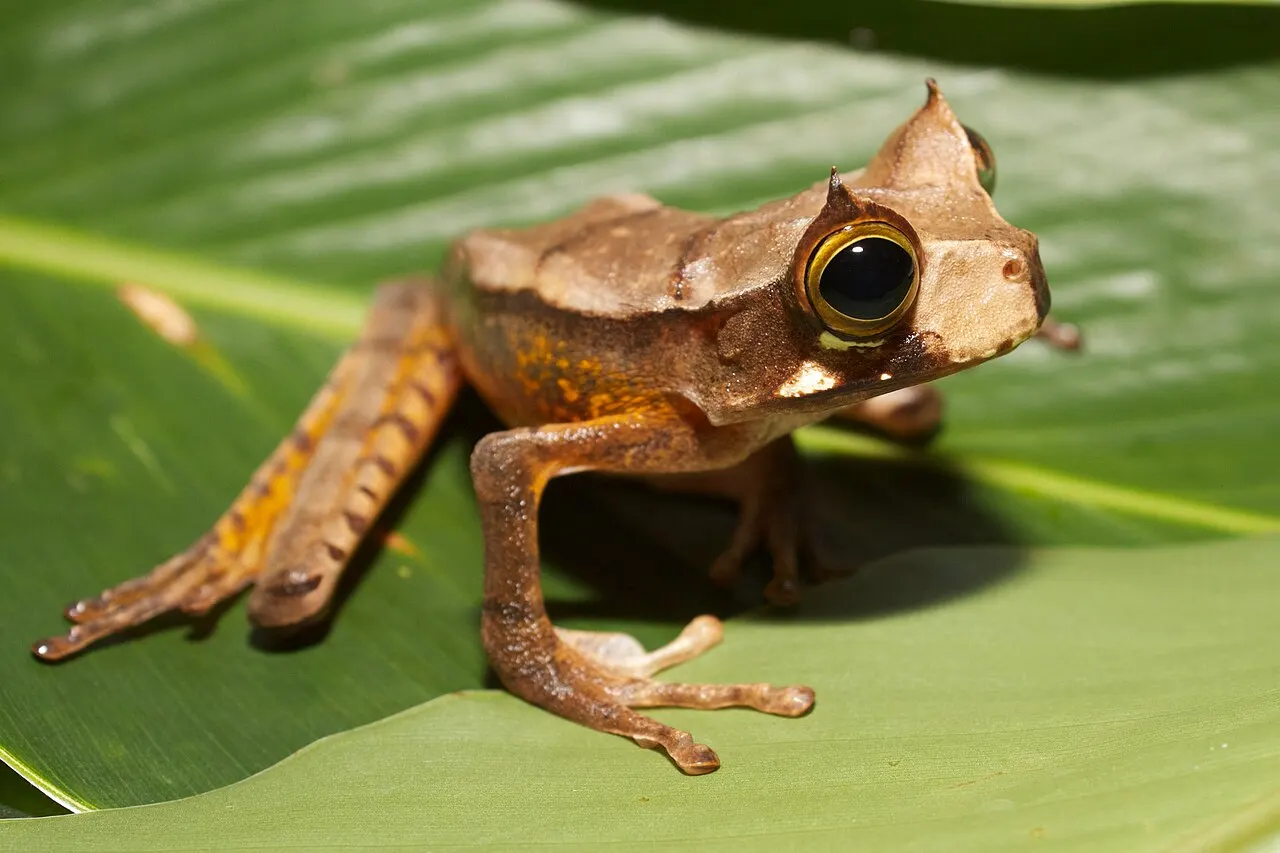
The horned marsupial frog (Gastrotheca cornuta) is a large tree frog with pointed, horn-like peaks above its eyes. Females brood their eggs in a back pouch. It lives in forest in Costa Rica, Panama, Colombia and Ecuador and was rated Critically Endangered by the IUCN in 2023.
How to recognise it
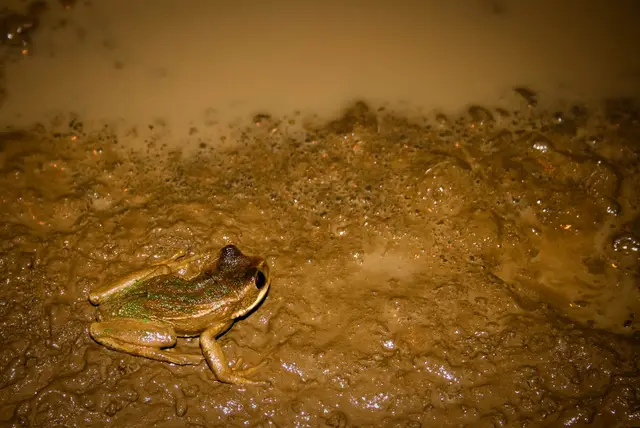
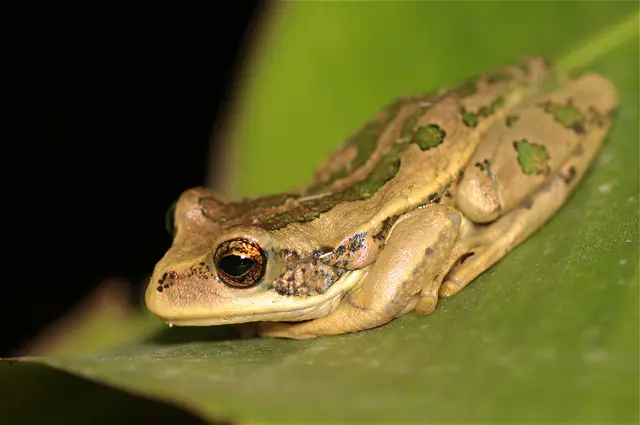
It is a big brown tree frog, up to 81 mm long according to the IUCN. The upper eyelids rise into the triangular points that give it its name, and the head is broad. The back is smooth with a few cross ridges and narrow dark stripes. Its colour reportedly shifts from pale brown at night to dark brown by day.
Females carry a pouch on the lower back. Fingers have rounded tip pads and the hind toes are partly webbed.
Where it lives
The frog is a highly arboreal canopy species of humid lowland and montane forest, primary and secondary, and it avoids open areas. The IUCN records it from sea level up to 1,932 m and also lists plantations and permanent streams among its habitats. It has been seen in oil palm plantations in Ecuador, and in Colombia it depends on permanent streams in humid areas with tall trees.
In Costa Rica it has been recorded at four localities between 300 and 700 m. On the Pacific side of Colombia, Ecuador and Panama it has reportedly been found between roughly 90 and 1,000 m.
Pins are Wikidata “endemic to” fields. Orange dots, when present, are GBIF occurrence tiles — survey bias included.
How it lives
Males call from high in the canopy. The call has been likened to a champagne cork being drawn. The IUCN says the frog breeds by direct development and has the largest known amphibian eggs. The female carries the fertilised eggs in her back pouch, and they hatch as fully formed frogs.
Each egg reportedly sits in its own chamber, and the embryos have umbrella-shaped gills pressed against the blood-rich pouch wall, where gas exchange takes place. There is no free-swimming tadpole. The IUCN gives a generation length of 5 years.
Why it is in trouble
The 2023 assessment records a decreasing trend. It suspects a decline of more than 80 percent over 15 years (three generations), driven by chytridiomycosis, a fungal skin disease the frog is highly susceptible to, and by loss and degradation of habitat. Listed threats include farming and ranching, housing, mining, drought, herbicides and pesticides, and the unintended effects of logging.
The IUCN says the frog has disappeared from 90 to 95 percent of its range in Costa Rica and Panama. A few remain: fewer than 50 adults are believed to survive in Costa Rica, mostly at Cerro Nimaro, and it persists in lowland forests of Panama such as Donoso. In Colombia it was never especially common, and in Ecuador it is now considered rare.
Rediscovery and rescue
In Ecuador there had been no record since 2005 until biologists from the group Tropical Herping found four frogs, one of them pregnant, in the Choco forest just outside the Cotacachi-Cayapas Ecological Reserve. National Geographic reported the find in December 2018. The IUCN says the four were collected in November 2018 to start a captive program at Centro Jambatu, and that Fundacion Jocotoco is working to protect and restore habitat.
The IUCN records the frog as breeding successfully at the Panama Amphibian Rescue and Conservation Project, as a captive colony against extinction, and as bred by the Balsa de los Sapos program in Ecuador. It also lists site protection and management as actions needed, and calls for a captive population in Costa Rica.
Sources
Written for this catalog in our own words from the sources below, checked against them on 12 November 2026. Population figures are estimates and carry the year they were made. Status and assessment year: IUCN. 2026. The IUCN Red List of Threatened Species. Version 2026-1. iucnredlist.org.