Endangered
Hong Kong Cascade Frog
Amolops hongkongensis
The Hong Kong cascade frog (Amolops hongkongensis) is a small frog of fast hill streams in Hong Kong and neighbouring Guangdong, in southern China. The IUCN Red List classed it as Endangered in 2021, mainly because its stream habitat is shrinking and broken into fragments.
How to recognise it
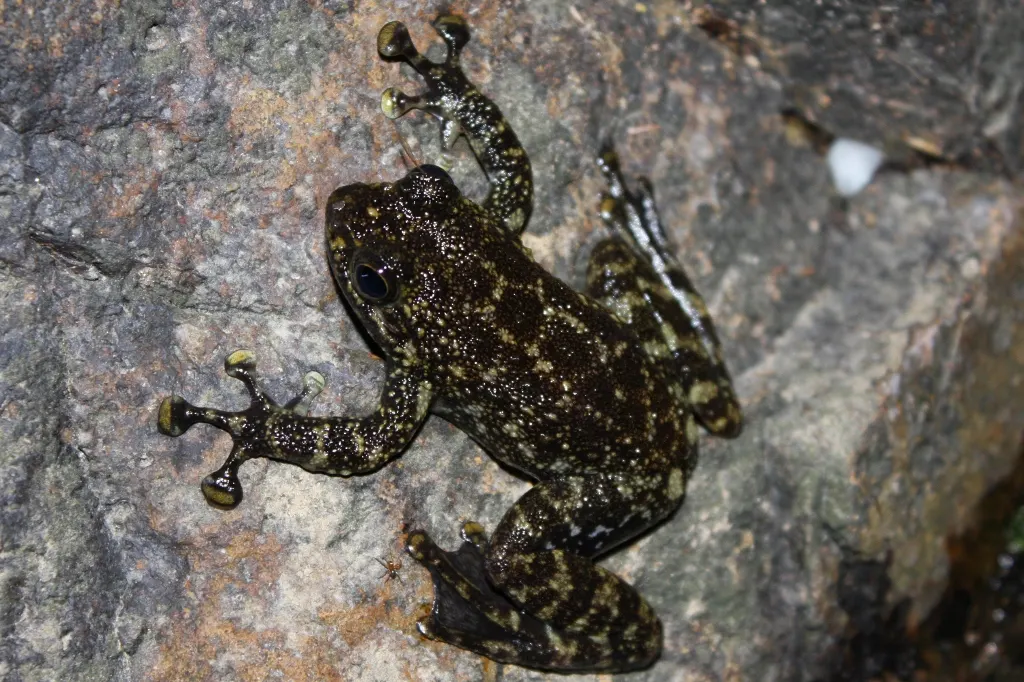
It has a grey-brown back marked with distinct black spots. Adults are small: a Hong Kong university profile gives 4 to 6.5 cm, while another reference puts both sexes at about 40 mm from snout to vent.
The tadpoles are dark-spotted and have a sucker on the underside, which lets them hold firmly to rock surfaces in the current. They grow to about 25 mm.
Where it lives
The species was first described in 1951 by Pope and Romer from Tai Mo Shan in Hong Kong. Populations are also known from Guangdong province. Within Hong Kong it is widespread in mountain streams but absent from Lantau Island.
It lives in lowland to hill forest along small, fast streams and waterfalls. The IUCN gives an elevation range of about 20 to 790 metres above sea level, and says it occurs in at least one protected area.
Pins are Wikidata “endemic to” fields. Orange dots, when present, are GBIF occurrence tiles — survey bias included.
How it lives
It feeds on ants and other insects. It sometimes turns up in the weep holes of catchwater channels, which suggests it will use man-made structures that carry running water.
Breeding runs from May to August. Females lay creamy white eggs in clutches of 12 to 60, and the eggs are placed on rock faces in the splash zone beside cascades, where the surface stays wet.
Why it is in trouble
The frog depends on fast, forested streams, so changes to those streams hurt it. The IUCN lists commercial and industrial development, dams, agro-industry plantations and renewable energy projects as threats, and records a continuing decline in the area it occupies, with the population split into fragments. Forestry and clear-cutting are reportedly pressures as well.
No population count is available, and the IUCN records the population trend as unknown.
What is being done
In Hong Kong the frog is a protected species under the Wild Animals Protection Ordinance (Cap 170). It occurs inside at least one protected area, and the IUCN lists site and area management as a conservation action needed.
Sources
Written for this catalog in our own words from the sources below, checked against them on 12 November 2026. Population figures are estimates and carry the year they were made. Status and assessment year: IUCN. 2026. The IUCN Red List of Threatened Species. Version 2026-1. iucnredlist.org.




