Critically Endangered
Karpathos Grayling
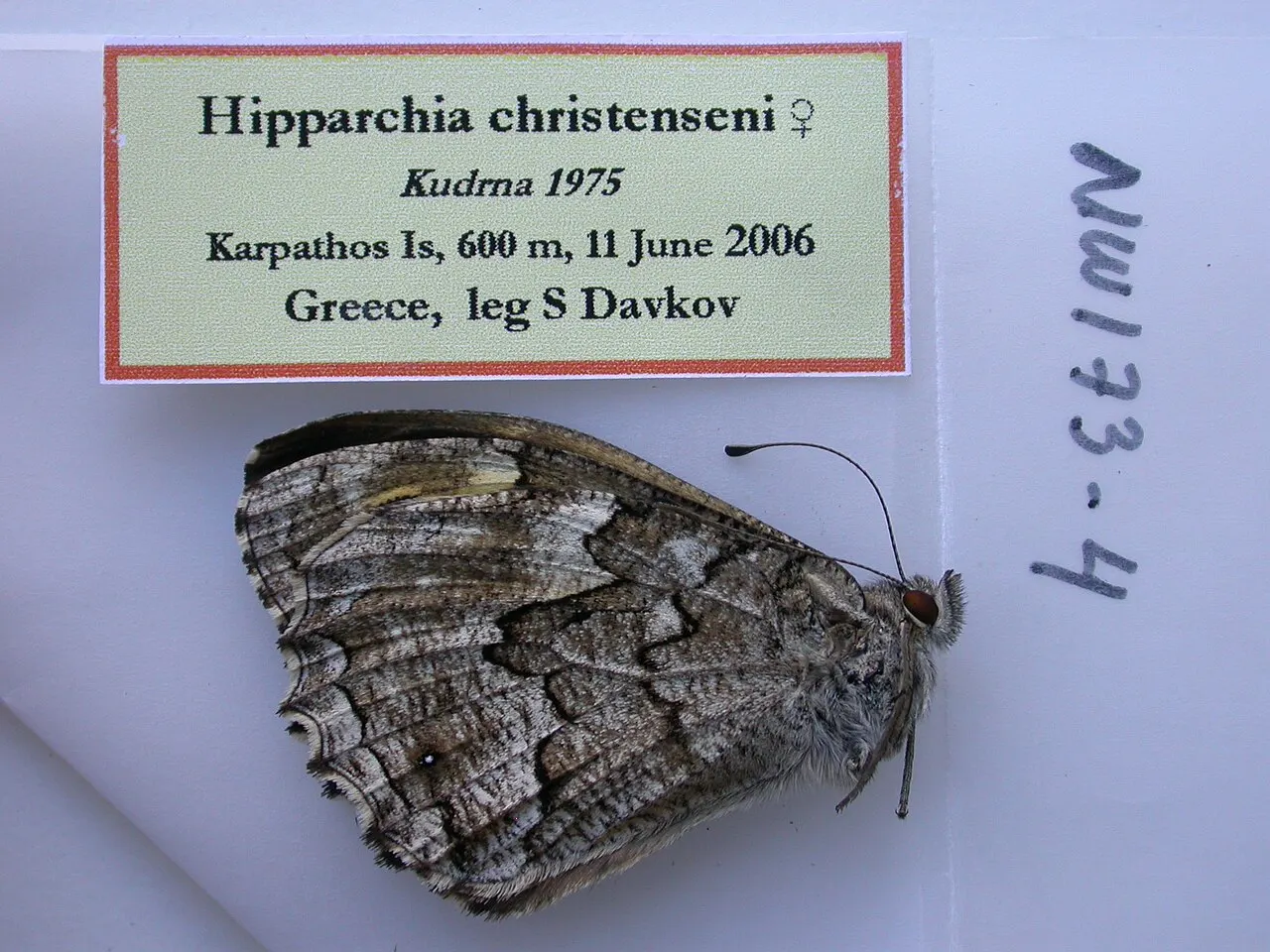
Hipparchia christenseni
The Karpathos grayling (Hipparchia christenseni) is a grayling butterfly found only on Karpathos, a Greek island in the eastern Aegean. The IUCN Red List rated it Critically Endangered in 2024. It occupies a tiny area of scrub and pine clearings, and wildfire and collecting are both listed as threats.
How to recognise it
It is a grayling butterfly in the genus Hipparchia, with a wingspan of about 45 to 54 mm. Adults often rest on tree trunks, particularly in woodland clearings. Similar graylings include Hipparchia semele, H. cretica and H. pellucida.
Kudrna described it in 1977. The type locality is Karpathos at 250 to 900 m.
Where it lives
It is found nowhere but Karpathos. It lives on rocky slopes with open Mediterranean scrub (phrygana and hard-leaved shrubland) and in clearings in coniferous woods, at roughly 50 to 900 m according to the Red List.
The Red List counts it as a single location. Its extent of occurrence is about 90 square kilometres and the area it actually occupies about 48. It occurs within the Natura 2000 protected area on Karpathos, and the assessment says its last remaining habitats should be protected and managed.
Pins are Wikidata “endemic to” fields. Orange dots, when present, are GBIF occurrence tiles — survey bias included.
How it lives
It has one generation a year, so there is no second brood to make up for a bad season. The Red List puts its generation length at one year. Its foodplants and early stages are not described in the sources used here.
Why it is in trouble
The Red List estimates a reduction of 50 to 74 percent, records a continuing decline in the area it occupies, and gives the population as not severely fragmented. Listed threats are a rise in fire frequency and intensity, and targeted collecting of the species as a specimen. The assessment lists the resulting problems as conversion and degradation of its habitat.
The 2025 European Red List of butterflies names it among Mediterranean island endemics put at further risk by more frequent extreme drought and wildfire. That assessment also found that 14.7 percent of European butterflies are now threatened, up from 8.5 percent previously.
What is being done
Listed actions include site and area protection, resource and habitat protection at national and sub-national level, site management, and awareness and communications. The Red List adds that rules against collecting and trading wildlife should be enforced and that a butterfly monitoring scheme should track its distribution and trend.
The species is not covered by international legislation or trade controls. Research needs flagged include population trends, habitat trends, population size, life history and threats.
Sources
Written for this catalog in our own words from the sources below, checked against them on 12 November 2026. Population figures are estimates and carry the year they were made. Status and assessment year: IUCN. 2026. The IUCN Red List of Threatened Species. Version 2026-1. iucnredlist.org.




