Endangered
Hewitson's Small Tree-nymph
Ideopsis hewitsonii
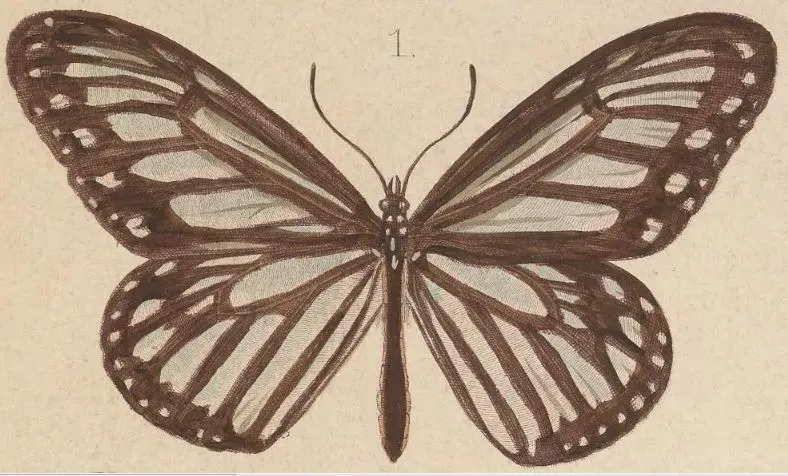
Hewitson's small tree-nymph (Ideopsis hewitsonii) is a white, translucent butterfly from a small group of islands in Cenderawasih Bay, off the north coast of New Guinea in Indonesia. The IUCN Red List has rated it Endangered since 1996, and little else about its life is recorded.
How to recognise it
This is a pale, almost clear butterfly with a distinctive pattern of broadly darkened veins on an otherwise white, see-through background. A 2009 taxonomic paper in Suara Serangga Papua called that pattern unique. Its antennae are short relative to the wings, the shortest among the closely related species the paper compared.
It belongs to Ideopsis, a genus of large, slender butterflies in the subfamily Danainae. Most are black and light blue or white, and they look like smaller versions of the wood nymphs (Idea).
Where it lives
Kirsch described the species in 1877. The 2009 paper says it is known only from the islands of Biak, Supiori and Mioswar in Cenderawasih Bay, in Indonesia's Papua region, and that Kirsch's original specimens apparently came from Mioswar rather than Biak, as an earlier catalogue had suggested.
Many sources describe the butterfly as endemic to New Guinea, but the evidence points to the offshore islands rather than the mainland. Museum specimens in the GBIF database come mostly from Biak, including several collected at Bosnik in 1929.
Pins are Wikidata “endemic to” fields. Orange dots, when present, are GBIF occurrence tiles — survey bias included.
How it lives
Very little has been published about its habits, caterpillar food plants or flight season. It is closely related to Ideopsis vitrea and Ideopsis klassika, in a group whose members have been split and lumped in different ways over the decades. In 1910 Fruhstorfer treated this butterfly as a subspecies of another island butterfly, Ideopsis inuncta, while current practice treats it as a species of its own.
It is still being seen. Three research-grade photo observations on iNaturalist from Papua, all made on 16 December 2025, record the butterfly alive.
Why it is in trouble
The Red List category rests on a small range. The assessment, made in 1996 under the old 2.3 version of the system, gave criteria B1+2c, which describe a restricted range together with decline or fluctuation in habitat or occurrence. It lists Indonesia as the only country and records no population trend. The butterfly had been rated Rare from 1986 to 1994.
The assessment lists no specific threats, and none turned up in other sources.
What is being done
No species-specific conservation action is recorded for this butterfly. The IUCN assessment is nearly three decades old and has not been updated, so its current status is poorly documented.
Sources
Written for this catalog in our own words from the sources below, checked against them on 12 November 2026. Population figures are estimates and carry the year they were made. Status and assessment year: IUCN. 2026. The IUCN Red List of Threatened Species. Version 2026-1. iucnredlist.org.




