Endangered
Herichthys steindachneri
Herichthys steindachneri
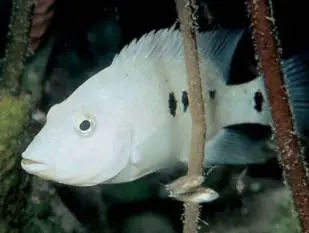
Steindachner's cichlid (Herichthys steindachneri) is a large freshwater fish found only in a few rivers of the Pánuco basin in eastern Mexico. The IUCN Red List assessed it as Endangered in 2019. Its whole known range covers about 99 square kilometres, and pollution and tourism pressure its pools.
How to recognise it
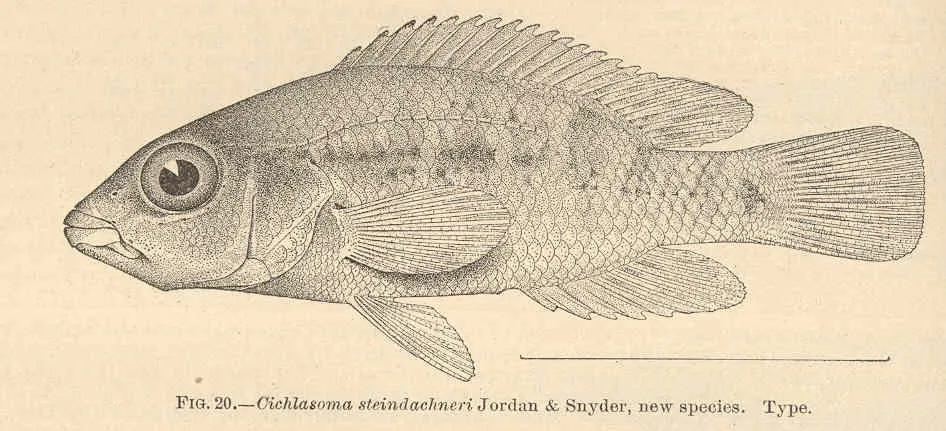
It is a big cichlid, reaching about 40 centimetres in standard length. The lower jaw sticks out past the upper one, and each jaw carries a single row of teeth. Together these features set it apart from other species in its genus, according to the 2013 redescription.
For years it was mistaken for another Mexican cichlid, Herichthys labridens. A 2013 paper in Zootaxa by Mauricio de la Maza-Benignos and Ma. de Lourdes Lozano-Vilano redescribed Steindachner's cichlid along with H. labridens and H. pantostictus, and described three new species, including Herichthys pame from the Río Tamasopo. The older descriptions from 1900 and 1904 that name several localities turned out to blend specimens of Steindachner's cichlid with H. pame.
Where it lives
The species is endemic to Mexico. It is recorded from the Tamasopo, Gallinas and Ojo Frío rivers in the Pánuco River basin, in the state of San Luis Potosí.
The Red List counts just two locations and puts the area it actually occupies at 28 square kilometres, inside an overall range of about 99 square kilometres. It lives low down, at 300 to 375 metres above sea level, in permanent rivers and streams and in small freshwater pools and marshes, at depths from the surface to about 2 metres. It prefers pools in fast water with plants along the edges, often below small cascades. The 2013 redescription calls it a very rare species.
Pins are Wikidata “endemic to” fields. Orange dots, when present, are GBIF occurrence tiles — survey bias included.
How it lives
It is a predator that feeds mostly on fish, and the Mexican tetra (Astyanax mexicanus) is its main recorded prey. Snails are eaten too. Males and females are separate, eggs are fertilised outside the body, and the female does most of the work of guarding eggs and young.
The Red List does not record a population size, and the trend is listed as unknown.
Why it is in trouble
With so small a range, anything that fouls the water reaches the whole population. The 2019 assessment lists sewage, nutrient loads and herbicides and pesticides as ongoing threats across more than 90 percent of the range, with pesticides rated the most damaging of them. Recreation and tourism development along the rivers add disturbance. The area it occupies is still shrinking.
The species also turns up in the aquarium trade, though it is described as hard to keep in tanks. The assessment does not name collecting as a threat.
What is being done
Very little is in place so far. The assessment records no recovery plan, no monitoring scheme, no protected area covering the species and no captive breeding programme. It calls for protecting and managing the sites where it lives and restoring habitat.
Sources
Written for this catalog in our own words from the sources below, checked against them on 12 November 2026. Population figures are estimates and carry the year they were made. Status and assessment year: IUCN. 2026. The IUCN Red List of Threatened Species. Version 2026-1. iucnredlist.org.