Endangered
Scaly gecko
Hemidactylus scabriceps
The scaly gecko (Hemidactylus scabriceps) is a small, ground-living, night-active gecko of South India and northern Sri Lanka. The IUCN Red List classed it as Endangered in 2021 because its dry, sandy habitat is shrinking and fragmented. It stayed poorly known for a long time after its 1906 description.
How to recognise it
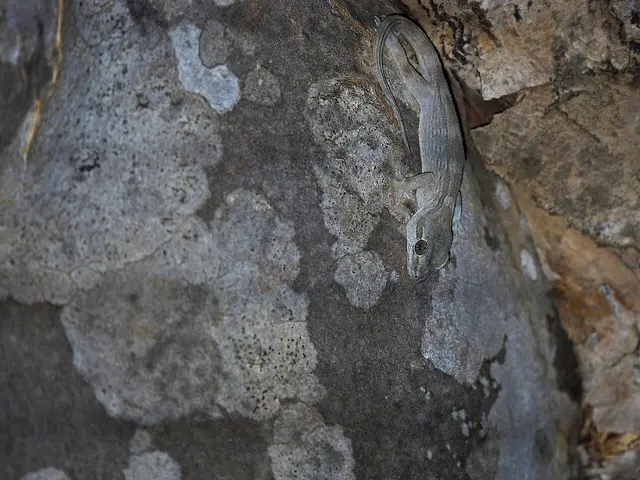
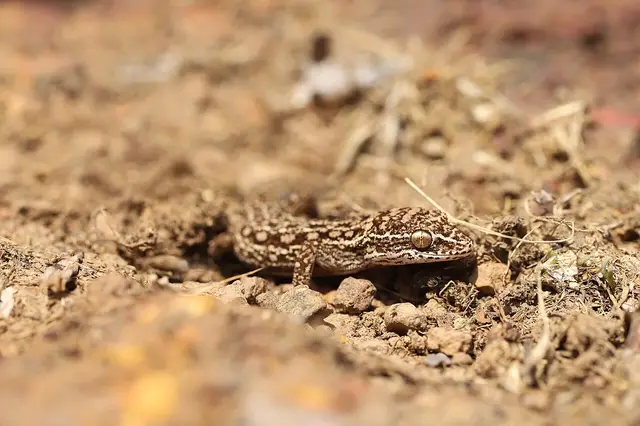
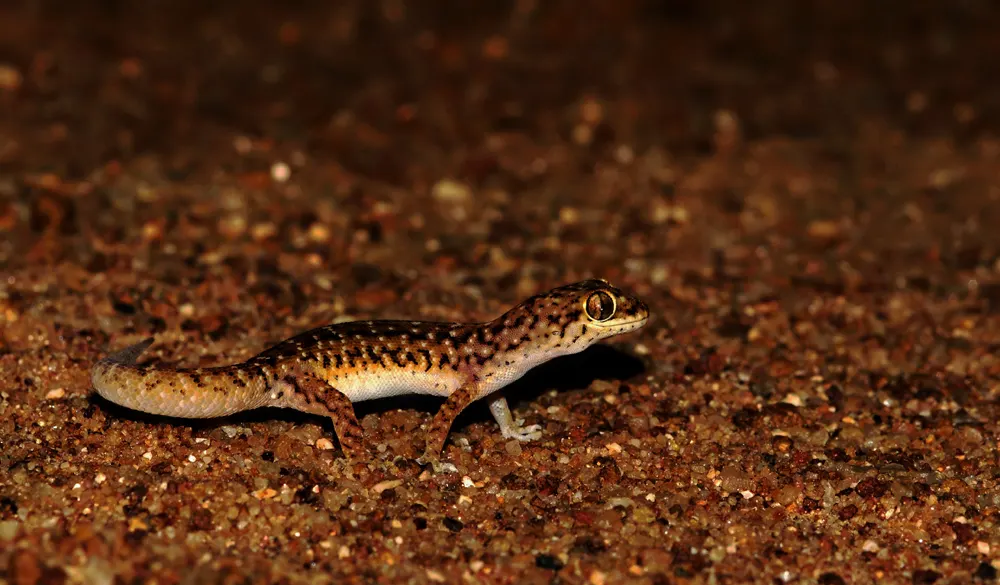
It is a short, stout gecko with a blunt, rounded snout and short limbs. The scales on its back are small, leaf-shaped and nearly smooth. The back is brownish, shading from yellow to red, with two parallel lines and pale crossbands, and the belly is creamy white.
A hatchling measured about 38 mm in total length in a 2018 field record, and a gravid adult female had a head-and-body length of 44 mm.
Where it lives
Records come from Tamil Nadu in India and from northern Sri Lanka. The species was described from sand dunes at Ramanathapuram, and a 2018 nest record came from Thoothukudi district. The Red List gives an elevation range from sea level to 385 m.
Its habitats are coastal sand dunes and dry tropical forest, and it is described from dry, semi-arid open ground. The Red List calls the population severely fragmented.
Pins are Wikidata “endemic to” fields. Orange dots, when present, are GBIF occurrence tiles — survey bias included.
How it lives
Scaly geckos are active at night on open ground and reportedly shelter under rocks by day. They also appear to be territorial, and two males have been seen making chirping calls while squaring up to each other.
Nesting is unusual among geckos. In April 2018 researchers in Thoothukudi district watched a female scrape a hole about 1 cm deep, lay two white eggs and cover them with soil. The eggs hatched after about 48 days. The same team recorded a viper that regurgitated a gravid scaly gecko, the first known sign of predation on the species.
Where it fits among geckos
Nelson Annandale described the species in 1906 from Ramanathapuram. It was later misidentified and placed in other genera, and a 2010 report from eastern Tamil Nadu recorded it again. A 2018 genetic study in the Journal of Threatened Taxa placed it inside a group of large rock-dwelling Hemidactylus geckos, even though it lives on the ground, and found high genetic divergence within the species, a possible sign of hidden species.
Why it is in trouble
The 2021 assessment (criteria B2ab(iii,iv)) records a continuing decline in the area of habitat. Listed threats include housing and urban growth, mining and quarrying, renewable energy sites, tourism developments, agro-industrial farming and more frequent fires. The trend is recorded as unknown, no population size is given, and the assessment records no recovery plan or systematic monitoring scheme.
Sources
Written for this catalog in our own words from the sources below, checked against them on 12 November 2026. Population figures are estimates and carry the year they were made. Status and assessment year: IUCN. 2026. The IUCN Red List of Threatened Species. Version 2026-1. iucnredlist.org.