Endangered
Oranssitimanttiahven
Hemichromis cerasogaster
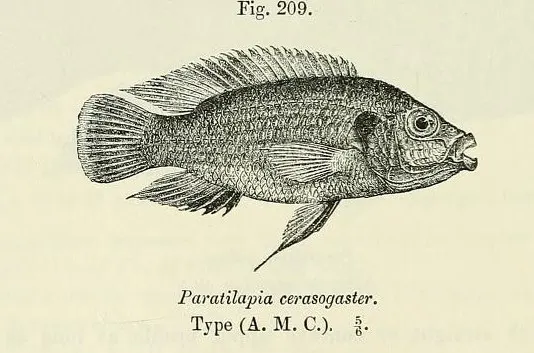
Hemichromis cerasogaster is a small red jewel cichlid from Lake Mai-Ndombe, a freshwater lake in the Democratic Republic of the Congo. The IUCN Red List assessed it as Endangered in 2010 because its range is so small. It is rarely imported, and photos labelled with its name have been questioned.
How to recognise it
This is a small fish, reaching about 10 cm. It belongs to the red jewel cichlids, but its body has a lilac base colour, with a golden mask across the face and a black spot on the dorsal fin. Both sexes show these markings. Aquarium dealers describe it as fairly peaceful for a jewel cichlid.
Identification has long been a problem. In a 2002 forum thread among cichlid keepers, one hobbyist argued that nearly every photo labelled cerasogaster actually showed the Congo form of a related species, Hemichromis stellifer. The same post says a specialist had compared an imported fish with a type specimen and believed they were the same species, though he had not made that firm.
A name that has moved around
Boulenger described the fish in the late 1890s as Paratilapia cerasogaster (sources give both 1898 and 1899). It was placed in Hemichromis in 1979. A 2022 revision of the genus by Lamboj and Koblmuller described a new genus, Rubricatochromis, and a Nordic cichlid society register now lists the species there, while the IUCN assessment still uses Hemichromis.
Where it lives
The species is known only from Lake Mai-Ndombe, once called Lake Leopold II, and surrounding areas in the Democratic Republic of the Congo. One source gives the type localities as Utanda and Kutu. The IUCN lists the habitat as permanent freshwater lakes of more than 8 hectares.
Fish sold to hobbyists as "Inongo" reportedly come from the lake's east shore, which a forum post gives as the home of the type specimen. Little else has been written about its diet or breeding in the wild.
Pins are Wikidata “endemic to” fields. Orange dots, when present, are GBIF occurrence tiles — survey bias included.
Why it is in trouble
The 2010 assessment uses criterion B1ab(v), which applies to species with a small range and a continuing decline in the number of mature individuals. The overall population trend is recorded as unknown, and the population is not considered severely fragmented.
The threats listed are mining and quarrying, which the IUCN rates as having negligible impact, and an unrecorded cause that it rates as low impact. The stresses named are conversion and degradation of its lake ecosystem. The fish is also eaten by people. No conservation actions are recorded for it.
In aquariums
Imports from the lake are uncommon, so the fish turns up in shops only now and then. One German supplier sells German-bred fish to wholesalers only. A Swedish cichlid society register rates it as an easy species, kept at 22 to 26 degrees C and pH 4.5 to 6.5 in a tank of at least 120 litres.
Sources
Written for this catalog in our own words from the sources below, checked against them on 12 November 2026. Population figures are estimates and carry the year they were made. Status and assessment year: IUCN. 2026. The IUCN Red List of Threatened Species. Version 2026-1. iucnredlist.org.




