Critically Endangered
Lac Alaotra bamboo lemur
Hapalemur alaotrensis
The Lac Alaotra bamboo lemur (Hapalemur alaotrensis), locally called the bandro, lives only in the reed marshes around Lac Alaotra in northeastern Madagascar. The IUCN Red List rated it Critically Endangered in 2020. It is the only primate known to live wholly in marsh vegetation, and its marsh keeps shrinking.
How to recognise it
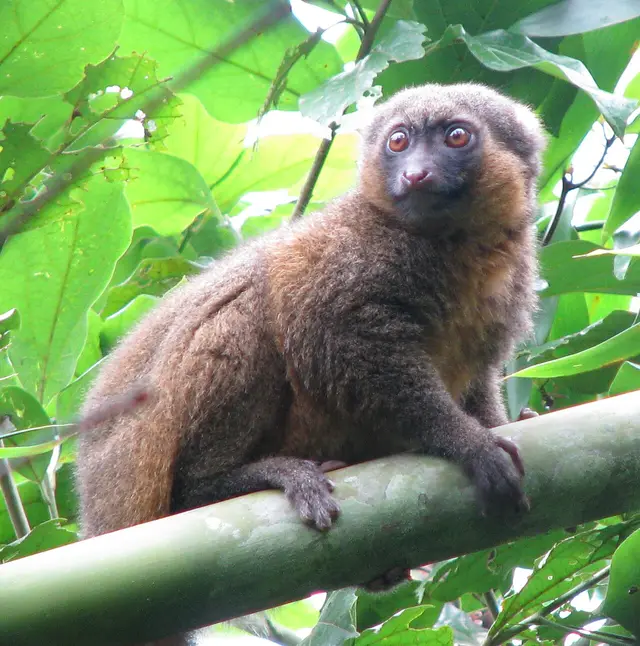
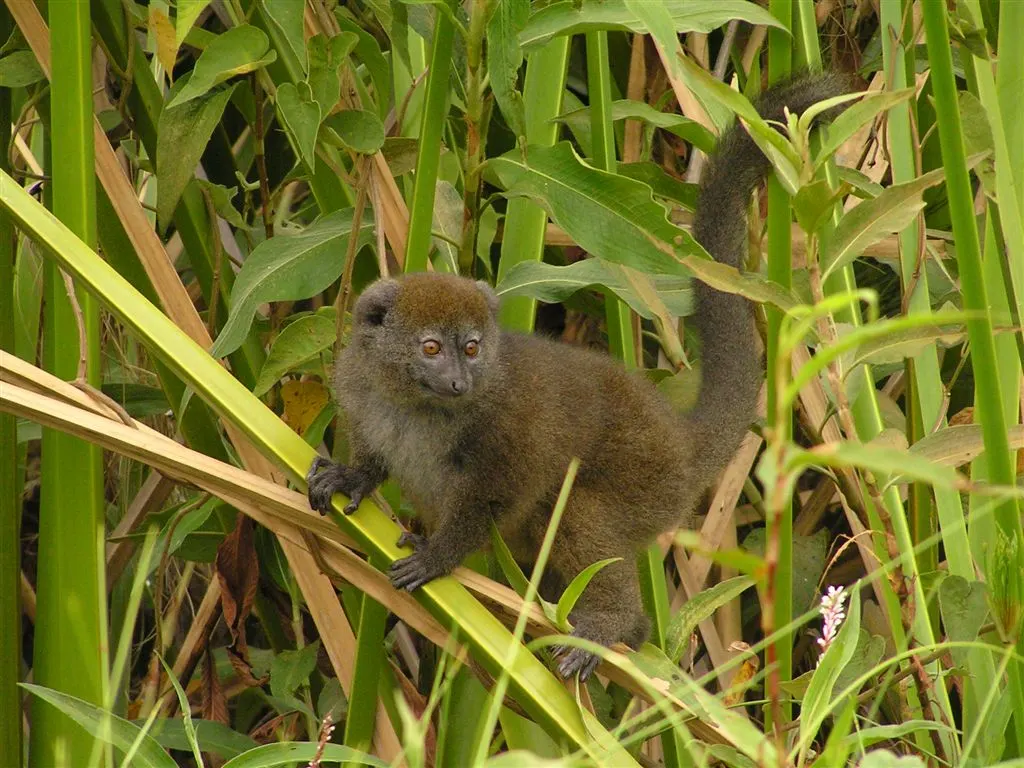
It is a compact, woolly lemur with a body about 40 cm long and a tail of similar length. It weighs roughly 1.1 to 1.5 kg. The back is grey-brown, the face and chest are paler grey, and the head and neck have a chestnut tone. It was described by Rumpler in 1975.
Authorities disagree on its rank. Some treat it as a subspecies of the eastern lesser bamboo lemur (Hapalemur griseus), and the Red List treats it as a full species.
How it lives
Despite the name, there is no bamboo at Alaotra. The lemur feeds on the leaves and shoots of reed and papyrus, mainly Cyperus madagascariensis, Phragmites communis and a grass called Echinochloa crus-galli. It moves by leaping and walking along bent stems, and it usually avoids open water, though it can swim.
Groups are small, usually two to nine animals, with an average of 3.3 to 4.3 in different studies. Each group defends a territory, with home ranges of 0.6 to 8 hectares and a mean near 2 hectares. Activity peaks at dawn and dusk. Births are reported in January and February, with a single baby carried on the mother's back.
Pins are Wikidata “endemic to” fields. Orange dots, when present, are GBIF occurrence tiles — survey bias included.
Where it lives
Lac Alaotra, Madagascar's largest lake, has about 20,000 hectares of open water. The lemur lives in the marshes around it in two subpopulations: a very small one in the north near the Belempona Peninsula and a larger one in the southwest. The Red List gives a single location, an extent of occurrence of about 519 square km, and elevations up to 750 m.
Why it is in trouble
The marsh once covered an estimated 60,000 to 80,000 hectares. Less than half remains, lost to rice paddies and damaged by uncontrolled burning, silt washing off the hills and invasive plants. A 2008 survey found no lemurs in areas burnt within the past year, and fragmented marsh was poor habitat.
Hunting adds to the pressure. The Red List records use as food and as a pet or display animal. In 1999 a team repeated a 1994 census of the marsh and found group encounter rates at least 50 percent lower at most sites. Allowing for unusually low water that year, they estimated a 30 percent fall in the total population over five years, and blamed fire and poaching. The 2020 assessment records a past decline of about 80 percent and an ongoing decline of 66 to 79 percent.
What is being done
Durrell Wildlife Conservation Trust has worked on the species since 1990, running surveys and conservation work. A protected area covering the Alaotra marshes was declared in 2007, though a 2010 paper noted that no formal management authority yet existed to enforce its rules. The wider watershed became a Ramsar wetland in 2003.
Community protection seems to help. At Andreba, where villagers created a community park, the 2008 survey found the highest occupancy and the largest groups. Poaching has not stopped, but awareness campaigns are believed to have lessened it.
Sources
Written for this catalog in our own words from the sources below, checked against them on 12 November 2026. Population figures are estimates and carry the year they were made. Status and assessment year: IUCN. 2026. The IUCN Red List of Threatened Species. Version 2026-1. iucnredlist.org.
- IUCN Red List assessment, Hapalemur alaotrensis (2020)
- Guillera-Arroita et al. 2010, Madagascar Conservation and Development 5(2)
- Mutschler et al. 2001, Oryx, population status of the Alaotran gentle lemur (abstract via Crossref)
- Alaotran gentle lemur species account, Naturalis lemur database
- Lac Alaotra bamboo lemur, encyclopedia entry