Endangered
Hainanpotamon orientale
Hainanpotamon orientale
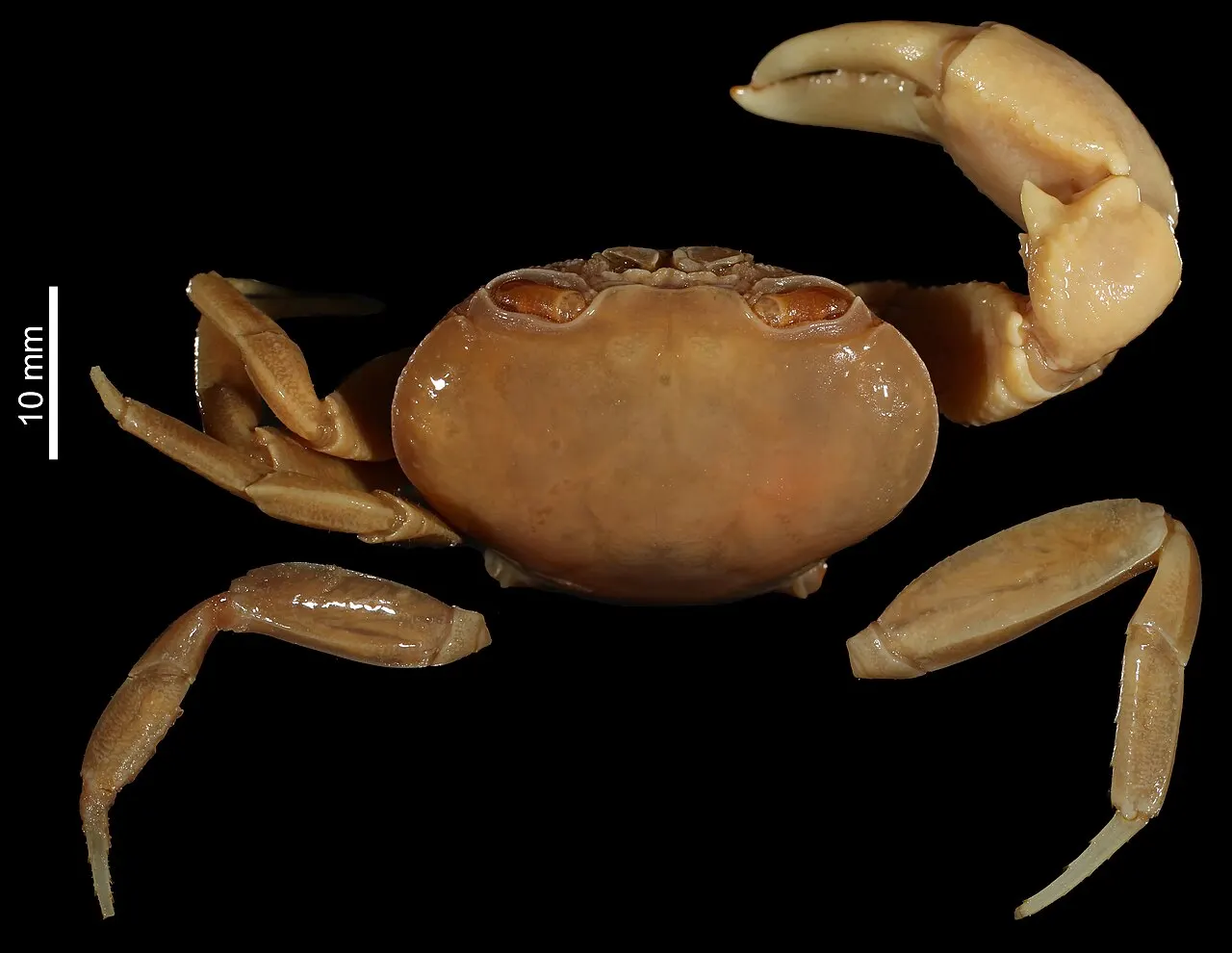
Hainanpotamon orientale is a freshwater crab known from the mountain streams of Hainan Island in southern China, and is the type species of its genus. The IUCN Red List rated it Endangered in 2008. Almost nothing has been published on its biology, and its identity was muddled until a 2007 revision.
How to recognise it
It's a river crab of the family Potamidae, with a smooth, high, inflated carapace that is broader than it is long. The front part of the side edge of the shell is gently serrated. The designated type specimen, a male, measured about 37 mm across the carapace, and a larger male from the original series was about 44 mm.
Telling Hainanpotamon species apart by eye is hard. Specialists rely mainly on the shape of the male's first gonopod (a modified limb used in mating), which in this species is slender and gently sinuous, with a rounded raised lobe on its dorsal fold. That is how the 2007 revision separated it from two close relatives on the island, H. helense and H. fuchengense.
Where it lives
The species was described by Parisi in 1916 from crabs collected on Mount Wuchi (now usually written Wuzhishan) on Hainan in April 1904. A 2007 revision in Zoological Science by Darren Yeo and Tohru Naruse redescribed the crab from those original specimens and gives its distribution as Mount Wuzhi. The mountain rises to 1,867 m and has three major drainages, which Yeo and Naruse suggest could isolate crab populations and help produce sibling species.
The IUCN's 2008 assessment lists it as occurring in China, on Hainan, in permanent rivers and streams, at four locations. Only five records exist in the global biodiversity database GBIF: three old specimen records, one sample record and one research-grade citizen-science observation from 2023.
Pins are Wikidata “endemic to” fields. Orange dots, when present, are GBIF occurrence tiles — survey bias included.
A case of mistaken identity
When the genus Hainanpotamon was set up in 1995, its author, Dai, did not examine Parisi's original specimens and used newly collected Hainan crabs to stand in for the type species. Yeo and Naruse compared the two in 2007 and concluded that the 1995 description portrayed a different, unnamed species, which they named Hainanpotamon daiae. Older papers and reports on H. orientale may therefore describe the wrong animal.
Why it is in trouble
The IUCN rated it Endangered in 2008 under criteria B1ab(i,ii,iii,iv,v) and 2ab(i,ii,iii,iv,v). In plain terms that means a small range limited to few locations, with decline or loss recorded or projected in range, habitat and numbers. No population size was recorded and the trend is listed as unknown, though the assessment did not treat the population as severely fragmented.
The one threat the assessment names is large-scale unintentional harvest. It also records that the crab occurs in at least one protected area.
What is being done
A 2021 survey of Hainan's freshwater crabs in Biodiversity Science found the island's diversity centred on the south-central mountains, including Wuzhi. It reported that the Hainan Tropical Rainforest National Park covers the potential ranges of these crabs better than the older, scattered nature reserves did. For H. orientale it counted about 21 percent of its occurrence pixels inside nature reserves and about 43 percent inside the national park.
That survey lists the crab as Vulnerable, a different category from the IUCN's 2008 Endangered assessment.
Sources
Written for this catalog in our own words from the sources below, checked against them on 12 November 2026. Population figures are estimates and carry the year they were made. Status and assessment year: IUCN. 2026. The IUCN Red List of Threatened Species. Version 2026-1. iucnredlist.org.
- IUCN Red List assessment, Hainanpotamon orientale (2008)
- Yeo and Naruse 2007, A Revision of the Freshwater Crab Genus Hainanpotamon, Zoological Science 24:1143-1158
- Hao et al. 2021, distribution pattern and conservation of freshwater crabs in Hainan Island, Biodiversity Science 29(5)
- GBIF, Hainanpotamon orientale (Parisi, 1916)




