Endangered
Hainan Peacock Pheasant
Polyplectron katsumatae
The Hainan peacock-pheasant (Polyplectron katsumatae) is a secretive forest pheasant found only on Hainan Island, China. It was long treated as a subspecies of the grey peacock-pheasant. The IUCN lists it as Endangered, and its 2022 assessment puts the population at 800 to 2,000 mature birds, still decreasing.
How to recognise it
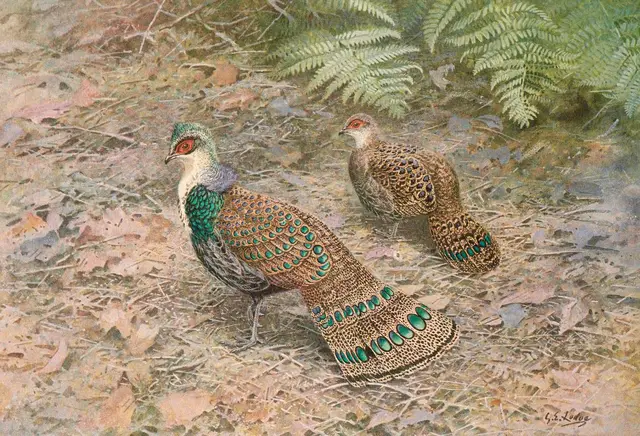
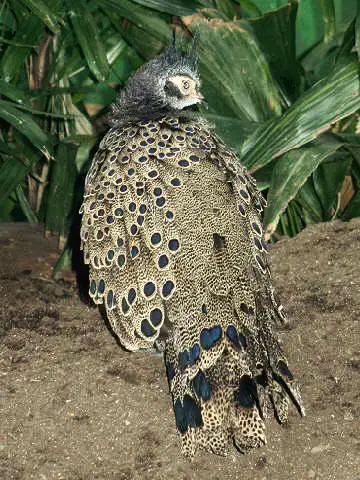
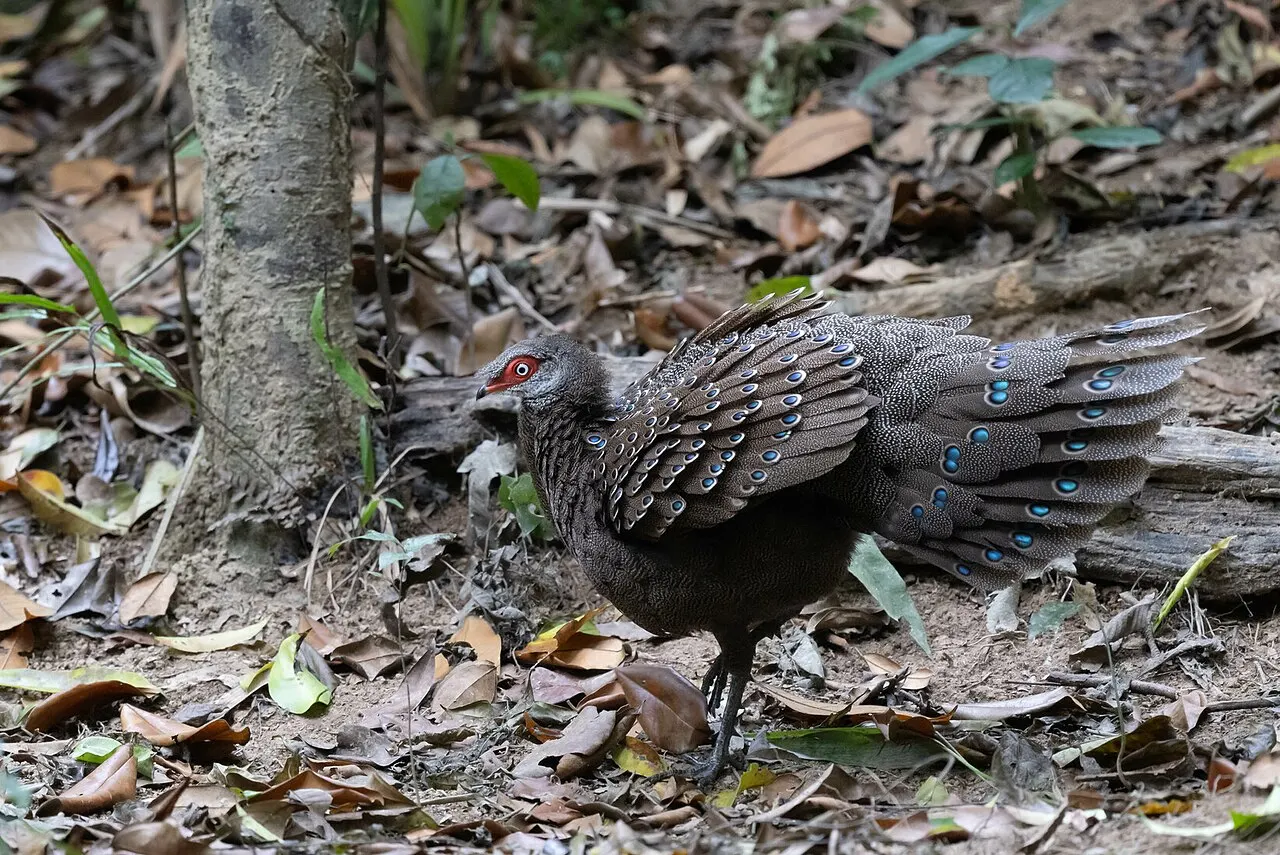
It is a grey-brown pheasant, about 53 cm long, with fine wavy barring and a short, forward-pointing crest. The upperparts carry rows of large eye-spots (ocelli), each green or blue with a pale or white surround.
The grey peacock-pheasant of the mainland is larger, with a longer crest. For years the Hainan bird was treated as a subspecies of it. A 2008 molecular study led by Chang supports full species status, and the two lineages are estimated to have split about 1.4 million years ago. BirdLife International also recognises the Hainan bird as its own species.
Where it lives
It occurs nowhere but Hainan. The IUCN records it in moist tropical and subtropical forest, both lowland and mountain, between about 200 and 1,300 m, and field records from the 1980s onward give a similar range of 100 to 1,300 m. A survey of the island's forests from 1987 to 1994 recorded it in five forests and collected reports from four more. It used well-developed secondary forest as well as primary forest, a wider choice than the Hainan hill-partridge makes.
It lives in at least one protected area. Interviews in 2019 and 2020 around eight forest areas, seven of them reserves, found the most sightings around Yinggeling National Nature Reserve.
Pins are Wikidata “endemic to” fields. Orange dots, when present, are GBIF occurrence tiles — survey bias included.
How it lives
Very little has been written about its daily life. It is a shy bird that occurs at low density. Bait-point observations at Bawangling in the 1990s gave a provisional estimate of about 3.75 birds per square km, roughly half the figure for silver pheasants there.
Camera traps add a more hopeful note. At Houmiling Provincial Nature Reserve, where few people reported seeing the bird, cameras detected peacock-pheasants as often as red junglefowl and silver pheasants. The researchers concluded that real numbers might be higher than sighting reports suggest.
Little is published on its nesting or diet.
Why it is in trouble
Hunting and forest loss are the main pressures. A 2021 study in Frontiers in Ecology and Evolution carried out interviews with 169 individuals or groups in 42 villages around seven reserves, from late 2016 to April 2017. Professional hunters said peacock-pheasants were never a main target, because adults weigh only about 0.5 kg, but they are taken as by-catch in snares and for personal meals. Seven people reported hunting pangolins or peacock-pheasants since 2010, and the study noted that direct questioning probably led to under-reporting.
Estimates of the decline vary. The Frontiers study cites a loss of almost 80% from historical levels, mostly since the 1950s. A later study led by Samuel Turvey cites about 2,775 birds in 1990 and possibly as few as 300 by 2000, a figure well below the IUCN's 2022 range. The IUCN rates intentional hunting as a medium-impact threat and lists conversion of forest to other uses among the stresses.
What is being done
The bird is a Category I Protected Species in China and is listed as Critically Endangered on the country's national Red List. The IUCN notes that conservation sites cover its whole range, that some birds are held in captivity, and that captive breeding, awareness work, habitat protection and regional legislation are among the actions in place or needed.
There is no species recovery plan and no systematic monitoring scheme. Turvey and colleagues argue that its survival across its range is uncertain without new surveys, and recommend camera trapping at Yinggeling and other sites.
Sources
Written for this catalog in our own words from the sources below, checked against them on 12 November 2026. Population figures are estimates and carry the year they were made. Status and assessment year: IUCN. 2026. The IUCN Red List of Threatened Species. Version 2026-1. iucnredlist.org.
- IUCN Red List assessment, Polyplectron katsumatae (2022)
- Wikipedia, Hainan peacock-pheasant
- Wang, Leader-Williams and Turvey 2021, Exploitation Histories of Pangolins and Endemic Pheasants on Hainan Island (Frontiers in Ecology and Evolution)
- Gao Yu-ren 1998, Conservation status of endemic Galliformes on Hainan Island, China (Bird Conservation International)
- Turvey et al., Local ecological knowledge and regional sighting histories of Hainan peacock-pheasant (University College London repository)