Endangered
Hainan hare
Lepus hainanus
The Hainan hare (Lepus hainanus) is a small, mostly night-active hare found only on Hainan Island, China. The IUCN Red List rated it Endangered in 2016, though a 2014 genetic study argued it is the same species as the Burmese hare. Perhaps 250 to 500 remain, mostly in the dry west.
How to recognise it
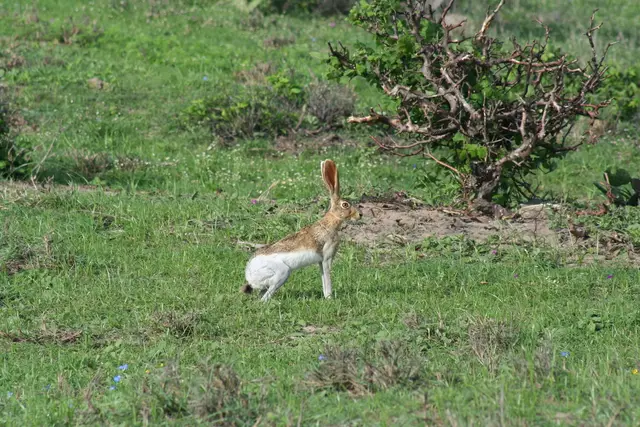
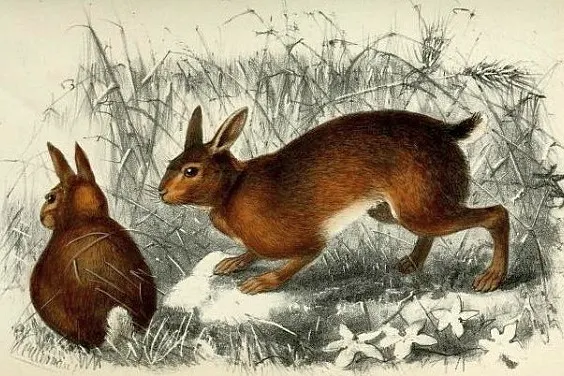
It is a small hare, reaching a maximum length of about 40 cm, with adults weighing roughly 1.25 to 1.75 kg. The coat is pale brown with touches of black and chestnut. The underside is white, the ears are short, and the tail is dark above and pale below.
Swinhoe described the species in 1870. It does not dig burrows.
Where it lives
The hare is endemic to Hainan Island. The IUCN gives an extent of occurrence of just 744 square kilometres, split between two locations, at elevations from sea level to 300 metres. It uses dry shrubland and dry grassland, along with pasture and heavily degraded former forest. In the 1995 surveys behind the IUCN account, it was found only at two deer ranches near ranger stations, where it had some protection from poaching, and on flat dry farmland with scrub.
The few remaining populations depend on nature reserves set up for Eld's deer, according to a 2024 Oryx report. In the journal Mammalia, Hui and colleagues reported a roadkill hare from Wenchang City in northeastern Hainan, about 200 km from the known range. A news report dates the find to 25 December 2024. It is the first documented record from the northeast since the 1980s. Hui, quoted in that report, said the western stronghold is less secure than traditionally assumed.
Pins are Wikidata “endemic to” fields. Orange dots, when present, are GBIF occurrence tiles — survey bias included.
How it lives
The Animal Diversity Web describes Hainan hares as shy and mostly solitary, and active at night, with most activity before midnight. The IUCN calls the species tame, probably because few native carnivores live in its range, and says it sometimes forages by day. It lives on the ground.
Its diet has not been directly described. It is presumed to eat plants, like other hares.
Why it is in trouble
More than 90 percent of the hare's original habitat is lost, much of it to housing and farming. The species survives mainly on cleared land used as deer ranches. The IUCN's threat list names housing, commercial and industrial development, tourism and recreation, and hunting that targets the species. Poaching for meat and skin was still regular when the IUCN's source data were collected, despite legal protection, and the IUCN says the hare may also compete with feral European rabbits.
The figure of 250 to 500 animals comes from the IUCN's 1995 density estimates combined with its judgement that no more than about two square kilometres of optimal habitat remain. A 2024 Oryx report repeated the figure without saying how it was derived. Surveys in August 2023 and January 2024 around Danzhou, Changjiang, Dongfang and Ledong in western Hainan found one live hare and a few footprints. The IUCN rated the species Vulnerable in 2008 and Endangered in 2016, and China now rates it Critically Endangered nationally.
There is also a question about what the animal is. The IUCN's 2016 assessment treats it as a distinct species and notes that earlier authorities classed it as a subspecies of the Burmese hare (Lepus peguensis). Kong and colleagues tested this in a 2014 genetic study. Genetic distance and a phylogenetic network supported a single species, while two other methods supported two, and the team suggested treating them as one. The Oryx report cites that study but argues that the island location hints at a separate evolutionary history, so the hare's status as a species remains uncertain.
What is being done
The hare is a Class II protected species in China, and the Hainan Tropical Rainforest National Park was established on the island in 2021. The IUCN's 2016 assessment records no recovery plan and no systematic monitoring scheme. It lists site protection, habitat restoration, species recovery and reintroduction among the actions needed.
The Oryx report calls for a full survey of the species and its habitat, strict enforcement against hunting, public awareness work and better habitat management. The Mammalia authors also ask for an island-wide survey.
Sources
Written for this catalog in our own words from the sources below, checked against them on 12 November 2026. Population figures are estimates and carry the year they were made. Status and assessment year: IUCN. 2026. The IUCN Red List of Threatened Species. Version 2026-1. iucnredlist.org.
- IUCN Red List assessment, Lepus hainanus (2016)
- IUCN taxon record, Lepus hainanus
- Li and Li 2024, Unnoticed, the Hainan hare is disappearing, Oryx 58(5)
- Animal Diversity Web, Lepus hainanus
- Kong et al. 2014, Mitochondrial DNA Part A, abstract (Europe PMC)
- Hui et al., Mammalia 90, abstract (Crossref record)
- Indian Defence Review report on the Mammalia hare carcass paper