Critically Endangered
Hadopyrgus ngataana
Hadopyrgus ngataana
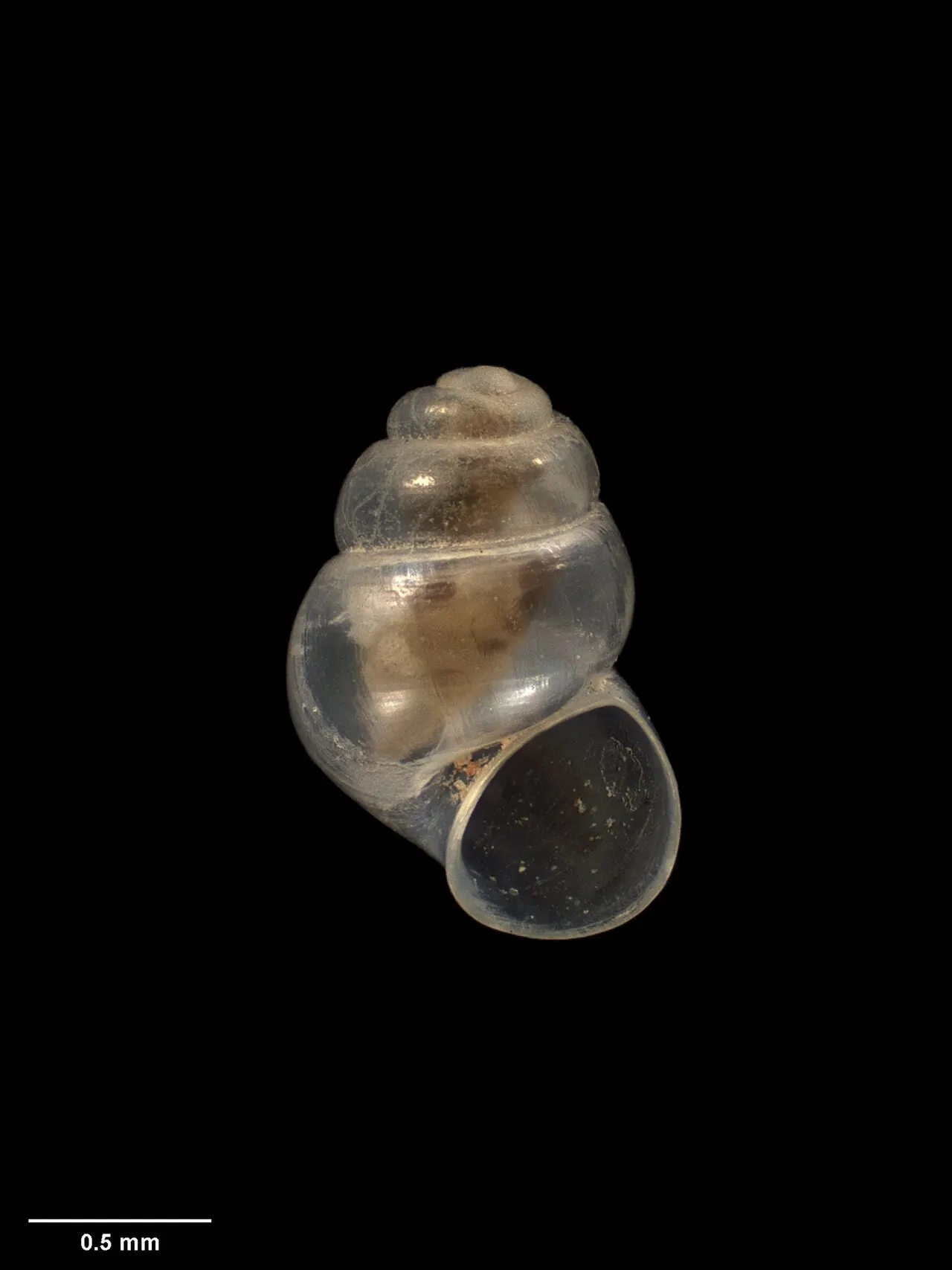
The Maitai Cave snail (Hadopyrgus ngataana) is a blind, see-through freshwater snail under 2 mm long. It has been found in only one pool, at the mouth of a cave near Nelson on New Zealand's South Island. The IUCN Red List rated it Critically Endangered in 2013.
How to recognise it
You would need a lens. An adult is about 1.7 mm tall and 1.2 mm wide, roughly the size of a pinhead. Its body is transparent and it has no eyes.
Its name joins two Maori words, ngata (snail) and ana (cave).
Where it lives
Every record comes from a single pool in a small stream at the entrance of Maitai Cave, in the Maitai River valley southeast of Nelson. The IUCN assessment describes the habitat as a stream in a limestone cave, counts one location and notes that the species occurs in at least one protected area. The cave lies within a reserve.
The IUCN says the area has been extensively surveyed and the snail is known only from the entrance to one pool. Its range is reportedly under one hectare in total.
Pins are Wikidata “endemic to” fields. Orange dots, when present, are GBIF occurrence tiles — survey bias included.
A snail that was mistaken for another
Frank Climo first collected it in the 1970s, when it was treated as a form of another cave-dwelling Hadopyrgus from the Nelson region. In 2001 Martin Haase and Christina Mosimann collected more specimens at the cave by washing and sieving gravel. Shape and genetic evidence showed it was a species of its own, which Haase formally described and named in 2008.
The holotype, the specimen that defines the species, is reportedly held at the Museum of New Zealand Te Papa Tongarewa.
Why it is in trouble
A population in one pool has nowhere to go if that pool is damaged. The IUCN assessment lists recreational activities as the one threat, ongoing and affecting the whole population. The cave sits very near an urban area, so visits are likely to be frequent and recreation is even encouraged there. The assessors expect this to be killing snails.
The snail also needs good water quality, so pollution such as nitrates reaching groundwater could harm it. The assessment records a decreasing trend and gives no population size.
In November 2018 New Zealand's Department of Conservation ranked the snail Nationally Critical. Freshwater invertebrates can be protected under the Wildlife Amendment Act 1980, but neither this species nor any other freshwater invertebrate has been.
What is being done
The IUCN calls for management of recreational activities in the cave to limit damage and disturbance, and lists site protection and site management as the actions needed. It also says more information is needed on the snail's distribution and threats.
In 2018 the snail featured in a Radio New Zealand Critter of the Week segment, in which the Department of Conservation's threatened species ambassador, Nicola Toki, talked about it.
Sources
Written for this catalog in our own words from the sources below, checked against them on 12 November 2026. Population figures are estimates and carry the year they were made. Status and assessment year: IUCN. 2026. The IUCN Red List of Threatened Species. Version 2026-1. iucnredlist.org.




