Endangered
Guyanancistrus nassauensis
Guyanancistrus nassauensis
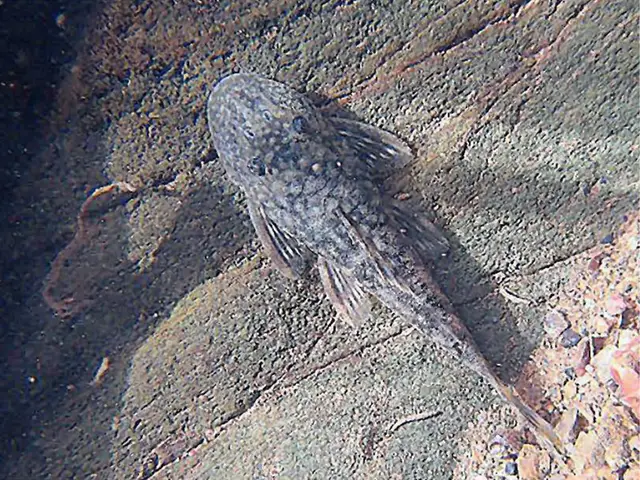
Guyanancistrus nassauensis is a small suckermouth catfish known only from clear streams in the Nassau Mountains of Suriname. Described in 2018, it has a large mouth for its genus. The IUCN Red List lists it as Endangered (2022) because its tiny range is under pressure from mining.
How to recognise it
It has a wide oval mouth with large tooth cups, and the lips form a disk covered in short papillae. The teeth are short and strong. Field teams nicknamed it the "Bigmouth" before it had a scientific name.
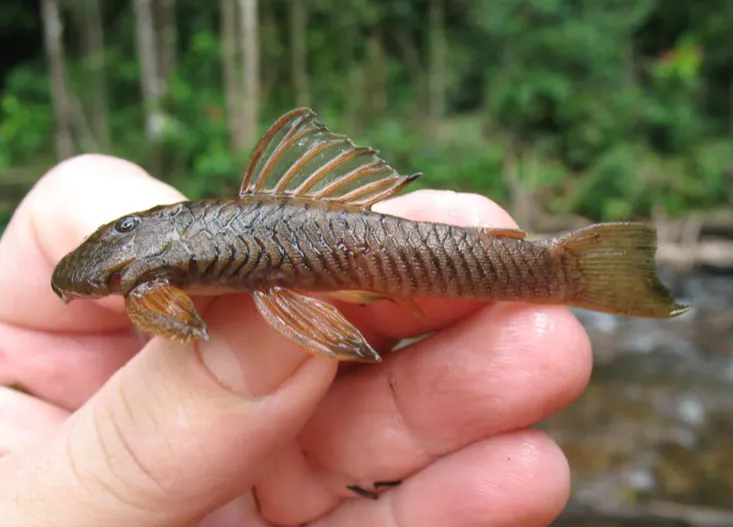
In a photographed live fish the body was brown with faint orange-brown spots and the fins were orange-brown. It is a dwarf: the largest specimen measured 61 mm standard length (body without the tail fin), and adults probably reach about 40 mm. It usually has four branched rays in the anal fin, where most relatives have five, and its pectoral spine is much shorter than that of Guyanancistrus longispinis or G. niger.
Where it lives
Its known range is Paramaka Creek and some tributaries in the Marowijne River basin, within an area of less than 20 by 20 kilometres in the Nassau Mountains. The IUCN assessment counts two locations and records it from Suriname only.
It has been found between about 120 and 530 metres above sea level, in cool, shallow, clear water over gravel, boulders and bedrock. The type locality is a northern branch of Paramaka Creek at 277 metres, 3 to 7 metres wide and less than 50 centimetres deep, with rainforest along the banks. Juvenile Guyanancistrus brevispinis and another local endemic catfish, Harttiella crassicauda, share the same streams.
Pins are Wikidata “endemic to” fields. Orange dots, when present, are GBIF occurrence tiles — survey bias included.
How it lives
Almost nothing has been recorded about its life in the wild. The 2018 study describes it as one of two Guyanancistrus species adapted to small, cool, low-productivity mountain streams, with dwarfism as one adaptation. Genetic data suggest it has interbred with G. brevispinis, a sister species that shares some of its water.
Four fish were reportedly kept in an aquarium in 2006. They were active day and night, didn't hide, weren't territorial and tolerated other fish. They avoided sand, grazed algae and accepted vegetarian flakes after a short adjustment.
The IUCN lists its population trend as unknown, and no population estimate exists.
Why it is in trouble
The species lives in one small mountain block, so damage to those streams affects all of it. Mining and quarrying is the only threat the IUCN lists, and it records a continuing decline in the area the fish occupies. The 2018 study calls the Nassau Mountains fauna hyperendemic and says it is threatened by proposed and ongoing mining.
The 2022 assessment records no conservation actions in place.
Sources
Written for this catalog in our own words from the sources below, checked against them on 12 November 2026. Population figures are estimates and carry the year they were made. Status and assessment year: IUCN. 2026. The IUCN Red List of Threatened Species. Version 2026-1. iucnredlist.org.