Endangered
Guyanancistrus brownsbergensis
Guyanancistrus brownsbergensis
Guyanancistrus brownsbergensis is a tiny armoured catfish known from a single mountain stream system in Brownsberg Nature Park, Suriname. It is listed as Endangered on the IUCN Red List (assessed 2022). Illegal gold mining and the threat of dams are the pressures behind that listing.
How to recognise it
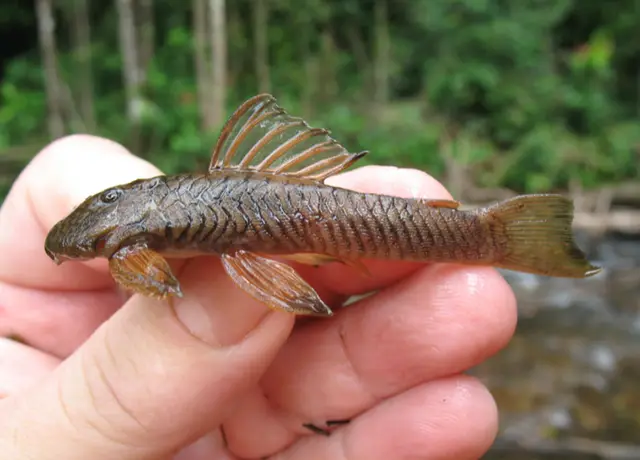
This is a loricariid, one of the suckermouth armoured catfishes, with an elongated body that reaches only 6.4 centimetres in standard length. FishBase counts two dorsal spines, seven dorsal soft rays and six anal soft rays.
Mol, Fisch-Muller and Covain described it in 2018. The species name honours Brownsberg Nature Park, where it was found.
Where it lives
It is known only from the upper Kumbu Creek, part of the Saramacca River basin, inside Brownsberg Nature Park in the Brownsberg Mountains. The Red List assessment counts a single location.
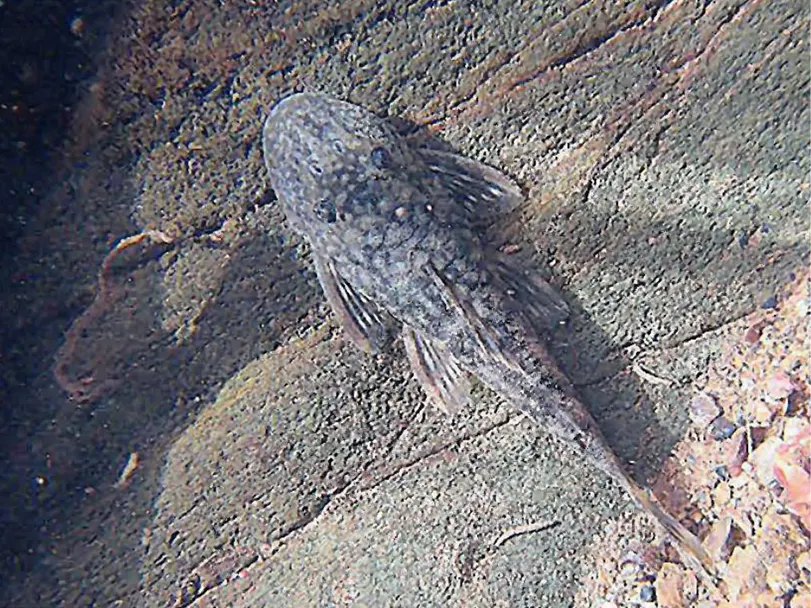
The type locality, at Kumbu Falls, is a small, fast-flowing mountain stream at roughly 430 metres above sea level. It is about 2.5 to 3.7 metres wide and 28 to 50 centimetres deep, with clear water at about 23 degrees Celsius and a pH of 7 to 7.5.
Pins are Wikidata “endemic to” fields. Orange dots, when present, are GBIF occurrence tiles — survey bias included.
How it lives
The stream bed is made of sand, gravel, pebbles, boulders and bedrock, and the banks are shaded by overhanging vegetation, with leaf litter and woody debris in the water. The Red List classes the species as a permanent-stream animal that does not migrate. Its diet and breeding have not been described in the sources available.
Why it is in trouble
Everything depends on one stream. The Red List assessment names mining and quarrying and large dams as threats, and records that the area it occupies is still declining. Illegal gold mining is cited as a threat to the park.
No population estimate exists, and the population trend is recorded as unknown. The Endangered listing rests on the tiny range, the single location and the continuing loss of habitat, under criterion B1ab(iii).
What is being done
The one place it lives is inside a nature park, and the assessment records that it occurs in at least one protected area. The park itself is reported to be under pressure from illegal gold mining, and the assessment lists no species-specific conservation actions.
Sources
Written for this catalog in our own words from the sources below, checked against them on 12 November 2026. Population figures are estimates and carry the year they were made. Status and assessment year: IUCN. 2026. The IUCN Red List of Threatened Species. Version 2026-1. iucnredlist.org.