Critically Endangered
Guibemantis punctatus
Guibemantis punctatus
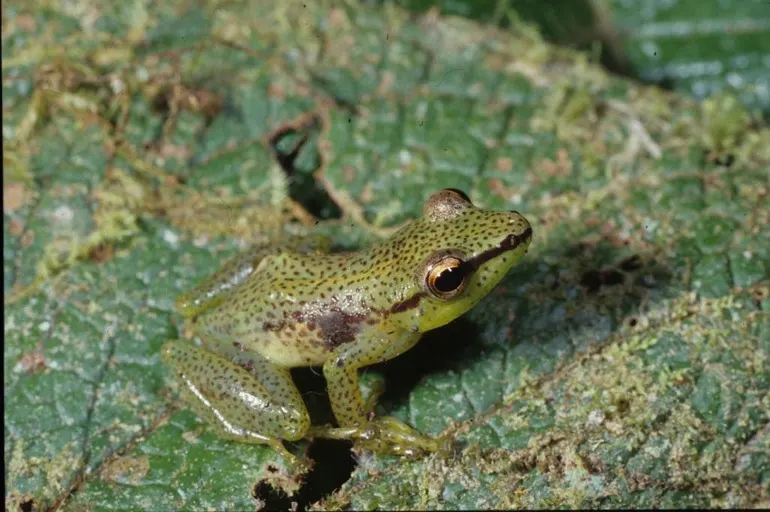
Guibemantis punctatus is a small Madagascan frog in the family Mantellidae, found nowhere else. The IUCN's 2016 assessment rates it Critically Endangered, with a decreasing population known from a single location. It belongs to a group of frogs that mostly raise their tadpoles in water held by plants rather than in ponds.
What kind of frog it is
Guibemantis punctatus was described in 1979 by Blommers-Schlösser and was first placed in the genus Mantidactylus, which is why older records use that name. It sits in the subgenus Pandanusicola, a set of mantellid frogs in which most species lay eggs on rainforest plants such as Pandanus, and the tadpoles develop in the small pools of water in the leaf axils.
Frogs of this group are poorly understood. A 2007 genetic study in Molecular Phylogenetics and Evolution found that several of the group's named species, though not punctatus itself, split into genetically distinct lineages, and concluded that many are probably complexes of cryptic species. Few reliable details on the size, call or breeding season of punctatus are published.
Where it lives
The species is endemic to Madagascar. The IUCN assessment counts a single location, gives an estimated extent of occurrence of 65 square kilometres, and lists two habitats: moist montane forest, which it treats as suitable, and heavily degraded former forest, which is marginal for the frog. Some summaries also list moist lowland forest.
The assessment records it as not migratory and notes that it occurs in at least one protected area.
Pins are Wikidata “endemic to” fields. Orange dots, when present, are GBIF occurrence tiles — survey bias included.
Why it is in trouble
The Red List records a continuing decline in the area the frog occupies and a decreasing population. The threats it names are small-holder farming, shifting agriculture, housing and urban areas, and small-scale livestock grazing, each of which converts or degrades forest. Each is scored as a low impact on its own, and the assessment also records unintentional harm from small-scale harvest.
Frogs that breed in water held by plants lose their nurseries when the forest goes, since the plants go with the trees. With only one location counted, local clearing matters a great deal.
What is being done
The assessment lists site and area protection, site management and resource and habitat protection as the conservation actions needed, and it notes that the species already occurs inside at least one protected area. No dedicated recovery programme for this frog turned up in the sources checked.
Sources
Written for this catalog in our own words from the sources below, checked against them on 12 November 2026. Population figures are estimates and carry the year they were made. Status and assessment year: IUCN. 2026. The IUCN Red List of Threatened Species. Version 2026-1. iucnredlist.org.




