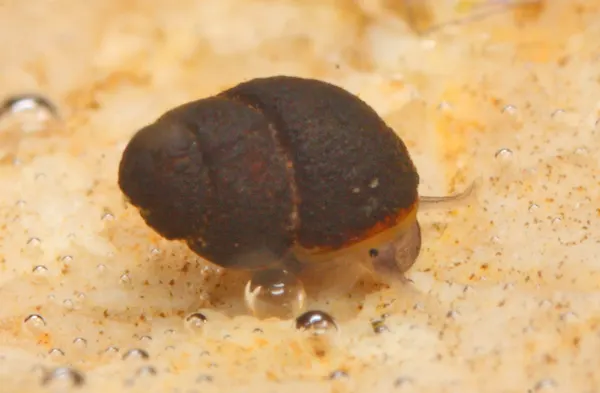
Critically Endangered
Graziana adlitzensis
Graziana adlitzensis
Graziana adlitzensis is a tiny freshwater spring snail known only from Austria, where the IUCN records it from a single location at about 680 metres above sea level. It is listed as Critically Endangered (assessed 2026). Described in 1995, it is still poorly documented, and its population trend is unknown.
What kind of animal it is
Graziana adlitzensis is a snail in the family Hydrobiidae, a group of small freshwater gastropods. Its genus, Graziana, is made up of minute freshwater snails that carry an operculum, a hard plate that closes the shell opening. Nine species are reportedly listed in the genus.
W. Fischer and P. L. Reischütz named the species in 1995, in a short paper on two new spring snail taxa published in the journal of the Vorarlberg malacological society. The IUCN records a German common name, Adlitzgraben-Zwergquellschnecke (roughly, Adlitzgraben dwarf spring snail). There is no widely used English name.
Where it lives
The Red List gives Austria as the only country. The assessment counts one location, at an elevation of 680 metres. It puts the area the snail actually occupies at 4 square kilometres and its overall range at about 20 square kilometres.
Its habitats are recorded as freshwater springs and karst water systems, the cave-like networks of water that run through limestone. The Global Biodiversity Information Facility (GBIF) holds just three preserved specimens of the species, one of them dated 1984. That is a thin trail for an animal this restricted, and it means little is known about how many snails survive.
Pins are Wikidata “endemic to” fields. Orange dots, when present, are GBIF occurrence tiles — survey bias included.
Why it is in trouble
A species confined to one spring is exposed to anything that changes that spring. The IUCN lists three threats: water being drawn from the groundwater for domestic use, run-off, and nutrient loads reaching the water. Each can degrade the habitat or kill snails directly.
The Critically Endangered listing rests on criteria B1ab(iii)+2ab(iii). In plain terms, the range is very small, it is confined to a single location, and the quality of the habitat is judged to be declining. The population trend itself is recorded as unknown, so the concern is the fragile habitat more than any counted fall in numbers.
What is being done
The assessment records that the snail occurs in at least one protected area. The conservation actions it lists are habitat and resource protection and awareness and communication. The species is not covered by any international legislation or trade controls.
The assessment records no dedicated recovery programme, captive population or regular monitoring for this snail.
Sources
Written for this catalog in our own words from the sources below, checked against them on 12 November 2026. Population figures are estimates and carry the year they were made. Status and assessment year: IUCN. 2026. The IUCN Red List of Threatened Species. Version 2026-1. iucnredlist.org.




