Endangered
Golden-shouldered Parrot
Psephotellus chrysopterygius
The golden-shouldered parrot (Psephotellus chrysopterygius) is a small, brilliantly coloured parrot of southern Cape York Peninsula in Queensland, Australia, and it nests in termite mounds. The IUCN Red List classed it as Endangered in 2022, with around 940 birds estimated and a decreasing trend.
How to recognise it
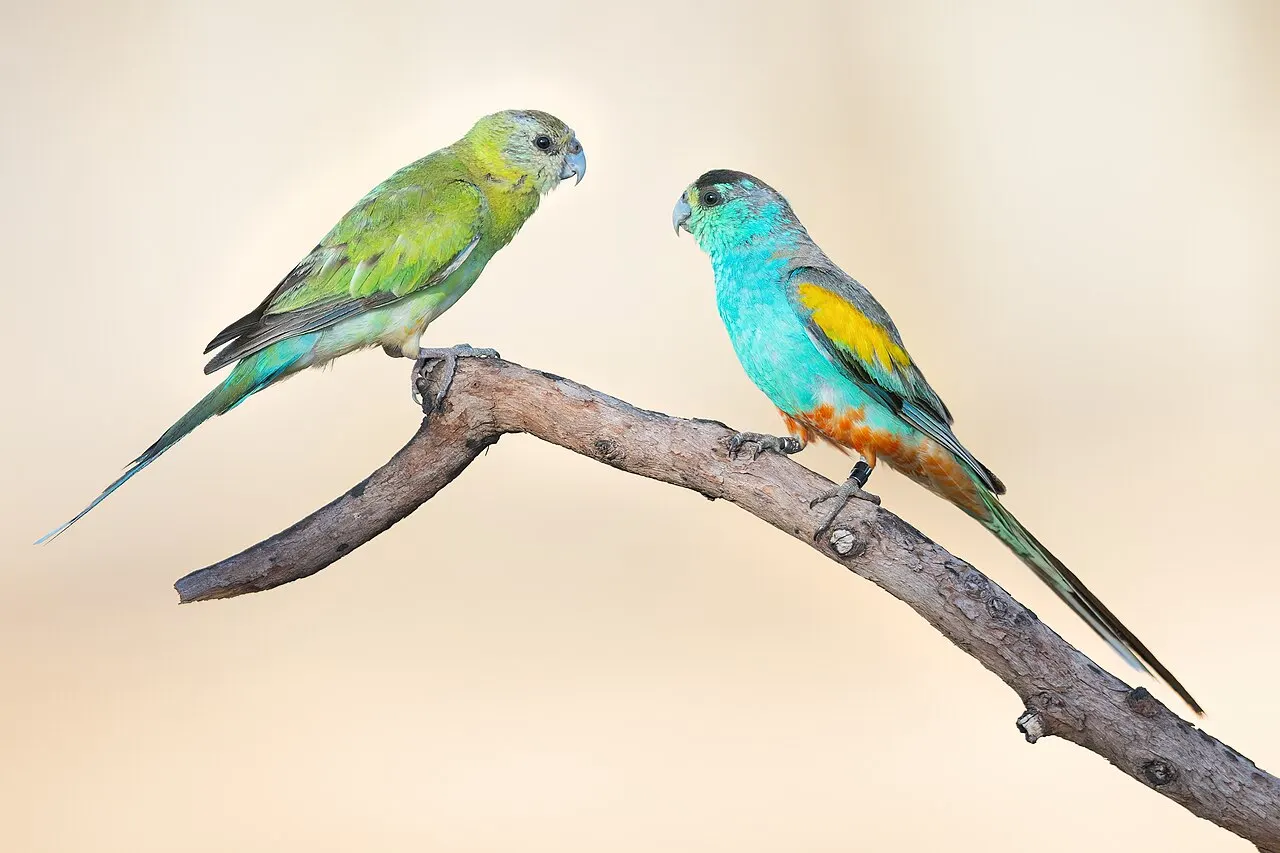
Adults are 25 to 27 cm long and weigh about 54 to 56 g. The male is mostly turquoise-blue with a yellow patch across the shoulder, a black cap and a dark salmon-pink belly. The female is dull greenish-yellow with a broad cream wing bar, and older females develop a charcoal-grey cap.
It is closely related to the hooded parrot of the Northern Territory and to the paradise parrot, which is presumed extinct. Local names include alwal and antbed parrot.
Where it lives
It lives only in Australia, in open grassy woodland on southern Cape York Peninsula, at elevations of about 90 to 150 m. The Red List habitat entry is dry savanna. The grassland must have plenty of termite mounds. A 2025 news report on a University of Adelaide study puts its current range at about 5% of the original.
Key sites include the Morehead River and Staaten River areas, and Artemis Station is another.
Pins are Wikidata “endemic to” fields. Orange dots, when present, are GBIF occurrence tiles — survey bias included.
How it lives
It feeds mainly on grass seeds, and before the wet season it relies chiefly on the seeds of firegrass. Breeding runs from about March to August. Pairs nest in cone-shaped termite mounds, and the female incubates 3 to 6 eggs for about 20 days.
Nest temperatures are usually about 28 to 30 degrees Celsius. A moth, Trisyntopa scatophaga, lays eggs at the nest entrance in roughly half of the nests, and its caterpillars eat the nestlings' droppings.
Why it is in trouble
A leading problem is woody thickening. Overgrazing and changed burning have let trees and shrubs, such as broad-leaved tea-tree, spread into the open grassland, and trees give predators cover. In a three-year study led by Gabriel Crowley of the University of Adelaide, 108 termite-mound nests were monitored and the fate of 555 eggs tracked. Just over half of the eggs produced fledglings. In the thickest woodland, fledging success was about a third of what the population needs to hold steady.
Butcherbirds increased most as trees spread, and chick skulls were found with bill punctures. Reptiles such as tree snakes are also suspected. Adults disappeared from a third of the nests studied. The Red List also lists grazing, deliberate taking of birds and a continuing decline.
What is being done
The Artemis Nature Fund began in 2019 on Artemis Station, a cattle property. The work includes clearing trees to reopen the grassland, with about 60 hectares of breeding habitat cleared between July 2021 and December 2022, supplementary feeding, and electric fencing against reptiles. An expanded agreement would grow the protected Nature Refuge there from 2,000 to 105,000 hectares. Nest monitoring in 2021 and 2022 found breeding success was about half of what it was 20 years ago.
Elsewhere, national park and Indigenous-owned land has been destocked and traditional fire practices reinstated to keep grassland open. The Red List records a recovery plan and a monitoring scheme in place, and guidelines on woodland thickening have gone to land managers across Cape York.
Sources
Written for this catalog in our own words from the sources below, checked against them on 12 November 2026. Population figures are estimates and carry the year they were made. Status and assessment year: IUCN. 2026. The IUCN Red List of Threatened Species. Version 2026-1. iucnredlist.org.




