Endangered
Glyptorhagada silveri
Glyptorhagada silveri
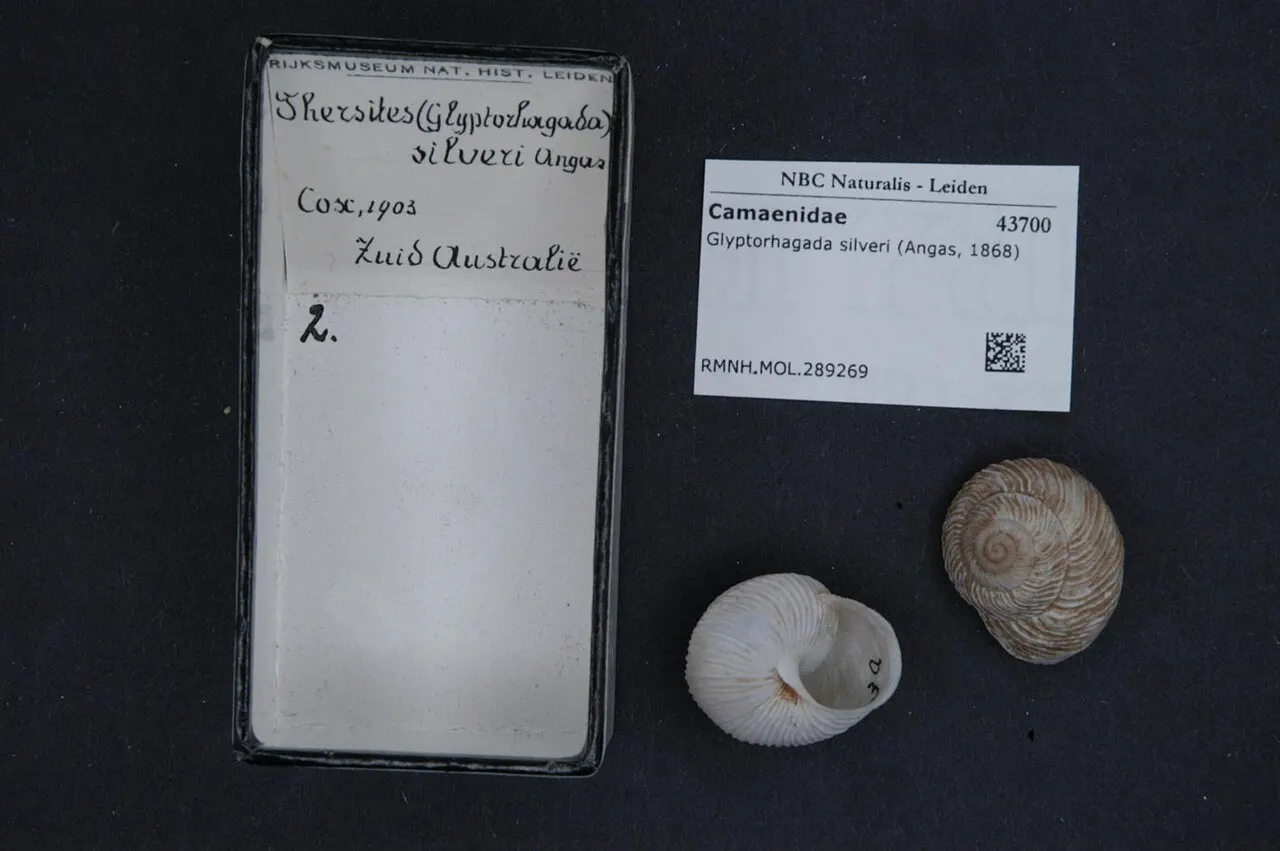
Glyptorhagada silveri is an air-breathing land snail from South Australia, known almost entirely from museum specimens collected around Mannahill and Oulnina in the state's dry north-east. The IUCN Red List last assessed it as Endangered in 1996, under criteria for a decline of at least half.
What it is
It belongs to the Camaenidae, a large family of land snails, in the order Stylommatophora, the group that holds most land snails and slugs. George French Angas described it in 1868 as Helix silveri, and it later moved to the genus Glyptorhagada. It is endemic to Australia.
The oldest dated specimens in the Global Biodiversity Information Facility (GBIF) are from 1868, and one of them lists S. W. Silver as the collector.
Where it has been found
GBIF holds 81 Australian records of this snail. Nearly all are preserved specimens in museum collections, and nearly all are from South Australia. Most come from a small area on the north-eastern plains: Oulnina Station and Pepuarta Hill, about 11 to 14 km south-south-east of Mannahill. A few lots come from near Peterborough, Yunta, Waukaringa and Teetulpa.
Single records are attributed to New South Wales, Queensland and Western Australia, and these look like labelling errors rather than real range. Dated specimens span more than a century: 1868, 1912, 1928, 1981 (one lot of 99 snails), 1982, 1992 and 1994. The latest dated record in the database is from 1994.
Pins are Wikidata “endemic to” fields. Orange dots, when present, are GBIF occurrence tiles — survey bias included.
What the Red List says
The 1996 assessment lists the snail as Endangered under criterion A2ce. That criterion covers a population reduction of at least 50 percent over ten years or three generations, inferred from a decline in range or habitat quality and from the effects of introduced species, pathogens, pollutants, competitors or parasites. The assessment was made under version 2.3 of the Red List, and the record holds no structured data on population size, habitat or specific threats.
An earlier 1994 assessment rated the species Rare. No later reassessment exists, so the 1996 rating is the current one.
Sources
Written for this catalog in our own words from the sources below, checked against them on 12 November 2026. Population figures are estimates and carry the year they were made. Status and assessment year: IUCN. 2026. The IUCN Red List of Threatened Species. Version 2026-1. iucnredlist.org.




